
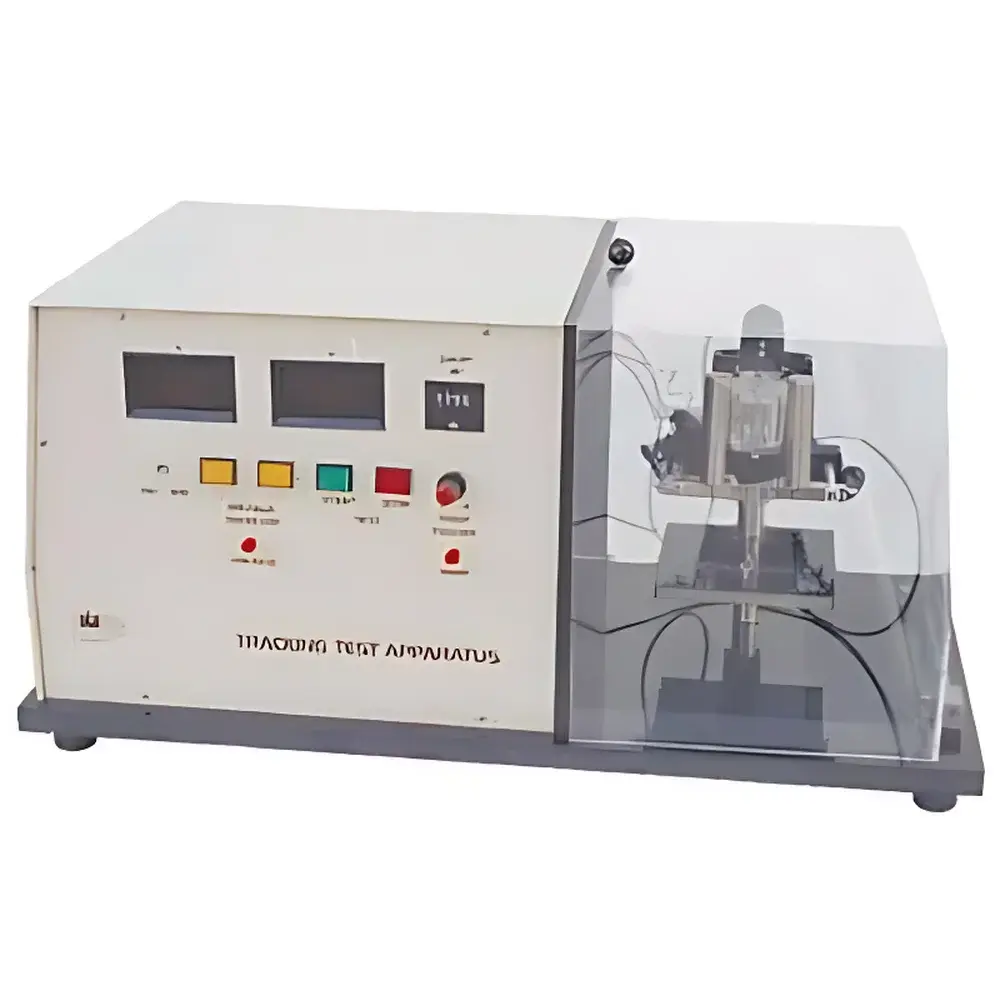
Tracking Index Tester by ATSFAAR
| Brand | ATSFAAR |
|---|---|
| Origin | Italy |
| Manufacturer Type | Authorized Distributor |
| Origin Category | Imported |
| Model | Tracking Index |
| Voltage Range | Up to 600 V DC/AC |
| Dropping Interval | 30 s ± 1 s |
| Droplet Volume | 20 mm³ ± 2 mm³ |
| Droplet Height | 35 mm (adjustable within 30–40 mm) |
| Electrode Force | 1 N (spring-loaded, calibrated) |
| Electrode Material | Platinum-tipped stainless steel |
| Sample Chamber | High-dielectric-strength insulated enclosure with hinged acrylic lid |
| Safety Interlock | Automatic circuit disconnection upon lid opening |
| Meters | 600 V full-scale voltmeter, 1 A full-scale ammeter |
| Control Panel | Start/Stop switch, main power switch, integrated timer |
Overview
The ATSFAAR Tracking Index Tester is a precision-engineered instrument designed for the standardized evaluation of electrical tracking resistance in polymeric insulating materials under humid, contaminated conditions. It operates in accordance with the fundamental principles of comparative tracking index (CTI) and proof tracking index (PTI) testing as defined in IEC 60112, ASTM D3638, and UL 746A. The device subjects test specimens to repeated droplets of conductive electrolyte (typically 0.1% ammonium chloride solution) while applying a constant AC or DC voltage—up to 600 V—across two platinum-tipped electrodes. Electrical breakdown is detected when leakage current exceeds 60 mA for more than 2 seconds, indicating surface carbonization and loss of insulation integrity. This method quantifies the material’s ability to resist formation of conductive paths along its surface—a critical parameter for components used in electrical enclosures, connectors, PCB substrates, and high-voltage housings in rubber and plastic manufacturing.
Key Features
- Compliant electrode configuration: Dual platinum-tipped stainless-steel electrodes apply a precisely controlled 1 N contact force per ISO 60112 Annex B, ensuring reproducible pressure distribution and minimizing indentation artifacts.
- Automated, metrologically traceable droplet delivery: Integrated solenoid-driven dispenser delivers 20 mm³ ± 2 mm³ droplets at strict 30-second intervals; drop height is mechanically adjustable between 30 mm and 40 mm to maintain consistent impact energy and wetting dynamics.
- High-integrity sample chamber: Fully insulated housing constructed from reinforced phenolic resin, fitted with a transparent, static-dissipative acrylic hinged lid enabling real-time visual monitoring without compromising safety or test integrity.
- Dual-range digital instrumentation: Front-panel 600 V full-scale voltmeter and 1 A full-scale ammeter provide simultaneous, analog-style readouts for voltage stability and leakage current progression—essential for identifying pre-breakdown current spikes and confirming pass/fail thresholds.
- Hardware-enforced safety interlock: Lid-mounted microswitch instantly de-energizes the high-voltage circuit upon any lid movement, eliminating risk of exposure during specimen loading or post-test inspection.
- Modular sample support system: Glass-bottomed sample container mounted on an articulated, height-adjustable bracket ensures optimal alignment with electrode tips and accommodates specimens up to 15 mm thick and 100 mm × 100 mm planar dimensions.
Sample Compatibility & Compliance
The tester accepts flat, rigid specimens conforming to IEC 60112 geometry requirements: minimum 10 mm × 10 mm surface area, thickness ≥ 3 mm (to prevent puncture), and surface roughness Ra ≤ 2.5 µm. Compatible materials include thermoset resins (epoxy, phenolic), thermoplastics (PBT, PET, PC), filled elastomers, and silicone-based insulators. All operational parameters—including voltage ramping protocol, droplet volume tolerance, timing resolution, and electrode geometry—are validated against IEC/EN 60112:2020 Edition 5.0, ASTM D3638-22, and UL 746A Section 20. The unit is supplied with CE marking documentation, RoHS-compliant construction, and factory calibration certificates traceable to national metrology institutes (e.g., INRIM, Italy).
Software & Data Management
While the ATSFAAR Tracking Index Tester operates as a stand-alone hardware platform, it supports GLP-compliant documentation through optional RS-232 or USB-to-serial interface (available as accessory kit). When connected to a host PC running certified lab data acquisition software, users may log timestamped voltage, current, and event markers (e.g., droplet count, time-to-failure, pass/fail status) in CSV or XML format. Audit trails meet FDA 21 CFR Part 11 requirements when paired with electronic signature-enabled software platforms. Internal mechanical timer provides independent verification of test duration, ensuring redundancy in case of external system failure.
Applications
This instrument is routinely deployed in R&D laboratories and QC departments across the rubber and plastics supply chain for qualification of flame-retardant compounds, halogen-free formulations, and nano-filled composites intended for automotive ECUs, household appliance casings, industrial control panels, and medical device housings. It supports material screening prior to UL recognition, assists in failure analysis of field returns exhibiting tracking-related short circuits, and enables comparative CTI ranking for supplier qualification against internal material specifications.
FAQ
What standards does this instrument comply with?
IEC 60112:2020, ASTM D3638-22, UL 746A, and GB/T 4207—fully supported via mechanical design, electrode specification, and droplet delivery accuracy.
Can the voltage be adjusted continuously or only in fixed steps?
Voltage is applied via an external, calibrated variable transformer (not included); the tester accepts input from 0–600 V AC/DC sources with stable regulation ±1% over load.
Is calibration service available directly from ATSFAAR?
Yes—ATSFAAR offers biennial factory recalibration including electrode wear verification, droplet volume gravimetric validation, and interlock response time measurement, with NIST-traceable documentation.
Does the system include electrolyte handling accessories?
The base configuration includes a 500 mL reservoir bottle, PTFE tubing, and drip nozzle assembly; optional automated refill module and waste collection tray are available.
How is specimen conditioning performed before testing?
Per IEC 60112, specimens must be conditioned at 23 °C ± 2 °C and 50% ± 5% RH for ≥48 hours; ambient conditioning chamber integration is supported via optional environmental hood adapter.






