
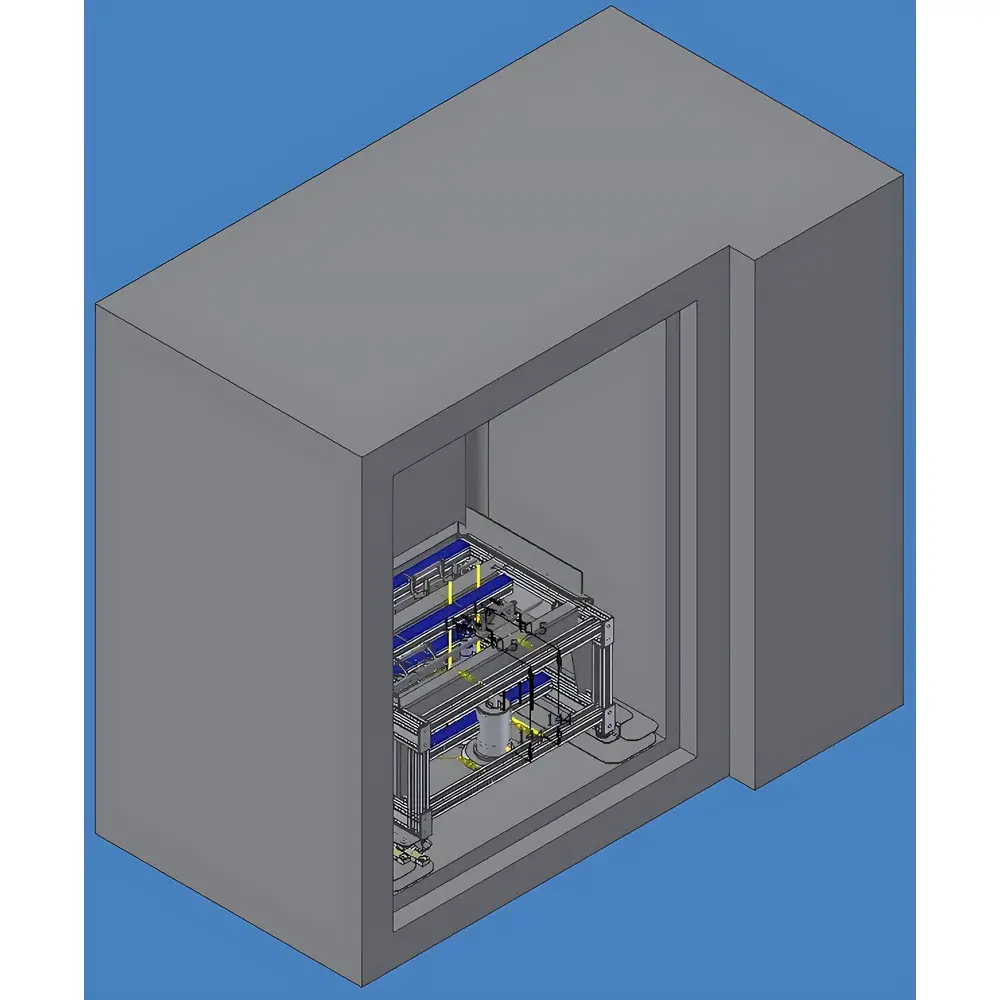
LT80 Cryogenic Elastic Modulus Analyzer (Resonance Frequency & Damping Analysis System)
| Brand | IMCE |
|---|---|
| Origin | Belgium |
| Model | LT80 |
| Operating Temperature Range | 77 K to 473 K (Liquid Nitrogen–Free) |
| Cooling Method | Closed-Cycle Mechanical Cryocooler |
| Price | €100,000 |
Overview
The LT80 Cryogenic Elastic Modulus Analyzer is a precision resonance-based dynamic mechanical characterization system engineered for non-destructive determination of elastic moduli—specifically Young’s modulus, shear modulus, and Poisson’s ratio—as well as internal friction (damping) behavior across cryogenic to elevated temperatures. Unlike conventional liquid nitrogen–dependent resonant systems, the LT80 integrates a high-stability closed-cycle mechanical cryocooler, enabling continuous, repeatable operation from 77 K (–196 °C) up to 473 K (+200 °C) without cryogen refills, dewar handling, or associated safety protocols. Its measurement principle relies on free-decay or forced-resonance excitation of rectangular, cylindrical, or disk-shaped solid specimens in flexural, torsional, or longitudinal vibration modes; natural frequencies and logarithmic decrement are extracted via high-resolution laser Doppler vibrometry or contact piezoelectric transducers, then converted into elastic constants using ASTM E1876-23 and ISO 12680-1 compliant algorithms.
Key Features
- Patented liquid nitrogen–free cooling architecture: integrated two-stage Gifford-McMahon cryocooler with active temperature stabilization ±0.1 K over full range
- Broad thermal coverage: seamless transition from cryogenic (77 K) to moderate high-temperature (473 K) regimes—enabling direct comparison with complementary high-temperature modulus analyzers (e.g., IMCE HT1200 series)
- Multi-mode resonance analysis: automated mode identification and frequency tracking for flexural (E), torsional (G), and longitudinal (E, ν) configurations
- High-fidelity signal acquisition: 24-bit ADC, 200 kHz sampling rate, real-time FFT processing with Q-factor resolution better than 1 × 10⁻⁴
- Modular vacuum chamber design: stainless steel construction with optical access ports, pressure control down to 10⁻³ mbar, and optional inert gas purge capability
- ISO/IEC 17025-aligned calibration traceability: factory-certified reference standards included for frequency and temperature metrology
Sample Compatibility & Compliance
The LT80 accommodates standard geometry specimens per ASTM E1876 (rectangular bars: 3–6 mm × 20–50 mm), ASTM C779 (ceramic disks), and ISO 12680-2 (metallic cylinders). Sample mass range: 0.5 g to 250 g. Surface finish requirements align with GLP-compliant mechanical testing practice (Ra ≤ 0.8 µm). The system meets electromagnetic compatibility (EMC) per EN 61326-1:2013 and safety standards IEC 61010-1:2010. Data integrity supports FDA 21 CFR Part 11 requirements through audit-trail-enabled software with user-role authentication, electronic signatures, and immutable raw-data archiving.
Software & Data Management
IMCE ResoSoft v4.2 provides full instrument control, real-time resonance spectrum visualization, automatic modal fitting (Levenberg-Marquardt optimization), and multi-temperature modulus mapping. Export formats include CSV, HDF5, and XML for integration with MATLAB, Python (SciPy/Pandas), or LIMS platforms. All measurement sessions generate timestamped metadata logs—including ambient pressure, cooling power, sensor gain, and environmental drift compensation flags—ensuring full experimental reproducibility. Software validation documentation (IQ/OQ/PQ protocols) is supplied for regulated environments operating under GMP or ISO 9001 quality management systems.
Applications
- Low-temperature superconducting material development: quantifying modulus softening near Tc and anelastic relaxation peaks in NbTi, MgB₂, and REBCO tapes
- Aerospace composite qualification: assessing cryogenic interlaminar stiffness degradation in carbon-fiber/epoxy laminates used in liquid oxygen tanks
- Cryogenic MEMS/NEMS device reliability: measuring thermoelastic damping shifts in silicon resonators below 100 K
- Nuclear materials research: monitoring irradiation-induced embrittlement in austenitic steels via damping peak evolution at 77–120 K
- Pharmaceutical solid-state science: characterizing glass transition-related modulus changes in amorphous lyophilized formulations under controlled humidity and sub-zero conditions
FAQ
Does the LT80 require liquid nitrogen or other cryogens?
No. It operates exclusively with a closed-cycle mechanical cryocooler—eliminating consumables, storage logistics, and operational hazards associated with cryogenic liquids.
Can the LT80 be integrated into an existing high-temperature modulus testing workflow?
Yes. Its standardized mechanical interface, digital I/O port, and shared ResoSoft platform allow synchronized operation and cross-temperature data fusion with IMCE’s HT1200 series (up to 1200 °C).
Is the system suitable for routine QC in production environments?
Yes. Designed for unattended overnight runs, it includes automated thermal ramping, pass/fail threshold alerts, and report templates compliant with ISO/IEC 17025 clause 7.8.
What calibration standards are provided with the system?
A NIST-traceable quartz tuning fork (for frequency verification) and certified Invar reference bar (for thermal expansion coefficient validation) are included, along with full calibration certificates.
How is temperature uniformity ensured across the specimen during measurement?
The chamber employs radial heating/cooling symmetry, low-thermal-mass specimen holders, and dual-point Pt100 sensors—one embedded in the holder, one adjacent to the sample surface—enabling real-time gradient correction in post-processing.



