
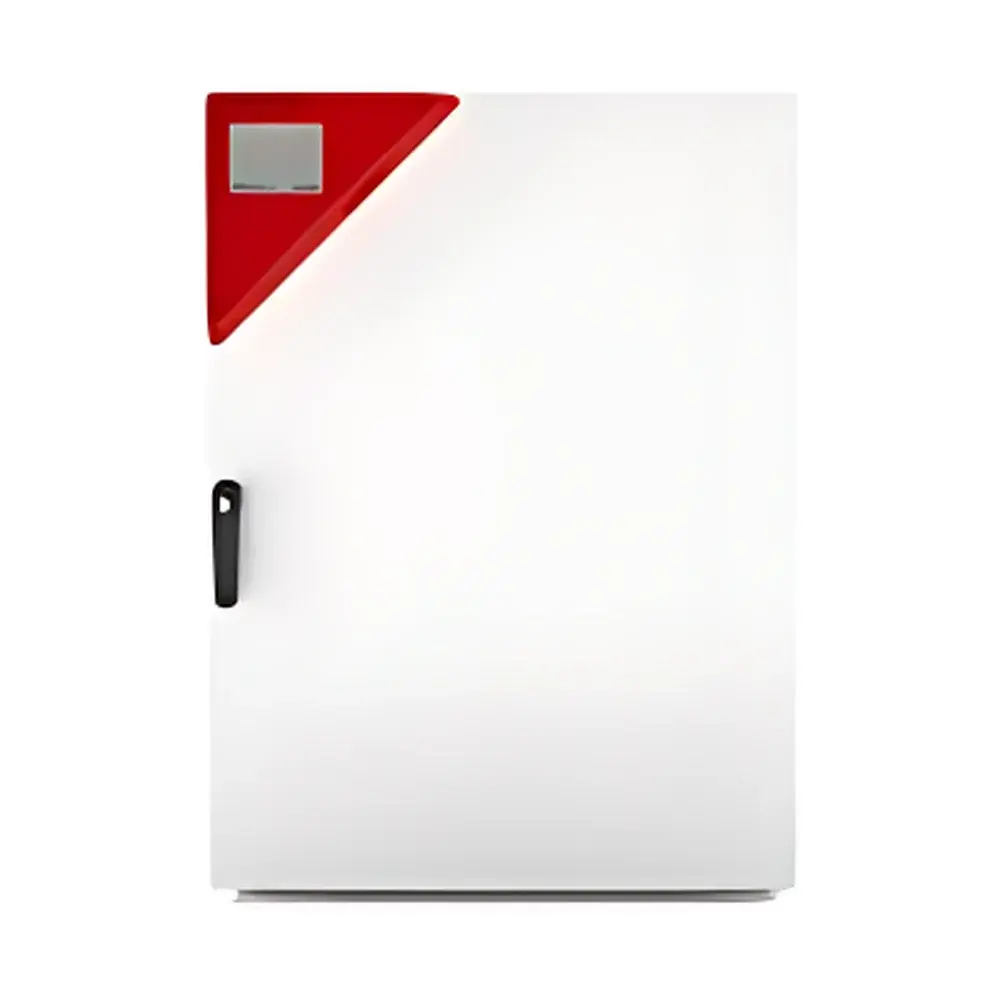
BINDER CB-S Solid.Line Series CO₂ Incubator
| Brand | BINDER |
|---|---|
| Origin | Germany |
| Model | CB-S Solid.Line |
| Internal Volume (L) | 170 / 267 |
| Net Weight (kg, empty) | 96 / 122 |
| Max. Total Load (kg) | 30 / 40 |
| Max. Load per Shelf (kg) | 10 / 10 |
| Rear Clearance (mm) | 100 / 100 |
| Side Clearance (mm) | 50 / 50 |
| Internal Dimensions – W×H×D (mm) | 560×600×505 / 620×750×575 |
| External Dimensions – W×H×D (mm) | 680×870×715 / 740×1020×785 |
| Temp. Range | Ambient +6 °C to 50 °C |
| Temp. Uniformity (±K @37 °C) | 0.3 / 0.4 |
| Temp. Stability (±K @37 °C) | 0.1 / 0.13 |
| Recovery Time (min @37 °C, 30 s door open) | 6 / 8 |
| Humidity Range | 90–95 % RH |
| CO₂ Range | 0–20 vol.% |
| CO₂ Sensing Principle | Infrared (IR) |
| Rated Power (230 V) | 1.3 kW / 1.5 kW |
| Standard/Max. Shelves | 2 / 6 or 2 / 8 |
| Sterilization | Dry-heat at 180 °C |
| Interface | Ethernet, USB, Dry Contact Alarm Output |
| Data Logging | Internal, USB exportable |
Overview
The BINDER CB-S Solid.Line Series CO₂ Incubator is a rigorously engineered, entry-level yet highly dependable platform designed for routine cell culture applications in academic laboratories, teaching facilities, and early-stage bioprocessing environments. Built in Germany to exacting industrial standards, it operates on the fundamental principle of maintaining precise, physiologically relevant conditions—namely temperature (ambient +6 °C to 50 °C), relative humidity (90–95 % RH), and CO₂ concentration (0–20 vol.%)—to sustain mammalian cell viability, proliferation, and metabolic stability over extended periods. Its core control architecture integrates an IR-based CO₂ sensor with zero drift over time, ensuring long-term accuracy without recalibration or consumables. The incubator’s stainless steel seamless chamber, safety-glass inner door, and ventilated perforated shelves collectively minimize contamination risk while supporting uniform gas distribution and thermal homogeneity. All models are validated for dry-heat sterilization at 180 °C—a critical feature for eliminating mycoplasma, spores, and biofilm residues without chemical agents.
Key Features
- Stainless steel seamless inner chamber with electropolished finish for enhanced cleanability and corrosion resistance
- Infrared (IR) CO₂ sensor with built-in temperature and pressure compensation, delivering stable, drift-free measurement across the full 0–20 vol.% range
- Venturi-mixed CO₂ inlet system enabling rapid, homogeneous gas distribution without turbulence-induced shear stress on sensitive monolayers
- Condensation-protected humidification system using evaporation from a heated water pan, actively managed to prevent condensate accumulation on samples or optics
- Microprocessor-controlled PID regulation for temperature and CO₂, with independent feedback loops and real-time deviation monitoring
- Integrated internal data logger storing timestamped temperature, CO₂, and humidity values; data exportable via USB in CSV format for traceability and audit readiness
- Dual-stage acoustic-optical alarm system with configurable thresholds and fault diagnostics displayed on the intuitive LCD interface
- Stackable design compatible with same-footprint BINDER CB and CBF series units using optional stacking adapters—optimizing lab floor space without compromising airflow or service access
Sample Compatibility & Compliance
The CB-S Solid.Line accommodates standard tissue culture vessels—including T-flasks, Petri dishes, multiwell plates, and roller bottles—across its two standard (expandable to six or eight) perforated stainless steel shelves. Each shelf supports up to 10 kg, with total payload capacities of 30 kg (CB-S 170) or 40 kg (CB-S 267). Its 180 °C dry-heat validation protocol aligns with ISO 14644-1 cleanroom practices and supports GLP-compliant decontamination workflows. While not certified for GMP manufacturing under Annex 1, the unit meets essential prerequisites for ISO/IEC 17025-accredited testing labs and satisfies foundational requirements referenced in USP , ASTM E2925, and EN 61010-1 for laboratory equipment safety and performance verification.
Software & Data Management
No proprietary software installation is required. All operational parameters—including setpoints, real-time readings, alarms, and logged data—are accessible directly via the front-panel LCD. Historical data (temperature, CO₂, humidity) are stored internally with user-defined sampling intervals and retrieved via USB mass-storage mode—compatible with standard spreadsheet or LIMS import protocols. Ethernet connectivity enables remote status monitoring and alarm notification via SNMP or Modbus TCP (firmware-dependent), supporting integration into centralized facility management systems. Audit trails comply with basic ALCOA+ principles: attributable, legible, contemporaneous, original, and accurate—though full 21 CFR Part 11 compliance requires external validation and electronic signature infrastructure.
Applications
- Routine maintenance and expansion of adherent and suspension mammalian cell lines (e.g., HEK293, CHO, HeLa, MCF-7)
- Embryonic stem cell passaging under low-oxygen priming conditions (when paired with optional O₂ module)
- Microbial co-culture studies requiring stable pH buffering via CO₂/HCO₃⁻ equilibrium
- Teaching laboratories conducting introductory cell biology, toxicology, or virology assays
- QC/QA workflows for raw material qualification (e.g., FBS lot testing) and media formulation development
- Pre-clinical assay platforms where reproducible environmental control is prerequisite to downstream ELISA, qPCR, or imaging analysis
FAQ
Does the CB-S Solid.Line support 21 CFR Part 11 compliance?
The incubator provides foundational data integrity features (internal logging, USB export, time-stamped records), but full Part 11 compliance—including electronic signatures, audit trail protection, and role-based access control—requires integration with validated third-party LIMS or ELN systems.
Can the CO₂ sensor be recalibrated by the user?
No. The IR sensor is factory-calibrated and sealed; it does not require periodic recalibration. Drift is mitigated by integrated temperature and pressure compensation algorithms.
Is humidification achieved via ultrasonic or steam injection?
Humidification is passive, using a heated water reservoir with natural evaporation. A dedicated condensation management system prevents droplet formation on chamber walls or samples.
What is the recommended maintenance interval?
BINDER recommends quarterly visual inspection of seals, gaskets, and water pan; annual verification of CO₂ sensor response using certified gas mixtures; and biannual cleaning of air filters and fan assemblies per the Maintenance Manual.
Can multiple CB-S units be networked for centralized monitoring?
Yes—via standard Ethernet (TCP/IP), up to 32 units can be monitored simultaneously using BINDER’s optional LabExchange software or custom SCADA implementations supporting Modbus TCP.



