
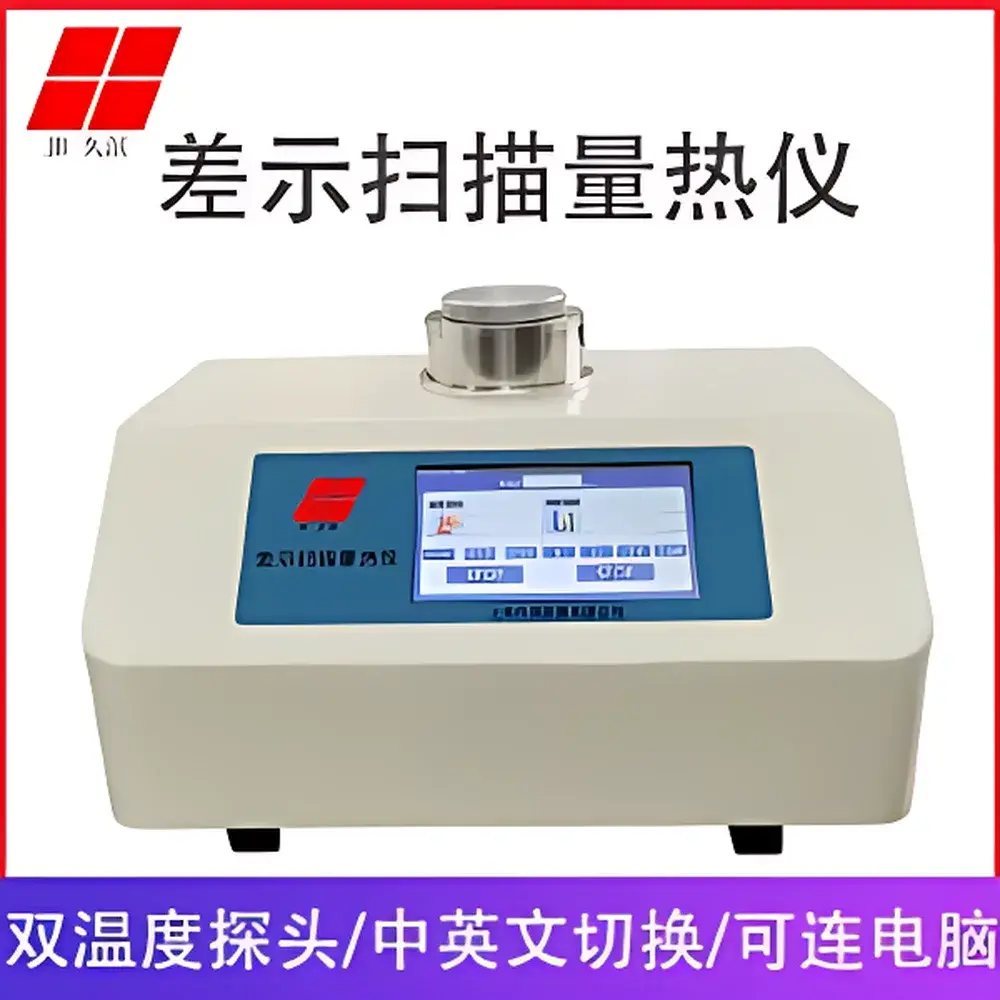
久滨仪器 DSC-300L Thermal Analyzer – Heat-Flux Differential Scanning Calorimeter
| Brand | Jiubin Instruments |
|---|---|
| Model | DSC-300L |
| Type | Heat-Flux DSC |
| Temperature Range | Ambient to 600 °C (extended capability to 1050 °C per specification) |
| Heating/Cooling Rate | 0.1–100 K/min |
| Temperature Resolution | 0.01 °C |
| Temperature Repeatability | ±0.1 °C |
| DSC Sensitivity | 0.001 mW |
| DSC Resolution | 0.01 µW |
| DSC Dynamic Range | ±800 mW |
| Atmosphere Control | Dual-gas auto-switching (N₂/O₂), plus dedicated purge gas line |
| Gas Flow Range | 0–300 mL/min |
| Gas Pressure Limit | ≤1 MPa |
| Display | 7-inch industrial-grade capacitive touchscreen |
| Interface | Standard USB 2.0 with auto-reconnect protocol |
| Compliance | GB/T 19466.2–2004, GB/T 19466.3–2004, GB/T 19466.6–2009, ISO 11357-2:1999, ISO 11357-3:1999 |
Overview
The Jiubin Instruments DSC-300L is a high-stability, heat-flux differential scanning calorimeter engineered for precise thermal characterization of solid and semi-crystalline materials across academic research, polymer development, pharmaceutical formulation, and quality assurance laboratories. Operating on the principle of heat-flux differential measurement—where the temperature difference between a sample and inert reference pan is monitored under controlled heating or cooling—the DSC-300L delivers quantitative thermodynamic data including glass transition temperatures (Tg), melting onset and peak temperatures (Tm), crystallization exotherms, enthalpy changes (ΔH), oxidative induction time (OIT), and specific heat capacity (Cp). Its ceramic furnace architecture ensures exceptional baseline stability and thermal uniformity, minimizing radiative perturbations common in resistive coil-based systems. The instrument supports both dynamic (ramped) and isothermal measurement modes, with full PID-controlled thermal programming enabling multi-segment protocols—e.g., pre-conditioning hold, linear ramp, isothermal stabilization, and controlled cooldown—all executed within a single run.
Key Features
- Industrial-grade 7-inch capacitive touchscreen interface with intuitive navigation, real-time curve overlay, and on-device parameter editing—no external PC required for basic operation.
- Patented ceramic furnace design delivering superior baseline flatness (<±5 µW drift over 30 min at 200 °C) and enhanced thermal homogeneity across the sensor platform.
- Indirect conductive heating architecture eliminates localized hot spots and reduces thermal lag, improving reproducibility of Tg and Tm determinations across repeated runs.
- Dual independent gas control system with automated switching between N₂ and O₂ atmospheres; switching time < 8 seconds with stabilization < 15 seconds—critical for comparative oxidation studies.
- Dedicated third gas inlet for inert purge during high-sensitivity measurements (e.g., low-enthalpy transitions or volatile samples), minimizing convective artifacts.
- USB 2.0 interface with robust firmware-level auto-reconnect logic—ensures uninterrupted data acquisition even after transient host disconnection or power cycling.
- Pre-loaded calibration routines using certified reference materials (indium, tin) compliant with ISO 11357-1 and ASTM E794, supporting user-performed temperature and enthalpy calibration without service intervention.
Sample Compatibility & Compliance
The DSC-300L accommodates standard aluminum, gold-coated aluminum, and high-pressure stainless-steel crucibles (up to 10 MPa rating optional), supporting solids, powders, films, fibers, and small-volume liquids (≤30 mg typical). It meets key regulatory and industry standards for thermal analysis validation: GB/T 19466.2–2004 (equivalent to ISO 11357-2:1999) for Tg determination; GB/T 19466.3–2004 (ISO 11357-3:1999) for melting/crystallization analysis; and GB/T 19466.6–2009 (ISO 11357-6:2018) for oxidative stability assessment under both isothermal and dynamic OIT protocols. While not inherently 21 CFR Part 11-compliant out-of-the-box, the instrument’s data export architecture (CSV, TXT, native .dsc binary) enables integration into validated LIMS or ELN platforms supporting audit trails, electronic signatures, and secure data archiving per GLP/GMP requirements.
Software & Data Management
Bundled JiubinTherm v4.x software provides cross-platform (Windows/macOS) acquisition, real-time visualization, and post-run analysis—including baseline correction, peak deconvolution, kinetic modeling (Ozawa-Flynn-Wall), and Cp calculation via dual-step method. Raw data files retain full metadata (operator ID, timestamp, atmosphere, gas flow, calibration history), and all processing steps are logged with versioned parameters. Export formats include ASTM E1447-compliant ASCII, Excel-ready CSV, and image exports (PNG/SVG) suitable for publication. Optional SDK enables API-driven automation for high-throughput screening environments.
Applications
- Polymer science: Quantification of crosslink density via Tg shift, crystallinity index from ΔHf, and thermal degradation onset (Td) under air/N₂.
- Pharmaceuticals: Solid-state form identification (polymorph screening), excipient compatibility testing, and stability-indicating assay development per ICH Q1A–Q5C guidelines.
- Electronics: Curing kinetics of encapsulants and underfill materials; solder alloy phase diagram validation.
- Food science: Starch gelatinization, fat polymorphism, and moisture-induced phase transitions.
- Metallurgy & ceramics: Sintering behavior, eutectic reactions, and heat capacity mapping for thermal barrier coating R&D.
FAQ
What is the maximum operating temperature for routine use?
The DSC-300L is rated for continuous operation up to 600 °C; extended-range operation to 1050 °C is supported with optional high-temperature sensor and crucible configurations.
Does the instrument support modulated DSC (MDSC®) functionality?
No—the DSC-300L implements conventional heat-flux DSC only. MDSC requires proprietary hardware modulation and is not part of this model’s architecture.
Can temperature and enthalpy calibrations be performed in-house?
Yes—certified indium (melting point 156.6 °C, ΔH = 28.45 J/g) and tin (231.9 °C, ΔH = 60.1 J/g) reference standards are included, and calibration procedures follow ISO 11357-1 Annex A.
Is remote monitoring or networked operation possible?
Direct Ethernet or Wi-Fi connectivity is not integrated; however, USB-connected operation allows host PC remote access via standard VNC or RDP protocols when deployed in controlled lab networks.
What maintenance intervals are recommended for the ceramic furnace and sensor assembly?
No scheduled furnace maintenance is required under normal use. Sensor cleaning and crucible inspection are advised after every 200 runs or upon visible residue accumulation—full service interval is 12 months or 1,000 operational hours, whichever occurs first.



