
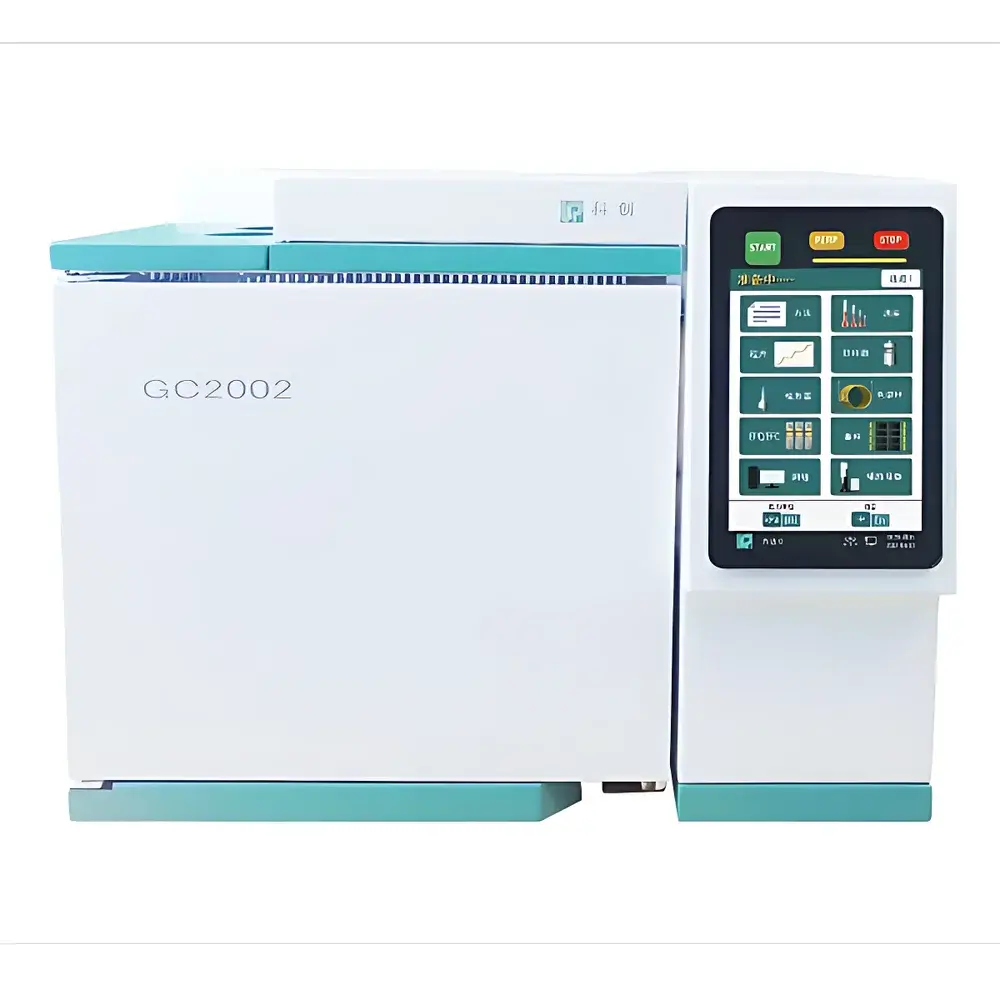
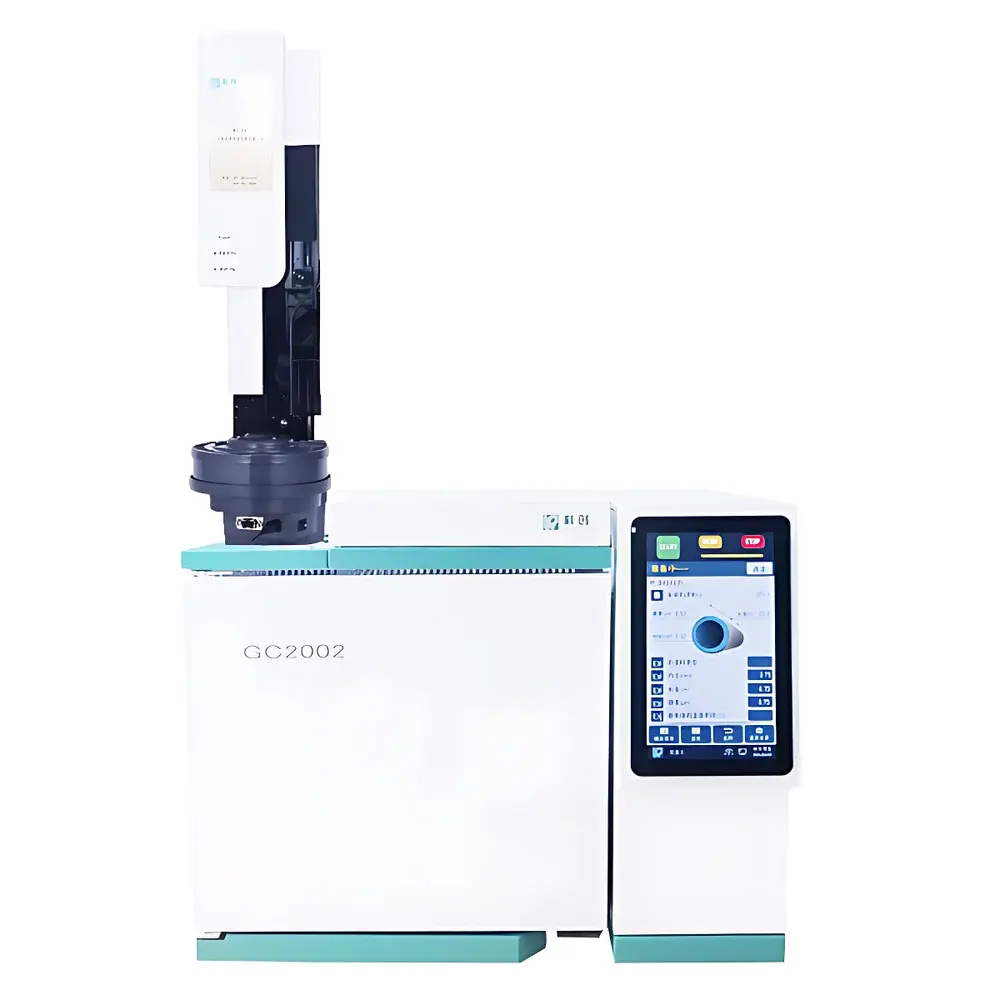
科创GC2002气相色谱仪
| Brand | Ke Chuang |
|---|---|
| Origin | Shanghai, China |
| Manufacturer Type | Direct Manufacturer |
| Instrument Type | Laboratory Gas Chromatograph |
| Model | GC2002 |
| Temperature Control Range | 3–450 °C |
| Oven Ramp Rate | 0–120 °C/min |
| Cooling Time | <4 min (450 °C → 50 °C at 22 °C ambient) |
| Carrier Gas Flow Range | 0–1200 mL/min |
| Carrier Gas Pressure Range | 0–600 kPa |
| Injector Max Temp | 3–450 °C |
| Injector Pressure Setpoint Range | 0–600 kPa |
| Injector Total Flow Setpoint Range | 0–1200 mL/min |
| EPC/EFC Pressure Accuracy | ±0.001 psi |
| EPC/EFC Flow Accuracy | ±0.001 mL/min |
| Temperature Stability | ±0.01 °C |
| Retention Time RSD | <0.008% |
| Peak Area RSD | <1.0% |
Overview
The Ke Chuang GC2002 is a network-enabled, laboratory-grade gas chromatograph engineered for high reproducibility, operational flexibility, and seamless integration into modern analytical workflows. Built on a robust dual-column oven architecture with independent temperature control, the GC2002 employs precise capillary or packed column separation coupled with advanced detection technologies—including TCD, FID, ECD, and FPD—to resolve volatile and semi-volatile organic compounds across environmental, pharmaceutical, petrochemical, food safety, and forensic applications. Its core measurement principle relies on differential partitioning of analytes between a mobile phase (inert carrier gas) and a stationary phase (capillary column coating), with retention time serving as the primary qualitative identifier and peak area/height as the quantitative metric. The instrument supports ASTM D3606, ISO 10301, USP , and EPA Method 8021B-compliant analyses when configured with appropriate columns and detectors—making it suitable for regulated laboratories requiring trace-level detection and method validation.
Key Features
- 10-channel independent temperature control system, including dual programmable ovens with 16-stage (extendable to unlimited) ramp profiles and ±0.01 °C thermal stability.
- RJ45 Ethernet interface enabling full digital signal transmission; integrated embedded chromatography workstation allows remote operation, real-time monitoring, and centralized fleet management—up to 253 instruments per network segment.
- Electronic Pressure and Flow Control (EPC/EFC) system with dual-mode operation (constant pressure or constant flow), plus optional 8-step programmed pressure/flow gradients for optimized method development.
- 10-inch capacitive touchscreen HMI with real-time baseline visualization, direct instrument reverse control, and intuitive method setup—eliminating dependency on external PCs during routine analysis.
- Standard MS-compatible interface (GC-MS coupling port), internal column oven lighting, and optional hydrogen leak detection and variable-frequency cooling fan for accelerated thermal cycling (≤5 min from 350 °C to 50 °C).
- Eight user-defined external event timers supporting automated sequential injection, valve switching, and detector synchronization for unattended multi-sample runs.
- Self-diagnostic firmware with continuous hardware health monitoring, overtemperature cutoff protection across all zones, and fault-code reporting with contextual localization.
Sample Compatibility & Compliance
The GC2002 accommodates standard 0.1–0.53 mm ID fused-silica capillary columns and packed columns up to 4 mm ID. It supports universal carrier gases (N2, H2, He, Ar) with pressure- and flow-compensated delivery ensuring consistent linear velocity across temperature gradients. Detector configurations meet ICH Q2(R2) requirements for specificity, linearity, accuracy, and precision in method validation. Optional FID with wide-dynamic-range amplifier prevents solvent peak saturation, while ECD achieves sub-femtogram sensitivity for halogenated pesticides per ISO 14501. All temperature and flow parameters are logged with timestamped audit trails compliant with FDA 21 CFR Part 11 when paired with validated software. The system meets GLP/GMP environmental specifications (operating range: 5–35 °C, ≤85% RH) and conforms to IEC 61010-1 safety standards for laboratory equipment.
Software & Data Management
The embedded GC2002 workstation provides full reverse control, real-time chromatogram display, and post-run data processing—including peak integration, calibration curve generation (linear, quadratic, or polynomial), and report export in PDF, CSV, or XML formats. Multi-detector time-programming enables simultaneous acquisition from two or more detectors on a single data channel, with configurable signal routing and baseline correction algorithms. Audit trail functionality records all user actions, parameter changes, and instrument events with immutable timestamps. Data files adhere to ASTM E1947-compliant structure for long-term archival and third-party software interoperability (e.g., OpenLab CDS, Chromeleon). Remote access via secure HTTPS allows supervisors to review QC metrics, approve methods, and enforce change control protocols without physical presence.
Applications
- Environmental analysis: VOCs in air/water per EPA TO-17 and Method 8260; PCBs and organochlorine pesticides using ECD.
- Pharmaceutical QC: Residual solvents (ICH Q3C), assay purity, and extractables/leachables profiling with FID and headspace autosampler compatibility.
- Petrochemical testing: Hydrocarbon group-type analysis (PIONA), gasoline oxygenates (MTBE, ETBE), and simulated distillation (ASTM D5292).
- Food & flavor: Fatty acid methyl esters (FAMEs), terpenes, aldehydes, and off-flavor compounds using polar and non-polar columns.
- Forensic toxicology: Ethanol quantification in blood (headspace-GC/FID), benzodiazepines and opioids (GC-MS confirmation-ready).
FAQ
Does the GC2002 support regulatory compliance for pharmaceutical labs?
Yes—the instrument’s EPC/EFC precision, audit-trail-capable software, and documented temperature/flow repeatability align with USP , ICH Q2(R2), and FDA 21 CFR Part 11 requirements when deployed with validated methods and qualified accessories.
Can multiple GC2002 units be controlled from one computer?
Yes—via standard Ethernet, a single workstation can manage up to 253 GC2002 instruments simultaneously, enabling centralized method deployment, data aggregation, and cross-instrument trending.
What is the maximum number of temperature program steps supported?
The column oven supports up to 16 predefined ramp stages, but the firmware allows indefinite extension through cascaded programs—enabling complex multi-segment methods for challenging separations.
Is hydrogen gas safe to use as a carrier with this system?
Hydrogen is fully supported, and optional integrated hydrogen leak detection (with audible/visual alarm and automatic shutdown) enhances safety in labs adopting high-efficiency H2 carrier methods.
How does the GC2002 handle solvent overload in FID analysis?
The standard wide-dynamic-range FID amplifier eliminates peak flattening, maintaining linearity across six orders of magnitude—even for large-volume injections or high-concentration solvents.
Related Products






