
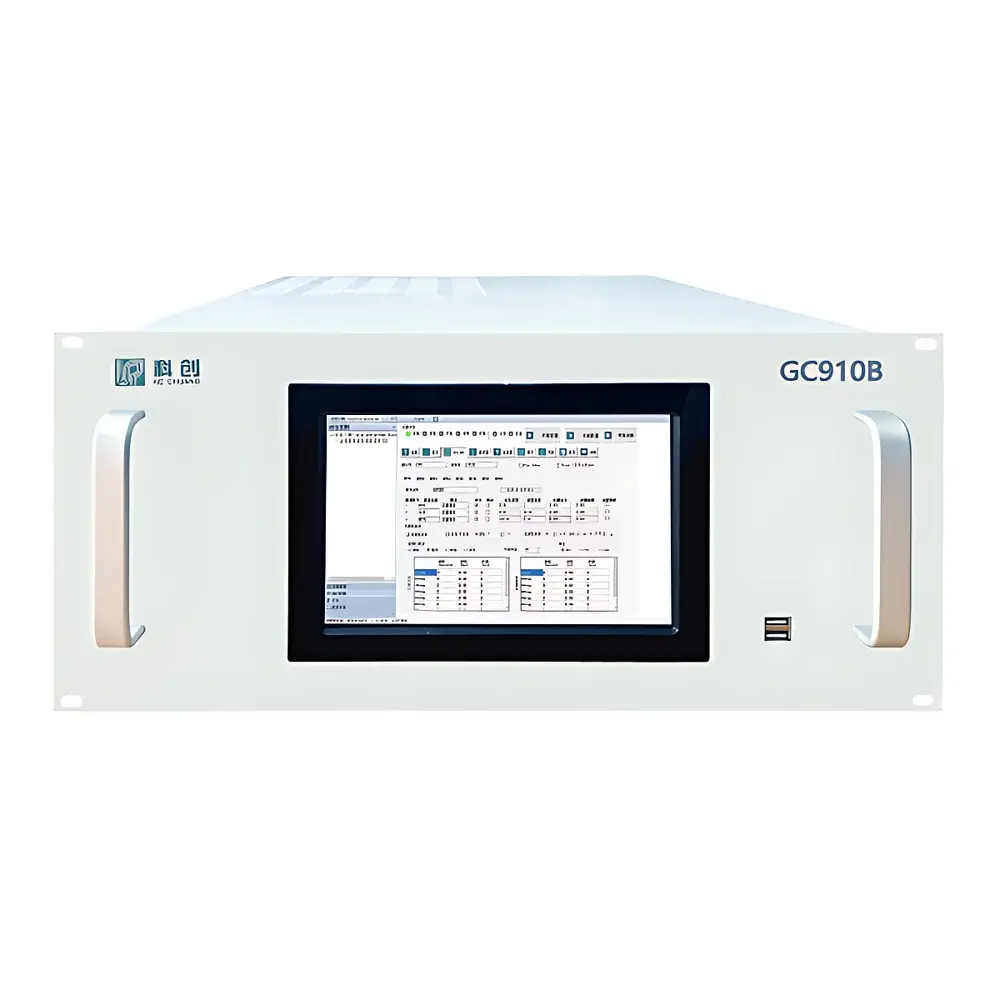
科创GC910B型气相色谱仪(可便携式用)
| Brand | Kechuang |
|---|---|
| Origin | Shanghai, China |
| Manufacturer Type | OEM Manufacturer |
| Product Category | Domestic |
| Model | GC910B Portable/Vehicle-Mountable Gas Chromatograph |
| Instrument Type | Portable Gas Chromatograph |
| Application Scope | General-Purpose |
| Oven Temperature Range | Ambient + 8 °C to 400 °C |
| Heating Rate | 0.1–40 °C/min |
| Cooling Rate | 400 °C to 50 °C in ≤4 min |
| Carrier Gas Flow Range & Control | 0–100 mL/min |
| Carrier Gas Pressure Range & Control | 0–250 kPa |
| Injector Maximum Operating Temperature | 300 °C |
| Injector Pressure Setting Range | 0–250 kPa |
| Injector Total Flow Setting Range | 0–1200 mL/min |
Overview
The Kechuang GC910B is a rugged, field-deployable gas chromatograph engineered for high-fidelity separation and quantification of volatile and semi-volatile organic compounds under non-laboratory conditions. Built on a modular, compact chassis weighing ≤20 kg, it employs capillary column-based separation with precise temperature-programmed oven control and fully digital electronic pressure/flow control (EPC/EFC). Its core architecture supports both portable handheld deployment and vehicle-integrated operation—ideal for environmental monitoring, emergency response, industrial hygiene, and on-site quality assurance where benchtop GC infrastructure is unavailable. The system operates via gas-phase partitioning kinetics governed by the Van Deemter equation, with retention time governed by analyte volatility, polarity, and stationary phase interaction. Dual independently programmable ovens enable parallel or sequential analysis configurations; column temperature stability is maintained at ±0.1 °C over ambient +8 °C to 400 °C, with heating rates adjustable from 0.1 to 40 °C/min and cooling from 400 °C to 50 °C in under 4 minutes via active airflow-assisted thermal management.
Key Features
- 10-channel independent temperature control system, including dual programmable column ovens with 64-stage ramp capability (expandable to unlimited steps) and ≤0.5% RSD in program reproducibility
- Integrated EPC/EFC system with 0.001 psi pressure resolution and 0.001 mL/min flow resolution; supports constant-pressure, constant-flow, and multi-step programmed pressure/flow profiles (up to 8 steps)
- 8-inch capacitive touchscreen interface with real-time baseline visualization, spectral overlay, and direct instrument reverse control—no external PC required for basic operation
- Digital RJ45 Ethernet interface enabling full remote operation, firmware updates, and data streaming; compatible with centralized fleet management systems supporting up to 253 units per network segment
- Onboard self-diagnostic engine with real-time fault localization, automatic overtemperature cutoff (any channel exceeding setpoint halts heating), and environmental drift compensation (≤0.1 °C oven fluctuation per 10 °C ambient change)
- Compact mechanical design: 482 mm (W) × 450–600 mm (D) × 222 mm (H); column chamber volume 165 × 135 × 92 mm; power consumption ≤2000 W; compliant with IEC 61010-1 for safety in mobile environments
Sample Compatibility & Compliance
The GC910B accommodates standard 0.1–0.53 mm ID fused-silica capillary columns and is compatible with universal carrier gases (N2, H2, He, Ar). It meets ASTM D3612 (petroleum hydrocarbons), EPA Method TO-17 (airborne VOCs), and ISO 11843-2 (detection limit validation) requirements when configured with appropriate detectors. All temperature and pressure control modules are traceable to NIST-certified references. Data acquisition and storage comply with ALCOA+ principles (Attributable, Legible, Contemporaneous, Original, Accurate, Complete, Consistent, Enduring, Available); audit trails, user access logs, and electronic signatures are supported through optional 21 CFR Part 11–compliant software modules. The instrument’s thermal and pneumatic stability ensures adherence to GLP/GMP environmental monitoring protocols during field audits.
Software & Data Management
The embedded chromatography workstation provides full method development, sequence scheduling, peak integration, calibration curve generation (linear, quadratic, polynomial), and report export (PDF, CSV, XML). It supports simultaneous acquisition from multiple detectors—including TCD, FID, ECD, and FPD—with configurable time-programmed detector switching within a single data channel. Raw signal files are stored in vendor-neutral .CDF format (compatible with OpenChrom and Chromeleon). Remote data synchronization uses TLS 1.2–secured HTTP(S) endpoints; local storage includes redundant SD card + internal flash memory (≥32 GB). Firmware updates are delivered via signed OTA packages with SHA-256 verification. Audit trail records include operator ID, timestamp, parameter modification history, and detector response metadata—fully exportable for regulatory submission.
Applications
- Environmental: On-site detection of BTEX, chlorinated solvents, and PAHs in soil gas, ambient air, and groundwater headspace
- Industrial Safety: Real-time monitoring of workplace exposure limits (OELs) for VOCs in petrochemical, pharmaceutical, and semiconductor fabrication facilities
- Emergency Response: Rapid identification of chemical warfare agents, toxic industrial chemicals (TICs), and illicit drug precursors in hazmat incidents
- Food & Agriculture: Field screening of pesticide residues, flavor volatiles, and ethanol fermentation byproducts
- Energy: Natural gas composition analysis (C1–C6 hydrocarbons), biogas methane purity verification, and refinery process stream profiling
FAQ
Is the GC910B certified for use in hazardous locations (e.g., Class I Div 1)?
No—the GC910B is rated for general-purpose use in non-classified environments (IEC 60079-0 general requirements). Explosion-proof enclosures require third-party certification and are not supplied by default.
Can the instrument operate on battery power?
It is designed for 220 V AC ±10%, 50 Hz input. External DC-AC inverters (≥2500 W continuous output) may be used in vehicle-mount applications; integrated battery backup is not available.
What detector configurations are factory-supported?
Standard configurations include TCD and FID; ECD and FPD are optional plug-in modules requiring separate calibration and gas supply setup.
Does the system support ASTM D1319 (hydrocarbon type analysis) or ASTM D6299 (precision control)?
Yes—when equipped with dual FID/TCD and appropriate polar/non-polar column sets, the GC910B meets method-specific hardware and data handling requirements for both standards.
How is method transfer validated between GC910B and laboratory GC systems?
Retention time indexing (RTI), relative retention time (RRT), and normalized peak area ratios are supported; inter-system comparability is established using NIST SRM 869b or equivalent certified reference materials.




