
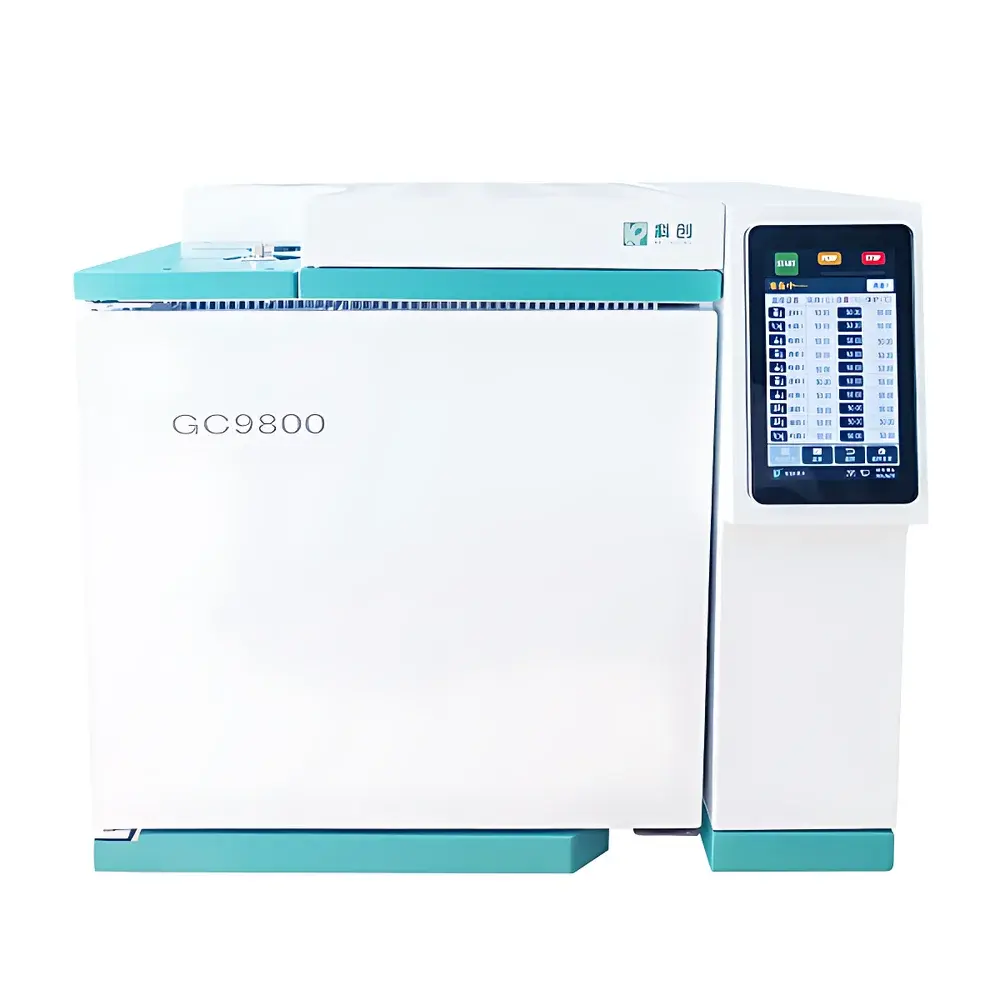
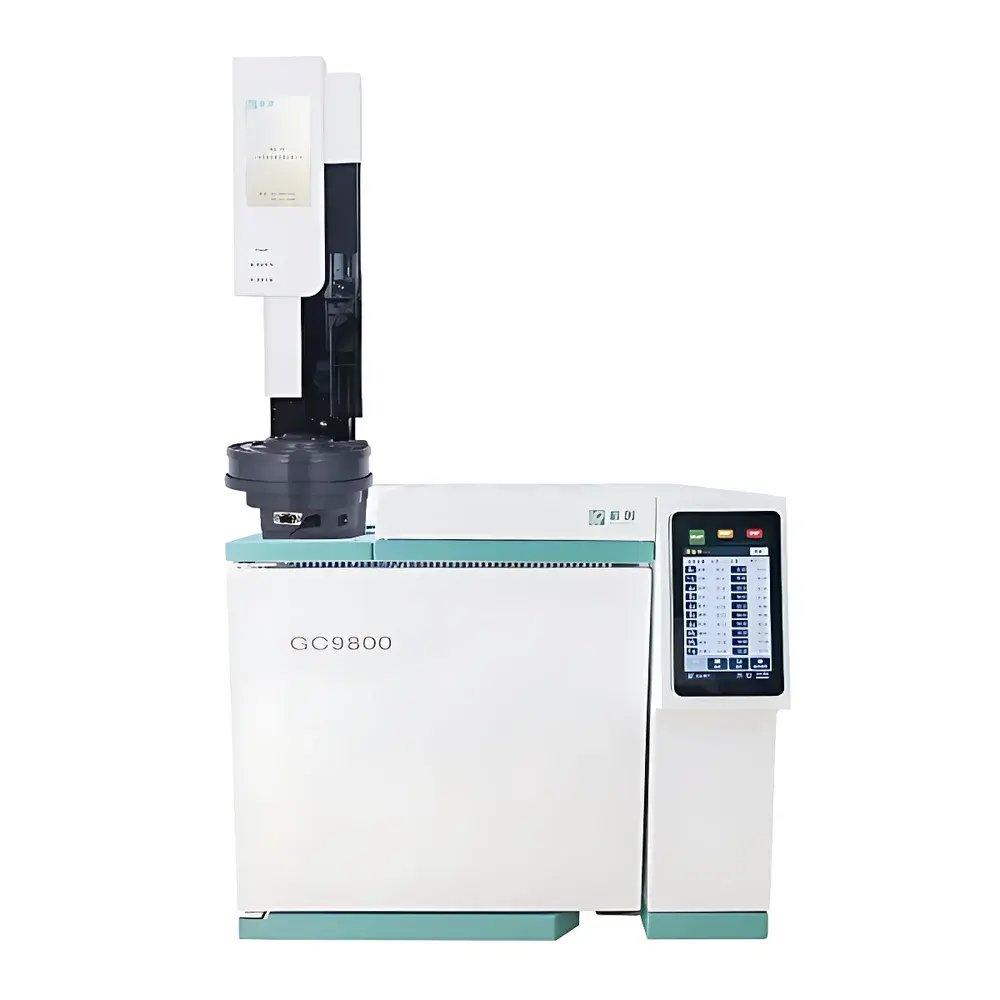
科创GC9800气相色谱仪带自动进样器
| Brand | Kechuang |
|---|---|
| Origin | Shanghai, China |
| Manufacturer Type | Direct Manufacturer |
| Instrument Type | Laboratory Gas Chromatograph |
| Model | GC9800N + Liquid Autosampler |
| Temperature Control Range | Ambient + 3 °C to 450 °C |
| Maximum Ramp Rate | 0–40 °C/min (adjustable in 0.1 °C/min increments) |
| Cooling Time | ≤4 min (350 °C → 50 °C, with motorized backdoor) |
| Carrier Gas Flow Range | 0–1200 mL/min |
| Carrier Gas Pressure Range | 0–970 kPa |
| Injector Temperature Max | 450 °C |
| Injector Pressure Setting Range | 0–970 kPa |
| Injector Total Flow Setting Range | 0–1200 mL/min |
| EPC/EFC Precision | ±0.001 psi (pressure), ±0.001 mL/min (flow) |
| Column Oven Dimensions | 305 × 160 × 278 mm (W × D × H) |
| Unit Weight | ≤50 kg |
| Power Supply | 220 V ±10%, 50 Hz ±5% |
| Operating Environment | 5–35 °C, ≤85% RH |
Overview
The Kechuang GC9800N Gas Chromatograph is a high-performance, modular laboratory gas chromatography system engineered for precision separation, quantification, and identification of volatile and semi-volatile organic compounds. Built on a dual-column oven architecture with independent programmable temperature control, the instrument implements advanced gas-phase separation principles based on differential partitioning between mobile (carrier gas) and stationary (capillary column) phases under precisely regulated thermal gradients. Its core design supports method robustness across diverse analytical workflows—including environmental monitoring, petrochemical analysis, pharmaceutical impurity profiling, food safety testing, and forensic toxicology—where reproducibility, trace-level sensitivity, and regulatory compliance are non-negotiable. The integrated electronic pressure and flow control (EPC/EFC) system ensures thermodynamic stability of retention times and peak shape fidelity across multi-day sequences, while the embedded 7-inch capacitive touchscreen and RJ45-based digital interface enable deterministic real-time instrument supervision without analog signal degradation.
Key Features
- 10-channel independent temperature control system, including two fully programmable column ovens supporting up to 16-stage (extendable to unlimited) ramp profiles with ≤0.5% RSD in retention time repeatability.
- High-resolution EPC/EFC system with ±0.001 psi pressure and ±0.001 mL/min flow control accuracy; supports constant-pressure, constant-flow, and multi-step programmed pressure/flow modes (up to 8 steps).
- Dual-column oven configuration enables simultaneous or sequential analysis using different stationary phases—ideal for method development, confirmation analysis, or parallel QC/QA validation.
- Integrated 7-inch industrial-grade touch interface with real-time baseline visualization, spectral overlay, and direct instrument parameter adjustment—no external PC required for basic operation.
- Modular detector architecture accommodating TCD, FID, ECD, and FPD configurations; all detectors feature wide-dynamic-range amplifiers to prevent solvent peak saturation and ensure linear response over 10⁴–10⁷ concentration ranges.
- Standard mass spectrometer coupling port and active cooling via motorized backdoor (cool-down from 350 °C to 50 °C in ≤4 minutes) enhance throughput in high-sample-volume labs.
- Embedded chromatography workstation firmware supports remote operation, audit-trail-enabled method storage, and networked control of up to 253 units via standard TCP/IP—compatible with centralized LIMS integration and GLP/GMP-compliant data governance frameworks.
Sample Compatibility & Compliance
The GC9800N accepts liquid, gaseous, and headspace-derived samples through its configurable inlet systems—including split/splitless, PTV, and cold-on-column options—with temperature stability maintained to ±0.01 °C across the full operating range (ambient +3 °C to 450 °C). Its EPC-controlled pneumatic architecture supports N₂, H₂, He, and Ar carrier gases, enabling optimization of resolution, speed, and detector compatibility per application. The system complies with foundational analytical standards including ASTM D3606 (benzene/toluene in gasoline), ISO 11843-2 (detection limit estimation), and USP (chromatographic separations). When configured with FID and operated under validated methods, it meets FDA 21 CFR Part 11 requirements for electronic records and signatures when deployed with appropriate access controls, audit trails, and data integrity safeguards.
Software & Data Management
The GC9800N runs an embedded chromatography data system (CDS) with bidirectional instrument control, real-time spectral acquisition, and automated calibration curve generation. The software supports customizable reporting templates compliant with ISO/IEC 17025 documentation requirements, including full metadata logging (instrument state, environmental conditions, user identity, timestamped events). All method parameters, sequence files, and raw data are stored in vendor-neutral formats (e.g., .cdf, .csv) with SHA-256 checksums to ensure data integrity. Remote access is secured via TLS 1.2 encryption, and the system supports scheduled backups to NAS or cloud repositories with versioned archiving. For regulated environments, optional software modules provide electronic signature workflows, role-based permissions, and 21 CFR Part 11-compliant audit trail generation—including user login/logout, method modification history, and result reprocessing logs.
Applications
- Environmental: Quantification of VOCs (e.g., BTEX, chlorinated solvents) in water, soil, and air per EPA Method 8260D and ISO 16017-1.
- Petrochemical: Hydrocarbon group-type analysis (PIONA), octane number determination, and sulfur speciation using FPD or SCDD detection.
- Pharmaceutical: Residual solvent testing per ICH Q3C guidelines; assay of volatile impurities in APIs and excipients.
- Food & Flavor: Fatty acid methyl ester (FAME) profiling, pesticide residue screening (ECD/FID), and aroma compound fingerprinting.
- Forensic & Clinical: Detection of ethanol, methanol, isopropanol, and toxic volatiles in blood/headspace samples per SAMHSA and CAP guidelines.
FAQ
Does the GC9800N support 21 CFR Part 11 compliance?
Yes—when deployed with the optional validated CDS package, including electronic signature workflows, audit trail logging, and role-based access control.
Can multiple detectors be operated simultaneously on one GC9800N unit?
Yes—the system supports concurrent acquisition from up to two detectors (e.g., FID + ECD) on separate data channels with independent time-programmed signal routing.
What is the minimum detectable concentration for ECD analysis?
The ECD achieves ≤10 fg/mL detection limit for γ-HCH (lindane), meeting EU Directive 2009/128/EC pesticide residue thresholds.
Is the autosampler compatible with standard 2-mL vials and 11-mm crimp caps?
Yes—the integrated liquid autosampler accepts ANSI/SIL standard vial formats and supports programmable wash cycles, needle purge, and injection volume ranging from 0.1–100 μL.
How does the system handle ambient temperature fluctuations during long-duration runs?
Environmental compensation algorithms maintain column oven stability within ±0.1 °C for every 10 °C ambient change, verified per ISO 17025 clause 5.4.2.





