
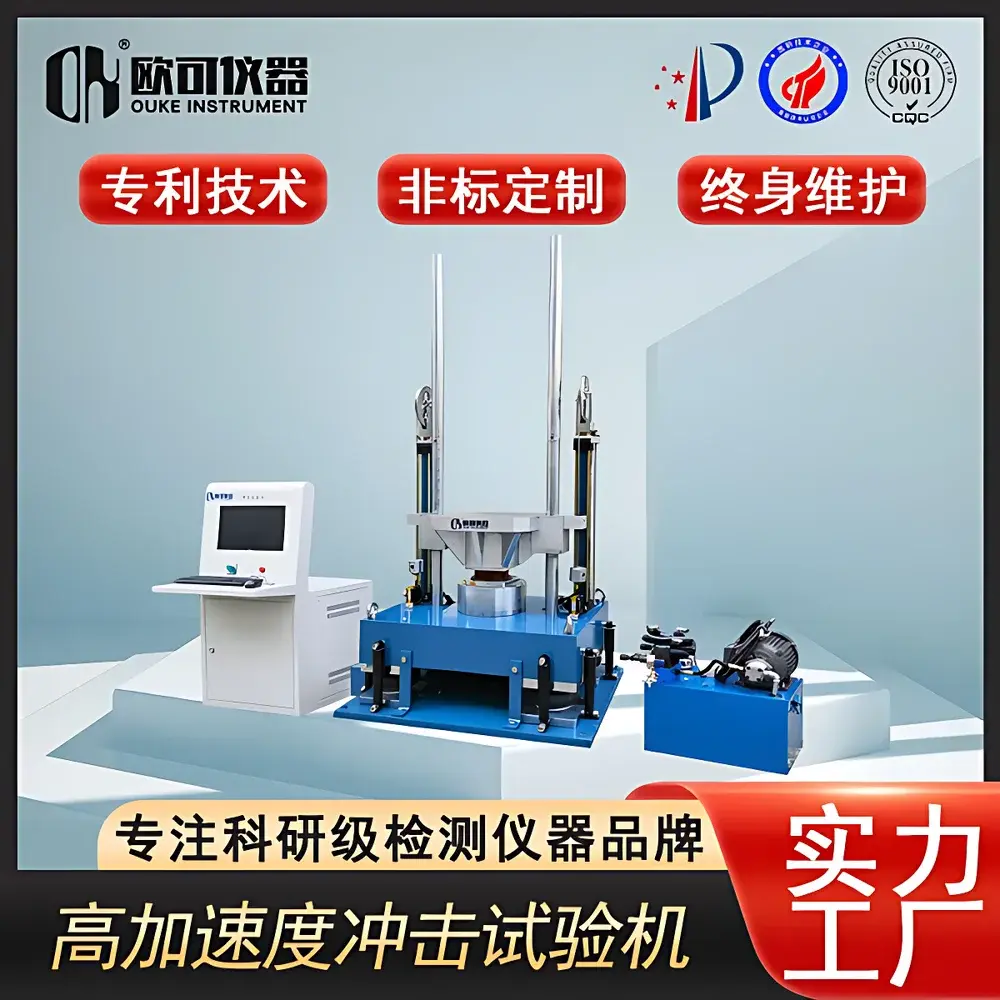
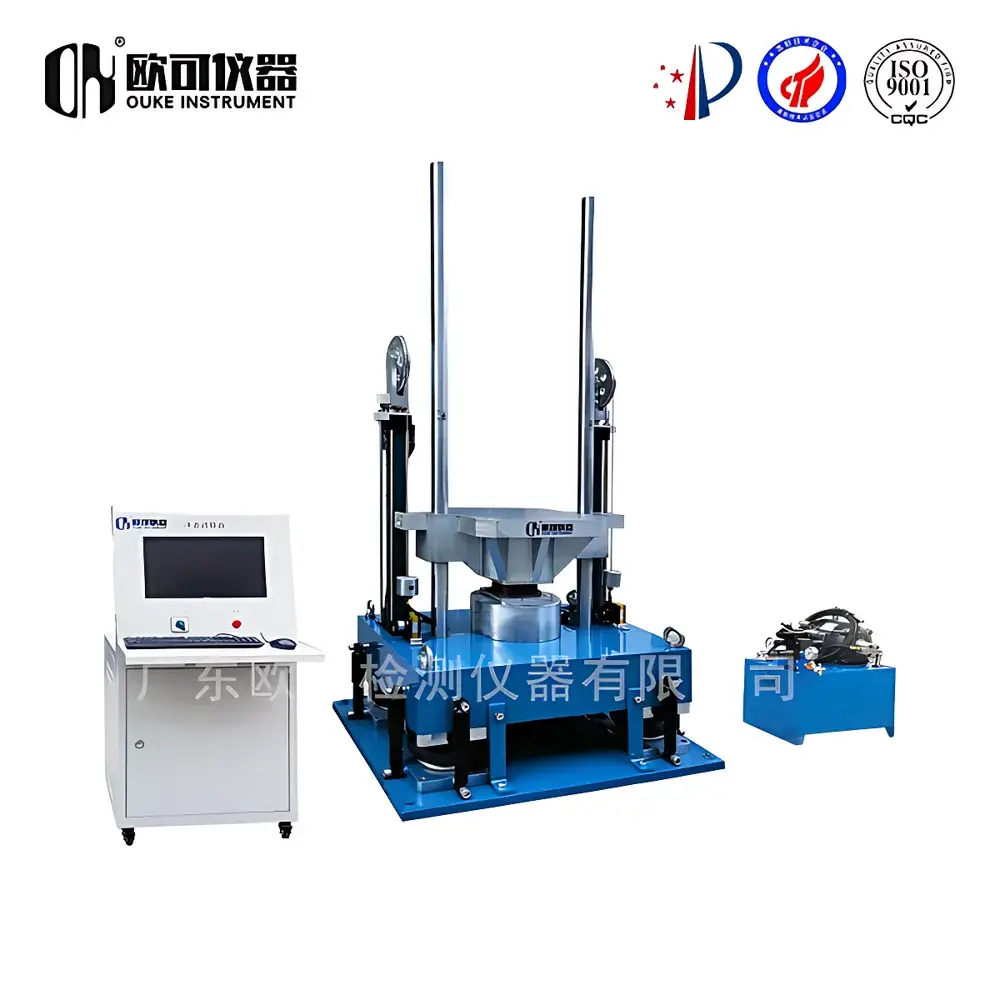
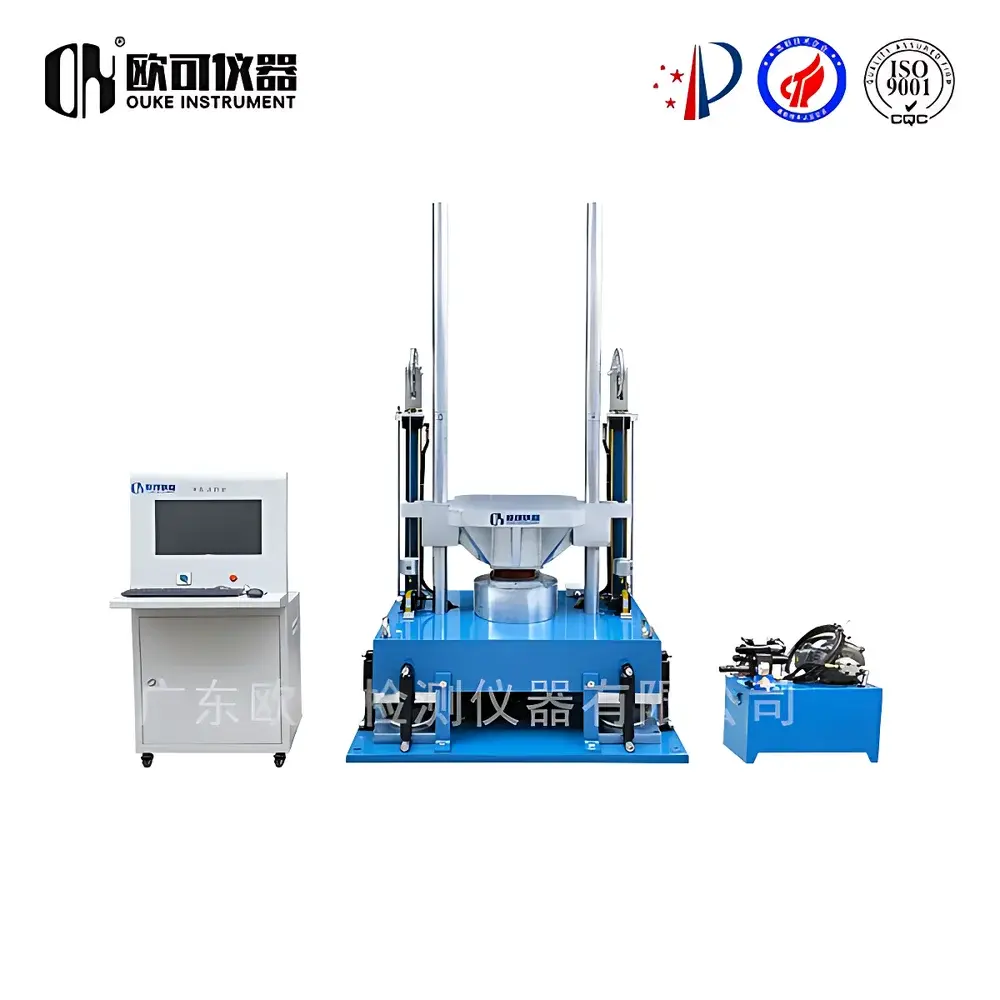
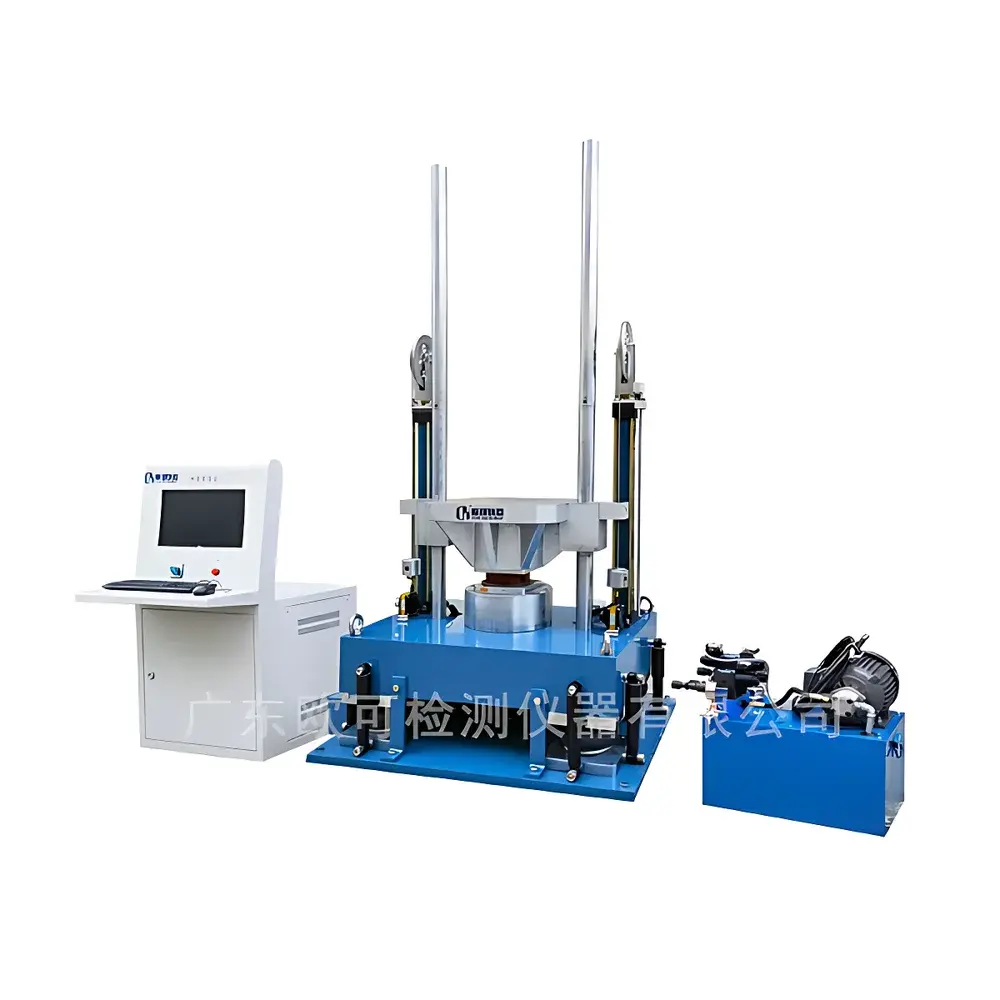
OK-S-10.2 High-Acceleration Shock Test System
| Brand | OK Instruments |
|---|---|
| Origin | Guangdong, China |
| Manufacturer Type | Direct Manufacturer |
| Product Category | Domestic |
| Model | OK-S-10.2 |
| Impact Energy | 1000 G |
| Impact Velocity | 4.5 m/s |
| Pendulum Moment (Impact Constant) | 500 N·m |
| Load Cell Range | 50 kN |
| Maximum Lifting Height | 480 mm |
Overview
The OK-S-10.2 High-Acceleration Shock Test System is an electro-mechanically engineered test platform designed to replicate transient, high-intensity mechanical shock environments encountered during transportation, handling, operational use, or accidental drop events. It operates on the principle of controlled deceleration: a rigid test table is accelerated to a defined velocity and then abruptly arrested—either via impact with a programmable pulse generator or through electromagnetic braking—thereby imposing a calibrated acceleration pulse onto the test specimen mounted on the table surface. The resulting shock waveform (characterized by peak acceleration, pulse duration, and shape) is governed by Newtonian mechanics and energy transfer dynamics, enabling precise simulation of real-world mechanical transients. Unlike quasi-static or cyclic loading systems, this instrument delivers single-event, non-repetitive impulses with millisecond-scale rise times and durations ranging from 0.5 ms to 20 ms—making it suitable for evaluating structural integrity, solder joint reliability, MEMS device survivability, and packaging performance under extreme inertial loading.
Key Features
- Electro-hydraulic hybrid actuation system delivering repeatable 4.5 m/s impact velocity with ≤±1.5% amplitude deviation across consecutive pulses
- Programmable pulse generation architecture supporting standardized shock profiles: half-sine (IEC 60068-2-27), terminal-peak sawtooth (MIL-STD-883 Method 2002), trapezoidal, and user-defined transient waveforms
- High-rigidity welded steel frame with modal damping treatment to suppress spurious resonances above 1 kHz
- Integrated 50 kN capacity piezoelectric load cell with TEDS-enabled signal conditioning for real-time force monitoring
- Digital closed-loop controller with waveform synthesis engine compliant with IEEE 1057 and ISO/IEC 17025 traceability requirements
- Adjustable lifting mechanism supporting up to 480 mm elevation for free-fall mode operation; compatible with lead, rubber, and elastomeric anvil configurations
Sample Compatibility & Compliance
The OK-S-10.2 accommodates specimens weighing up to 50 kg on its 400 × 400 mm aluminum honeycomb test table, with optional fixture plates for PCBs, ECUs, optical modules, and packaged consumer electronics. Its shock output meets the pulse fidelity criteria specified in IEC 60068-2-27 (Shock), MIL-STD-202G (Method 213), MIL-STD-883 (Method 2002), and JESD22-B104 (Board Level Drop Test). Waveform validation is performed using onboard triaxial accelerometers and synchronized high-speed data acquisition (≥1 MHz sampling rate), ensuring conformance to GLP-compliant test reporting protocols. All firmware and calibration records adhere to FDA 21 CFR Part 11 audit trail requirements for regulated industries including medical device manufacturing and aerospace component qualification.
Software & Data Management
The system is operated via OK-TestSuite™ v4.2—a Windows-based application supporting waveform synthesis, sequence programming, live oscilloscope-style visualization, and automated pass/fail evaluation against user-defined tolerance bands (e.g., ±10% peak G, ±15% pulse width). Raw time-series data are stored in HDF5 format with embedded metadata (test ID, operator, timestamp, environmental conditions), enabling seamless integration into LIMS and PLM platforms. Export options include CSV, MATLAB .mat, and universal ASAM MDF4 for cross-platform analysis. Software validation documentation—including IQ/OQ/PQ reports—is provided upon delivery, fulfilling ISO 9001:2015 and ISO/IEC 17025:2017 laboratory accreditation prerequisites.
Applications
- Drop testing of smartphones, tablets, and wearable devices per ISTA 3A and ASTM D4169 transport simulation protocols
- Qualification of automotive electronic control units (ECUs), radar sensors, and ADAS components under road-induced shock spectra
- Spacecraft payload survivability verification during stage separation and pyrotechnic shock events
- Military-grade ruggedization validation for handheld radios, night vision systems, and field-deployable instrumentation
- Packaging optimization studies for pharmaceutical primary containers and diagnostic kits subjected to air cargo handling
- Reliability screening of electromechanical relays, microswitches, and RF connectors under mechanical shock stress screening (MSSS)
FAQ
What shock waveforms can the OK-S-10.2 generate?
It natively supports half-sine, terminal-peak sawtooth, and trapezoidal pulses per international standards; custom waveforms may be imported as time-acceleration datasets via CSV or MATLAB files.
Is the system compliant with MIL-STD-883 Method 2002?
Yes—the system’s pulse fidelity, measurement uncertainty budget (<±2.5% at 1000 G), and documentation structure satisfy all technical and procedural requirements outlined in Revision H of MIL-STD-883.
Can the OK-S-10.2 be integrated with existing vibration test systems?
The unit features Ethernet/IP and Modbus TCP interfaces, enabling synchronized operation with electrodynamic shakers to execute combined vibration–shock test profiles per DO-160 Section 8 and RTCA/DO-160G Annex L.
What calibration interval is recommended?
Annual metrological calibration against NIST-traceable reference accelerometers and velocity interferometers is advised; factory-certified calibration certificates include measurement uncertainty statements per ISO/IEC 17025.
Does the system support remote operation and monitoring?
Yes—web-enabled diagnostics, real-time telemetry streaming, and secure SSH access allow supervised operation from offsite locations while maintaining full audit trail integrity.



