
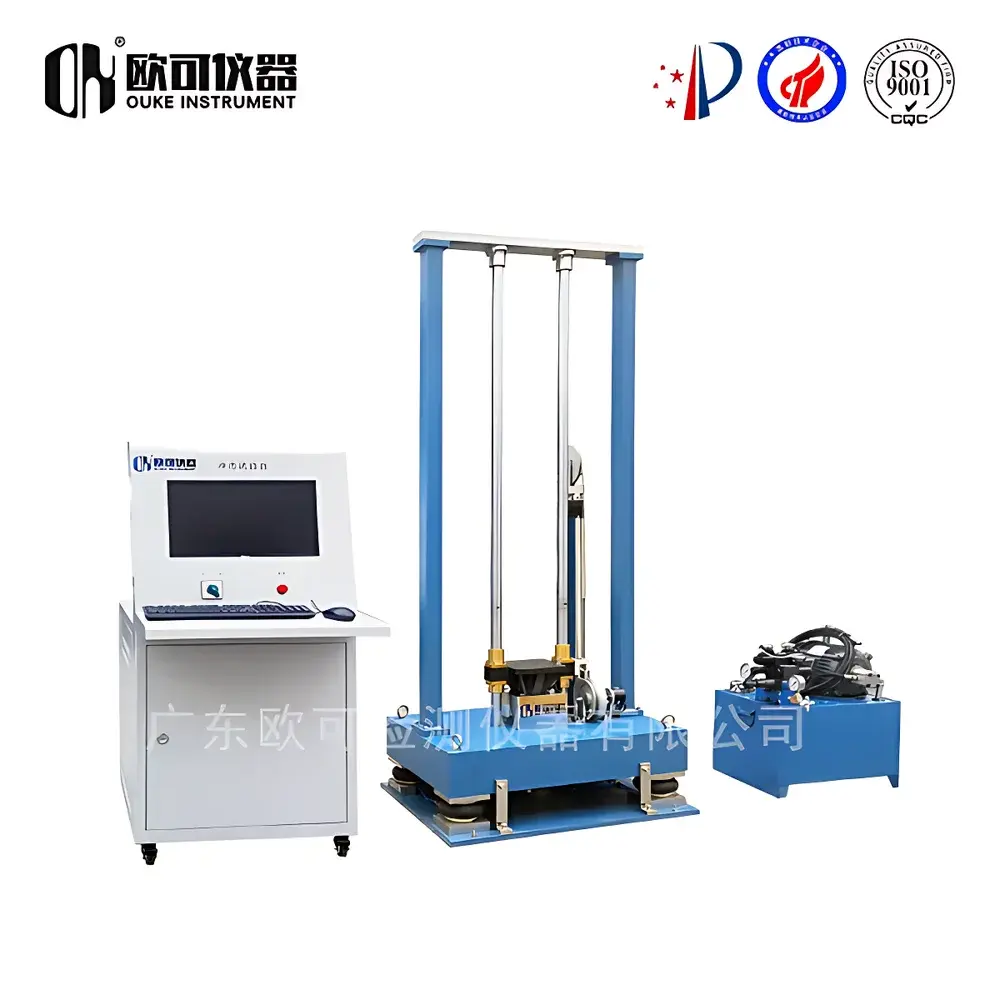
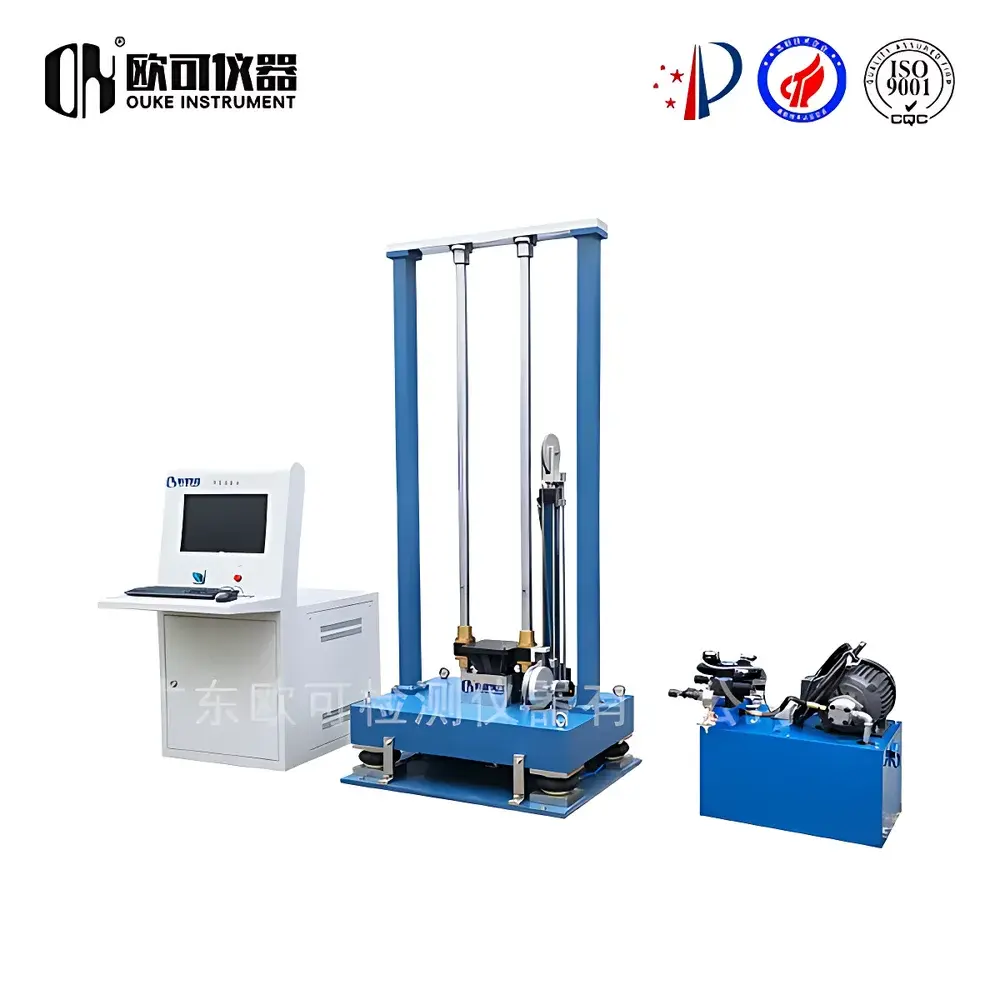
OK-S-100 Acceleration Shock Test System
| Brand | OK Instruments |
|---|---|
| Origin | Guangdong, China |
| Manufacturer Type | Direct Manufacturer |
| Instrument Category | Domestic |
| Model | OK-S-100 |
| Impact Energy | 1000 G |
| Impact Velocity | 4.5 m/s |
| Pendulum Torque (Impact Constant) | 500 N·m |
| Load Cell Range | 50 kN |
| Maximum Lifting Height | 650 mm |
Overview
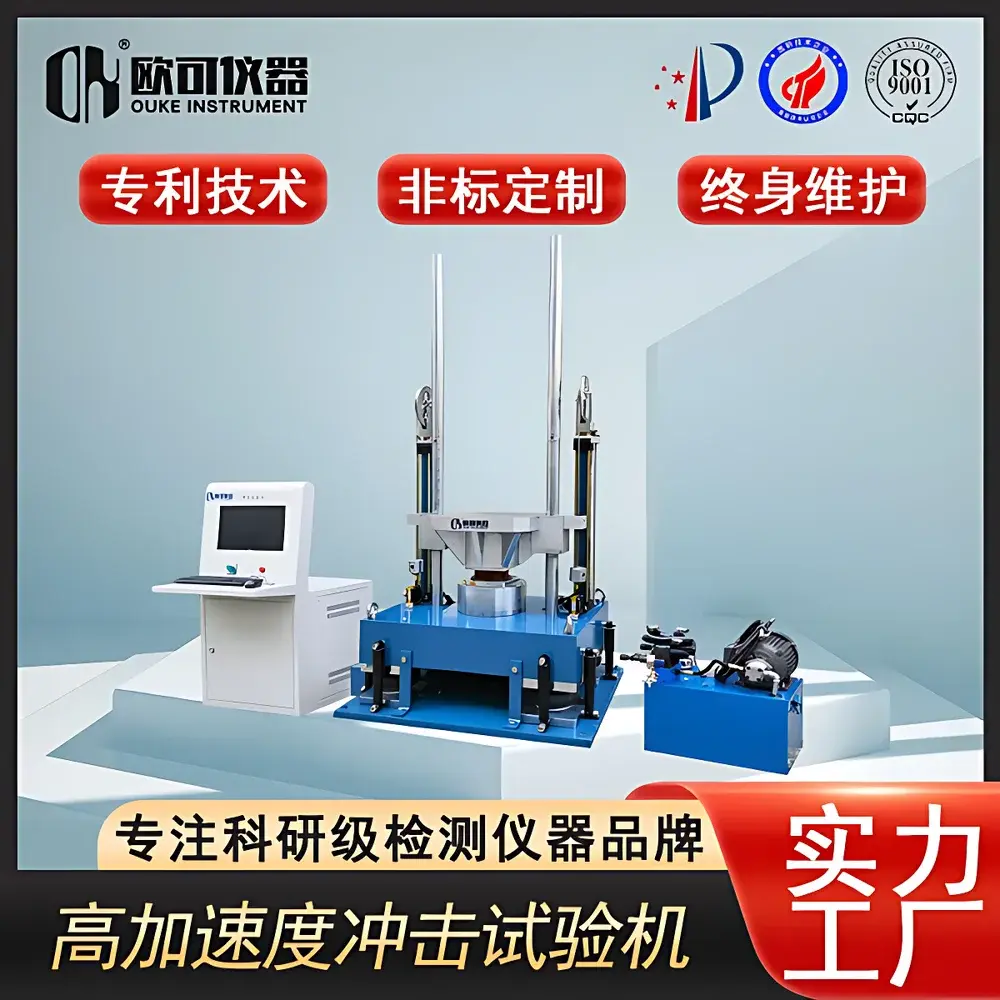
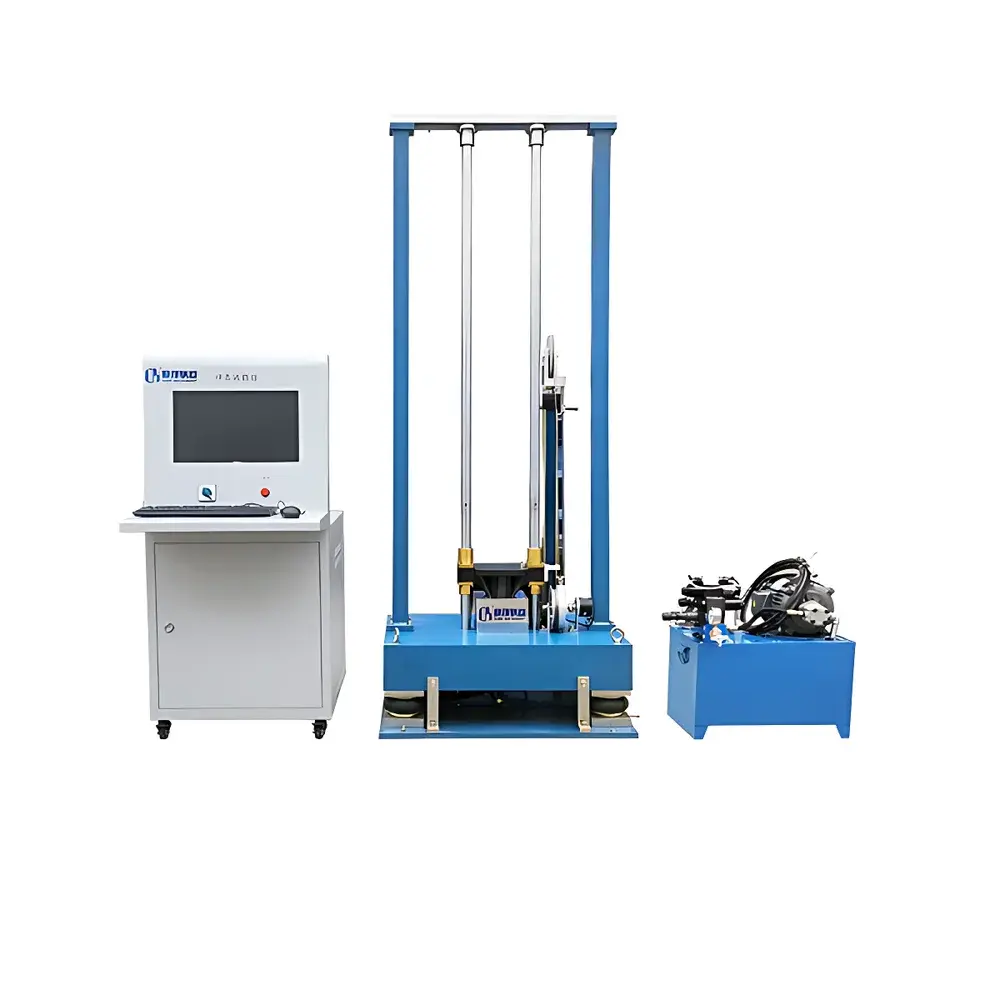
The OK-S-100 Acceleration Shock Test System is a high-fidelity mechanical shock simulation platform engineered for controlled reproduction of transient, high-intensity acceleration environments encountered during transportation, handling, accidental drop events, or operational deployment. It operates on the principle of rapid deceleration—accelerating a rigid test table to a defined velocity and then inducing abrupt stopping or directional reversal via calibrated impact interfaces. This generates reproducible acceleration pulses (measured in g, where 1 g = 9.80665 m/s²) with precisely controllable peak magnitude, pulse duration, and waveform shape. Unlike static or quasi-static testers, the OK-S-100 delivers true dynamic shock loading compliant with fundamental principles of shock physics—including conservation of momentum, energy dissipation through viscoelastic interfaces, and structural response modeling under short-duration, high-slew-rate excitation. Its design targets laboratory-grade repeatability and traceable waveform fidelity, making it suitable for engineering validation, qualification testing, and failure mode analysis across regulated and mission-critical sectors.
Key Features
- Triple-mode actuation architecture: configurable operation in pneumatic-hydraulic impact mode (for semi-sine and terminal-peak sawtooth waveforms), electromagnetic direct-drive mode (enabling programmable multi-pulse and transient waveform synthesis), and free-fall drop mode (for ISTA-compliant packaging impact simulation).
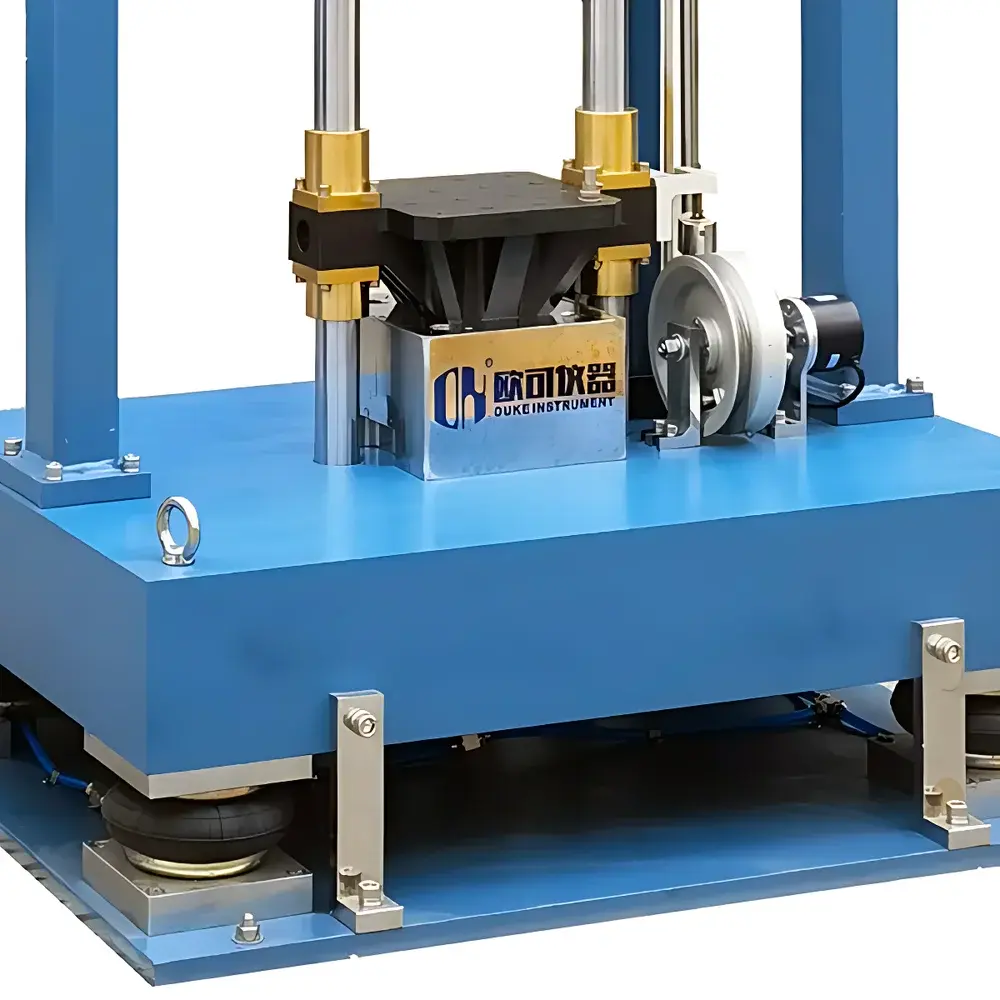
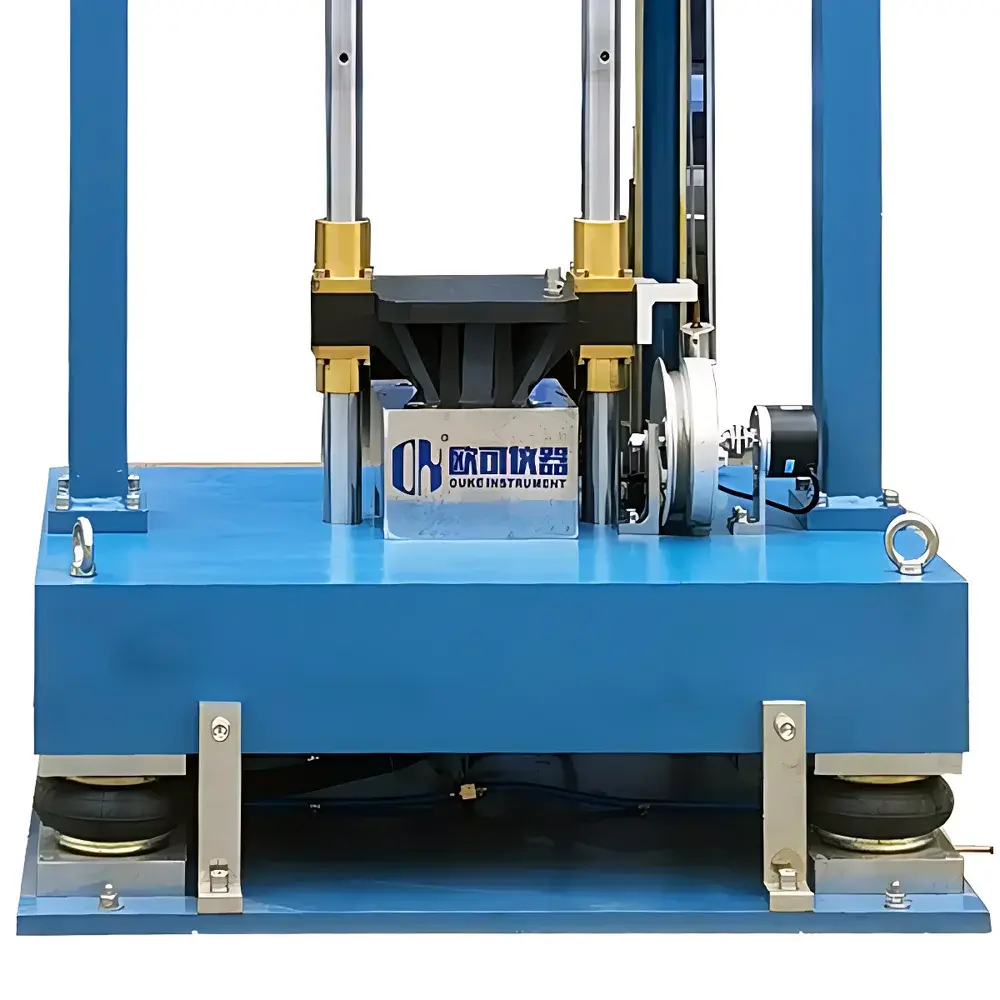
- Integrated waveform shaping system: interchangeable pulse generators—including elastomeric pads (silicone, nitrile rubber), metallic anvil inserts, and graded-density foam stacks—allow physical tuning of rise time, pulse width, and spectral content per IEC 60068-2-27 Annex A requirements.
- High-rigidity monolithic test table (650 mm × 650 mm active surface) constructed from stress-relieved aluminum alloy with T-slot mounting grid (M6/M8), ensuring minimal modal coupling and uniform load transmission across payloads up to 50 kg.
- Dual-channel real-time measurement subsystem: includes MEMS-based ±2000 g triaxial accelerometers mounted directly on the table surface and optional fixture-integrated sensors; synchronized data acquisition at ≥1 MHz sampling rate with onboard anti-aliasing filtering and IEEE 1588 precision time stamping.
- Industrial-grade control unit featuring deterministic real-time OS (VxWorks), touch-enabled HMI, and built-in waveform library supporting MIL-STD-883 Method 2002, JESD22-B104, and ISO 16750-3 profiles.
Sample Compatibility & Compliance
The OK-S-100 accommodates specimens ranging from miniature electronic components (e.g., MEMS sensors, PCB assemblies) to full-system enclosures (e.g., avionics boxes, ruggedized communication terminals). Fixture adaptability supports both bolted-down and clamped configurations, with maximum payload mass limited by dynamic balance constraints rather than static capacity. The system is fully compliant with international shock test standards including IEC 60068-2-27 (Shock), MIL-STD-202G Method 213 (Mechanical Shock), MIL-STD-883K Method 2002 (Shock Testing of Microcircuits), and JESD22-B104 (Board-Level Shock). Optional calibration certificates traceable to NIM (National Institute of Metrology, China) and third-party verification reports (per ISO/IEC 17025) are available upon request. All firmware and control logic adhere to GLP/GMP-relevant audit trail requirements, including user action logging, parameter change history, and electronic signature support for 21 CFR Part 11 compliance readiness.
Software & Data Management
The OK-S-100 is operated via OK-TestSuite™ v4.2—a Windows-based application developed in accordance with IEC 62443-3-3 cybersecurity guidelines. It provides waveform definition using time-amplitude point editing, FFT-based spectral matching, and import of field-acquired shock records (CSV, TDMS, MATLAB .mat formats). Test sequences support conditional looping, pass/fail thresholds based on peak g, velocity change (Δv), and zero-crossing count, and automatic report generation in PDF/XLSX formats with embedded oscillograms and metadata (test date, operator ID, environmental conditions). Raw sensor data is stored in HDF5 format with embedded calibration coefficients and sensor serial numbers, enabling full metrological traceability. Remote monitoring and diagnostic access is supported via secure TLS 1.3 encrypted API endpoints compatible with enterprise LIMS and PLM integration.
Applications
- Electronics reliability: drop testing of smartphones, tablets, and wearables per ISTA 3A; solder joint integrity assessment under repeated shock exposure; connector retention force degradation analysis.
- Automotive electronics: ECU survivability evaluation under road-induced shock spectra; camera module lens alignment stability after bump events; battery pack structural integrity verification during crash simulation pre-test phases.
- Aerospace & defense: qualification of flight-critical avionics against launch-stage pyroshock envelopes; satellite component screening for separation shock per ECSS-Q-ST-70-02C; ruggedized radio housing validation under blast-induced ground shock.
- Packaging engineering: comparative analysis of cushioning materials using half-sine pulses per ASTM D3332; correlation of lab-generated shock signatures with real-world logistics data (e.g., truck vibration-to-shock conversion models).
- Component-level qualification: mechanical endurance testing of relays, switches, and piezoelectric actuators under defined shock histories; fatigue life prediction via Miner’s rule integration with measured strain response.
FAQ
What shock waveforms can the OK-S-100 generate natively?
It supports semi-sine, terminal-peak sawtooth, trapezoidal, and initial-peak sawtooth waveforms per IEC 60068-2-27, with optional electromagnetic module enabling arbitrary waveform replay.
Is the system capable of closed-loop waveform correction?
Yes—when equipped with the optional real-time feedback controller, it performs iterative pulse adjustment using measured vs. target error minimization (least-squares optimization) across up to three consecutive impacts.
Does the OK-S-100 meet FDA or aerospace regulatory documentation requirements?
The system supports 21 CFR Part 11-compliant electronic records and signatures; full IQ/OQ documentation packages and vendor-supplied validation protocols are available for GxP and AS9100 environments.
Can test data be exported for third-party analysis tools like MATLAB or Python?
All raw time-series data is exportable in HDF5, CSV, and TDMS formats, with metadata headers containing sensor calibration IDs, sampling parameters, and environmental timestamps.
What maintenance intervals are recommended for long-term waveform accuracy?
Annual metrological recalibration of load cells and accelerometers is advised; pneumatic/hydraulic system inspection every 500 operating hours; electromagnetic coil thermal cycling verification every 2,000 shocks.



