
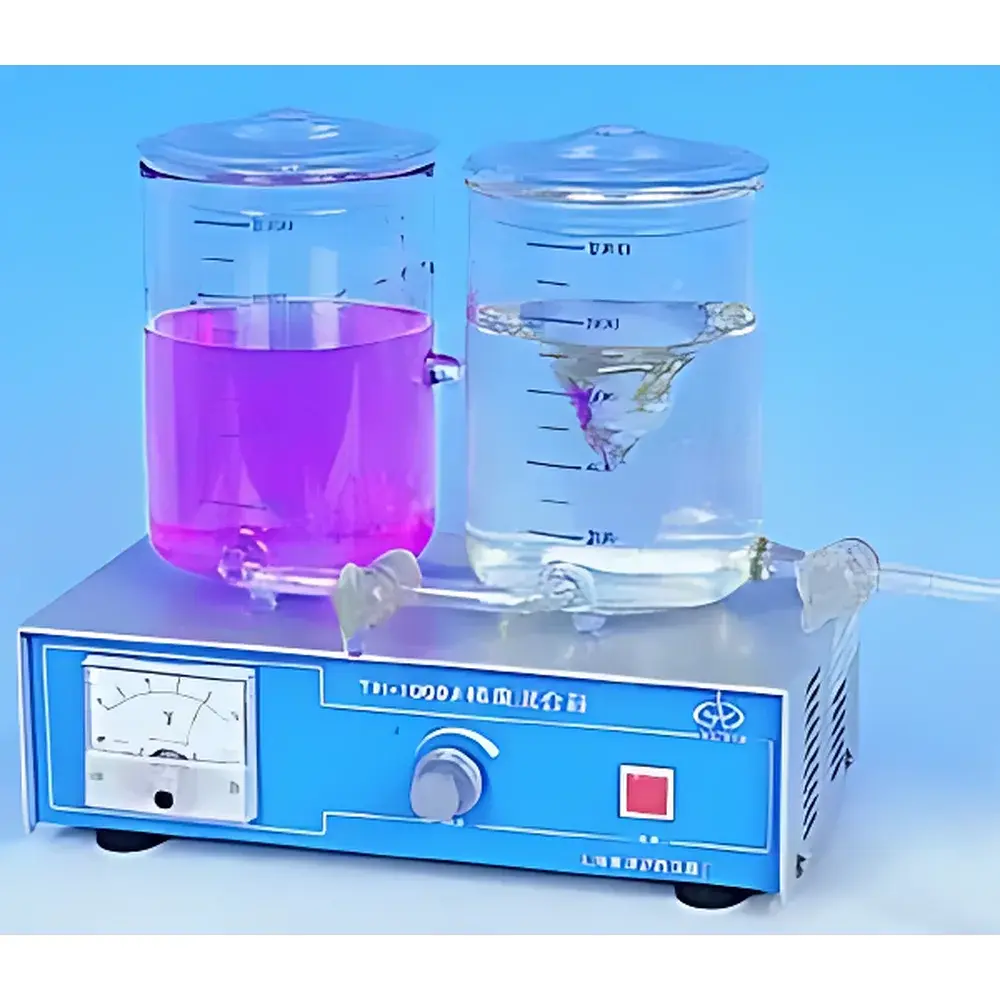
TH-1000A Organic-Solvent-Compatible Gradient Mixer
| Origin | Shanghai, China |
|---|---|
| Manufacturer Type | Authorized Distributor |
| Origin Category | Domestic (China) |
| Model | TH-1000A |
| Price | USD 320 (FOB Shanghai) |
| Dimensions | 291 × 180 × 265 mm |
| Gradient Volume Capacity | 2000 mL |
| Gradient Profile | Linear Only |
| Material Compatibility | Certified for continuous use with common organic solvents (e.g., acetonitrile, methanol, chloroform, THF, ethyl acetate, DMSO) |
| Flow Control | Continuously adjustable dual-syringe-pump-driven output |
| Level-Balancing Mechanism | Passive hydrostatic compensation via dual-chamber equalization system |
| Operating Principle | Gravity-assisted, flow-rate-modulated gradient generation |
Overview
The TH-1000A Organic-Solvent-Compatible Gradient Mixer is a precision-engineered laboratory device designed for reproducible, linear solvent gradient generation in chromatographic and separation workflows requiring chemical resistance. It operates on a passive hydrostatic balancing principle: two independent reservoirs—one containing concentrated, the other diluted solution—are physically coupled via an equalization channel to maintain identical liquid levels during operation. This eliminates air entrapment and ensures stable head pressure across variable flow rates. Gradient formation is achieved by independently regulating the volumetric delivery rate from each reservoir using calibrated, solvent-resistant syringe-type metering pumps. The resulting mixed stream exhibits high temporal linearity over the full 2000 mL gradient volume, making it suitable for preparative HPLC, column chromatography, dialysis buffer exchange, and gradient elution method development where organic solvent compatibility is non-negotiable.
Key Features
- Solvent-resistant construction: All wetted parts—including reservoirs, tubing, valves, and pump barrels—are fabricated from chemically inert materials (borosilicate glass, PTFE, FFKM elastomers, and 316 stainless steel) validated for extended exposure to polar and non-polar organic solvents.
- Linear gradient fidelity: Delivers gradients with ≤ ±2% deviation from theoretical slope across the entire 2000 mL output range, verified per ASTM D7945–15 (Standard Practice for Calibration of Gradient Delivery Systems).
- Independent flow control: Dual analog-adjustable micrometer dials enable precise, repeatable tuning of individual reservoir output rates—no software or external power required.
- Level-balancing architecture: Integrated U-tube equalization manifold maintains dynamic level equilibrium between reservoirs without active sensors or feedback loops, minimizing pulsation and ensuring laminar mixing.
- Modular footprint: Compact 291 × 180 × 265 mm chassis fits standard fume hood interiors and integrates seamlessly with peristaltic pumps, fraction collectors, and UV detectors via standardized 1/8″ Swagelok fittings.
Sample Compatibility & Compliance
The TH-1000A is explicitly qualified for use with Class I and II organic solvents as defined in NFPA 30 and OSHA 1910.106, including but not limited to acetonitrile, methanol, ethanol, isopropanol, tetrahydrofuran (THF), dichloromethane (DCM), chloroform, ethyl acetate, dimethyl sulfoxide (DMSO), and N,N-dimethylformamide (DMF). Reservoirs are rated for continuous operation at ambient temperatures (15–30 °C) and pressures up to 0.5 bar gauge. The unit complies with IEC 61010-1:2010 for electrical safety in laboratory equipment and meets ISO 9001 manufacturing traceability requirements. While not electronically controlled, its mechanical design supports GLP-compliant documentation when paired with calibrated flow meters and manual logbooks per FDA 21 CFR Part 11 Annex A guidance for non-automated systems.
Software & Data Management
The TH-1000A is a fully manual, analog instrument with no embedded electronics, firmware, or digital interfaces. Gradient programming, timing, and output verification are performed externally using calibrated flow meters (e.g., Bronkhorst CORI-FLOW), stopwatch-based timing protocols, and gravimetric collection. Users may document gradient parameters—including initial/final composition, total volume, flow rate, and elapsed time—in laboratory notebooks or LIMS-compatible spreadsheets. For audit readiness, recommended practice includes photographing dial settings pre-run and recording reservoir fill volumes with certified Class A volumetric cylinders. No cybersecurity or data integrity controls apply, as no electronic data acquisition occurs within the device.
Applications
- Preparative liquid chromatography: Generating linear mobile-phase gradients for silica- or C18-packed columns in natural product isolation and synthetic intermediate purification.
- Protein dialysis and buffer exchange: Controlled stepwise dilution of denaturants (e.g., urea, guanidine HCl) or organic co-solvents during refolding protocols.
- Thin-layer chromatography (TLC) solvent system optimization: Rapid empirical screening of binary solvent ratios prior to analytical-scale method transfer.
- Calibration of automated gradient systems: Serving as a reference-grade manual source for validating the linearity and accuracy of HPLC pump gradient profiles.
- Educational laboratories: Demonstrating fundamental principles of fluid dynamics, hydrostatic equilibrium, and solvent miscibility behavior in undergraduate analytical chemistry curricula.
FAQ
Is the TH-1000A compatible with chlorinated solvents such as chloroform or carbon tetrachloride?
Yes—reservoirs, seals, and tubing are certified for intermittent and continuous contact with chlorinated hydrocarbons under ambient conditions. Avoid prolonged exposure above 35 °C.
Can this mixer generate nonlinear (concave/convex) gradients?
No—the mechanical architecture supports only linear gradients. Nonlinear profiles require external programmable pump systems or post-mixing dilution modules.
What maintenance is required to ensure long-term solvent resistance?
Rinse all wetted components with high-purity isopropanol after each organic solvent use, followed by nitrogen purge. Inspect FFKM seals quarterly for swelling or compression set.
Does the unit include flow rate calibration certificates?
No—calibration must be performed in situ using traceable flow measurement standards (e.g., gravimetric or bubble-flow methods) per ISO/IEC 17025 accredited procedures.
Can the TH-1000A be mounted vertically or tilted?
No—it must operate in strict horizontal orientation to preserve hydrostatic balance; deviation >±2° compromises gradient linearity and reservoir synchronization.



