
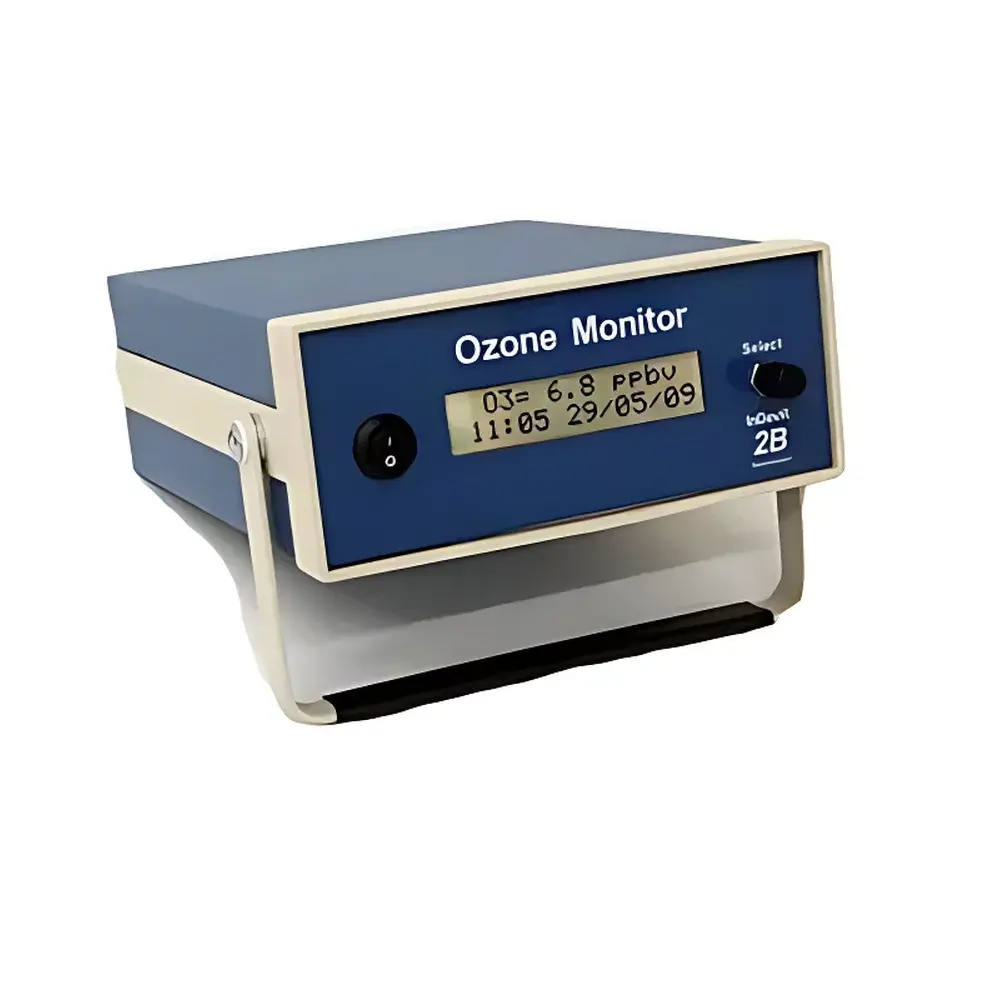
202 Portable Ozone Analyzer
| (Manufacturer | US-based distributor |
|---|---|
| Origin | USA |
| Instrument Type | Portable |
| Model | 202 |
| Detection Principle | UV Absorption at 254 nm |
| Measurement Range | 0 ppb – 250 ppm |
| LOD | 3.0 ppb (critical value) |
| Response Time | 20 s (t₉₀, two-point) |
| Zero Drift | <2 ppb/day, <5 ppb/year |
| Sensitivity Drift | <1%/day, <3%/year |
| Resolution | 0.1 ppb |
| Accuracy | ±1.5 ppb or ±2% of reading (whichever is greater, 10-s mode) |
| Flow Rate | 1.0 L/min (min. required: 0.6 L/min) |
| Data Storage | 16,383 records |
| Operating Temperature | 0–50 °C standard |
| Power | Rechargeable battery or 110/220 V AC adapter |
| Dimensions | 9.5 × 21.5 × 30 cm |
| Weight | 2.8 kg (instrument only), 1.3 kg (carrying case excluded)) |
Overview
The Model 202 Portable Ozone Analyzer is an engineered solution for high-fidelity, field-deployable measurement of ambient and occupational ozone (O₃) concentrations. It operates on the well-established principle of ultraviolet absorption spectroscopy at the characteristic 254 nm wavelength — a method recognized for its selectivity, linearity, and minimal cross-sensitivity to common atmospheric interferents such as NO₂, SO₂, and hydrocarbons. Designed to meet the performance requirements of regulatory-grade monitoring, the instrument delivers trace-level sensitivity with a certified limit of detection (LOD) of 3.0 ppb and a resolution of 0.1 ppb. Its optical path is actively temperature-stabilized and incorporates proprietary water vapor compensation algorithms, eliminating baseline artifacts caused by humidity fluctuations — a critical capability for long-term unattended operation in variable environmental conditions.
Key Features
- Integrated long-life diaphragm sampling pump with regulated flow control (1.0 ± 0.1 L/min), ensuring consistent sample delivery across pressure and temperature gradients
- Onboard data logger with non-volatile memory supporting up to 16,383 timestamped records — configurable averaging intervals (10 s, 1 min, 5 min, 1 hr) optimize storage duration for application-specific duty cycles
- Real-time clock with automatic time/date stamping, compliant with GLP audit-trail requirements for environmental data integrity
- Dual-output interface: RS-232 serial port and analog voltage output (0–2.5 V DC), enabling seamless integration with SCADA systems, dataloggers, and central monitoring platforms
- Multi-unit display support: ppb, ppm, pphm, µg/m³, mg/m³, °C, K, mbar, torr — facilitating direct comparison with regional air quality standards (e.g., EPA, WHO, EU Directive 2008/50/EC)
- Low-power architecture optimized for extended battery operation (typical >12 h continuous use); compatible with external 110/220 V AC power for stationary deployments
- Robust mechanical design: IP54-rated enclosure, shock-absorbing internal mounting, and thermal management enabling reliable operation from –20 °C to +50 °C (with optional low-temperature firmware)
Sample Compatibility & Compliance
The Model 202 is validated for direct analysis of ambient air, indoor air, workplace breathing zones, and process gas streams containing ozone at sub-ppb to ppm levels. Its UV absorption methodology conforms to the physical basis outlined in ISO 13964:1998 (Air quality — Determination of ozone — Ultraviolet photometric method) and aligns with the analytical procedures specified in GB/T 18204.2–2014 (Public place hygiene inspection methods). All factory calibrations are traceable to NIST Standard Reference Materials (SRMs) via documented chain-of-custody protocols. The instrument supports user-performed zero/span verification using certified ozone generators or permeation devices, satisfying routine quality assurance (QA) requirements under ISO/IEC 17025 and EPA Method TO-11A.
Software & Data Management
Data retrieval is performed via USB 2.0 interface using vendor-supplied Windows-compatible software, which provides export functionality in CSV and Excel formats. The software enforces secure session logging, supports batch calibration coefficient updates, and generates PDF-formatted compliance reports including instrument ID, calibration dates, drift verification results, and raw/time-averaged datasets. Audit trails record all configuration changes, calibration events, and firmware updates — meeting documentation requirements for FDA 21 CFR Part 11 (electronic records and signatures) when deployed in regulated pharmaceutical or cleanroom environments.
Applications
- Urban and regional air quality monitoring networks — deployed on mobile platforms, rooftop stations, or temporary ground sites
- Aerospace and upper-atmosphere research — integrated into balloon-borne payloads and UAV-based sensor suites for vertical ozone profiling
- Industrial hygiene assessments — real-time personal exposure monitoring in semiconductor fabrication, water treatment, and disinfection facilities
- Indoor air quality (IAQ) studies in schools, hospitals, and office buildings where ozone-generating equipment (e.g., printers, air purifiers) may contribute to occupant exposure
- Calibration and verification of fixed-site ozone monitors — serving as a transportable reference standard in intercomparison exercises
- Environmental impact assessments for ozone-generating technologies, including UV-C reactors and corona discharge systems
FAQ
Is the Model 202 suitable for continuous unattended operation?
Yes — its low drift specifications (<2 ppb/day zero drift, <1%/day sensitivity stability), internal temperature regulation, and robust data logging enable multi-week deployments without manual intervention.
Does the analyzer require periodic recalibration?
Per ISO 13964 and typical QA protocols, zero and span checks are recommended before each deployment cycle; full calibration is advised every 3–6 months depending on usage intensity and environmental stress.
Can the instrument measure ozone in humid or condensing conditions?
Yes — the optical cell includes active desiccation and algorithmic water vapor correction, maintaining accuracy across 10–95% RH without external dryers or scrubbers.
What certifications does the device hold?
The Model 202 complies with CE marking (EMC Directive 2014/30/EU and RoHS 2011/65/EU). While not intrinsically safe, it is rated for use in non-hazardous locations per IEC 61010-1.
How is NIST traceability documented?
Each unit ships with a Certificate of Calibration listing NIST-traceable ozone concentration values, uncertainty budgets, and reference standard IDs — fully editable in the reporting software for regulatory submission.







