
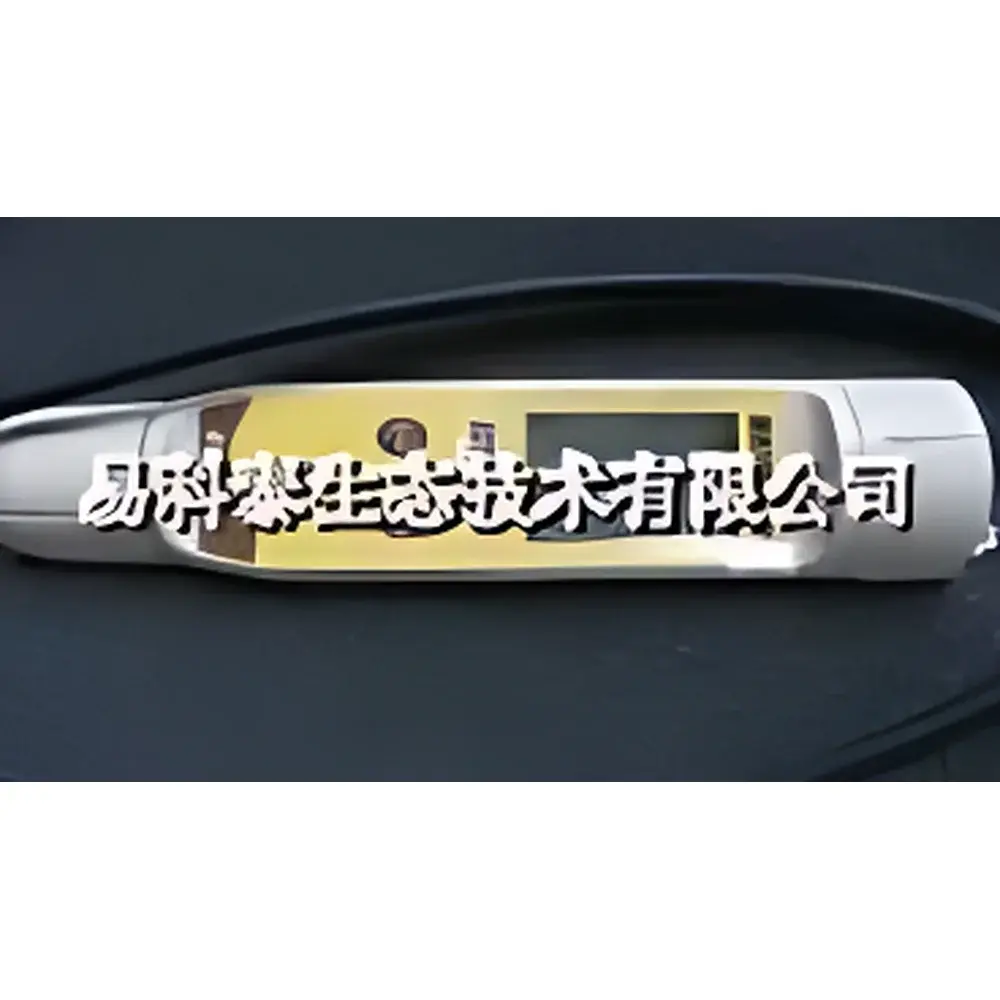
2265FS Portable Salinity Meter
| Origin | USA |
|---|---|
| Manufacturer Type | Authorized Distributor |
| Origin Category | Imported |
| Model | 2265FS |
| Pricing | Available Upon Request |
| Measurement Range | 0–19.99 mS/cm |
| Resolution | 0.01 mS/cm |
| Accuracy | ±2% of reading |
| Probe Length | 20 cm |
| Temperature Compensation | Automatic (ATC), 0–50 °C |
Overview
The 2265FS Portable Salinity Meter is a field-deployable, battery-powered conductivity-based salinity measurement instrument engineered for rapid, on-site assessment of electrical conductivity (EC) in soils, natural waters, irrigation solutions, and organic liquid matrices. Unlike laboratory benchtop systems requiring sample extraction and dilution, the 2265FS employs direct-contact two-electrode conductivity sensing—measuring the conductance of ions (primarily Na⁺, Cl⁻, Ca²⁺, Mg²⁺, and SO₄²⁻) between platinum-coated stainless-steel electrodes embedded in its robust 20 cm probe. The device operates on the principle that EC correlates linearly with total dissolved salts (TDS) under defined ionic strength and temperature conditions, enabling reliable estimation of salinity (reported as dS/m or mS/cm) without gravimetric or titrimetric validation. Its compact architecture, integrated ATC circuitry, and IP67-rated housing make it suitable for unattended operation in high-humidity greenhouses, saline-affected agricultural fields, estuarine monitoring sites, and aquaculture facilities.
Key Features
- Automatic Temperature Compensation (ATC) across 0–50 °C using a built-in NTC thermistor, minimizing thermal drift and ensuring consistent EC readings across diurnal field conditions.
- Field-optimized two-electrode probe with 20 cm insertion length—designed for direct soil penetration and minimal disturbance to matrix structure during in-situ measurement.
- IP67-rated waterproof enclosure and sealed probe junction, certified for immersion up to 1 meter for 30 minutes—enabling reliable use in rain, dew, or flooded furrows.
- High-resolution LCD display with backlight for low-light conditions; intuitive single-button interface requiring no menu navigation or calibration mode toggling.
- Battery-powered operation (4 × AA alkaline, included) supporting >200 hours of continuous use; auto-power-off after 10 minutes of inactivity to conserve energy.
- Factory-calibrated with traceable KCl standard (1.413 mS/cm at 25 °C); optional user recalibration via supplied 1413 µS/cm and 12.88 mS/cm reference solutions.
Sample Compatibility & Compliance
The 2265FS is validated for direct measurement in saturated paste extracts, moist mineral soils (clay to sandy loam), freshwater and brackish surface water (0–20 ppt salinity), hydroponic nutrient reservoirs, and ethanol-free organic solvents (e.g., glycerol–water mixtures). It complies with ASTM D512-20 (Standard Test Method for Chloride Ion in Water) and ISO 11265:2020 (Soil quality — Determination of electrical conductivity) for field-screening applications. While not intended for GLP-regulated final reporting, its ±2% accuracy meets USDA-NRCS Field Handbook Tier 2 requirements for salinity mapping and FAO Irrigation and Drainage Paper No. 56 screening thresholds. Calibration traceability follows NIST SRM guidelines, and all accessories—including probe, carrying case, and reference standards—bear CE and RoHS markings.
Software & Data Management
The 2265FS operates as a standalone instrument with no Bluetooth, USB, or cloud connectivity. All measurements are displayed in real time and retained only in volatile memory—no internal data logging or export capability is provided. This design prioritizes operational simplicity, electromagnetic immunity in agronomic environments (e.g., near irrigation pumps or RF-emitting telemetry units), and long-term reliability under thermal cycling. For traceable recordkeeping, users are advised to manually log values alongside GPS coordinates and sampling depth using standardized field notebooks compliant with ISO/IEC 17025 documentation practices. Optional third-party mobile apps (e.g., AgriLog™, FarmOS-compatible EC modules) may be used to digitize entries post-measurement, though no proprietary software or drivers are bundled.
Applications
- Rapid salinity screening in greenhouse substrate management—identifying EC hotspots exceeding 2.0 dS/m threshold for sensitive ornamental crops.
- Pre-irrigation soil EC profiling in arid-zone agriculture to assess leaching requirement and prevent Na⁺ accumulation.
- Monitoring of drainage water quality from tile-drained fields to comply with regional nitrate–salinity co-regulation frameworks (e.g., EU Nitrates Directive Annex II).
- Baseline EC mapping in coastal restoration projects where porewater conductivity indicates seawater intrusion extent.
- Quality control of recirculating aquaculture system (RAS) intake water, ensuring conductivity remains within species-specific tolerance bands (e.g., < 5 mS/cm for tilapia).
FAQ
Does the 2265FS measure sodium concentration directly?
No—it measures bulk electrical conductivity, which serves as a surrogate for total ion concentration. Sodium-specific quantification requires ion-selective electrode (ISE) or ICP-OES analysis.
Can the probe be used in muddy or clay-rich soils without clogging?
Yes—the smooth, tapered 20 cm probe geometry and non-porous electrode surface resist particle adhesion; rinse with deionized water after each use to maintain repeatability.
Is calibration required before every field session?
Calibration is recommended daily when operating across >10 °C ambient shifts or after exposure to high-salinity media (>15 mS/cm); otherwise, weekly verification suffices per ASTM D512 protocol.
What is the warranty coverage and service support structure?
The instrument carries a 24-month limited warranty covering materials and workmanship; technical support and certified recalibration services are available through authorized North American and EMEA distribution partners.
How does ATC affect accuracy in frozen or high-temperature soils?
ATC is functional only between 0–50 °C; measurements below freezing or above 50 °C require manual correction using published temperature coefficient tables (β = 1.88%/°C for 25 °C reference).





