
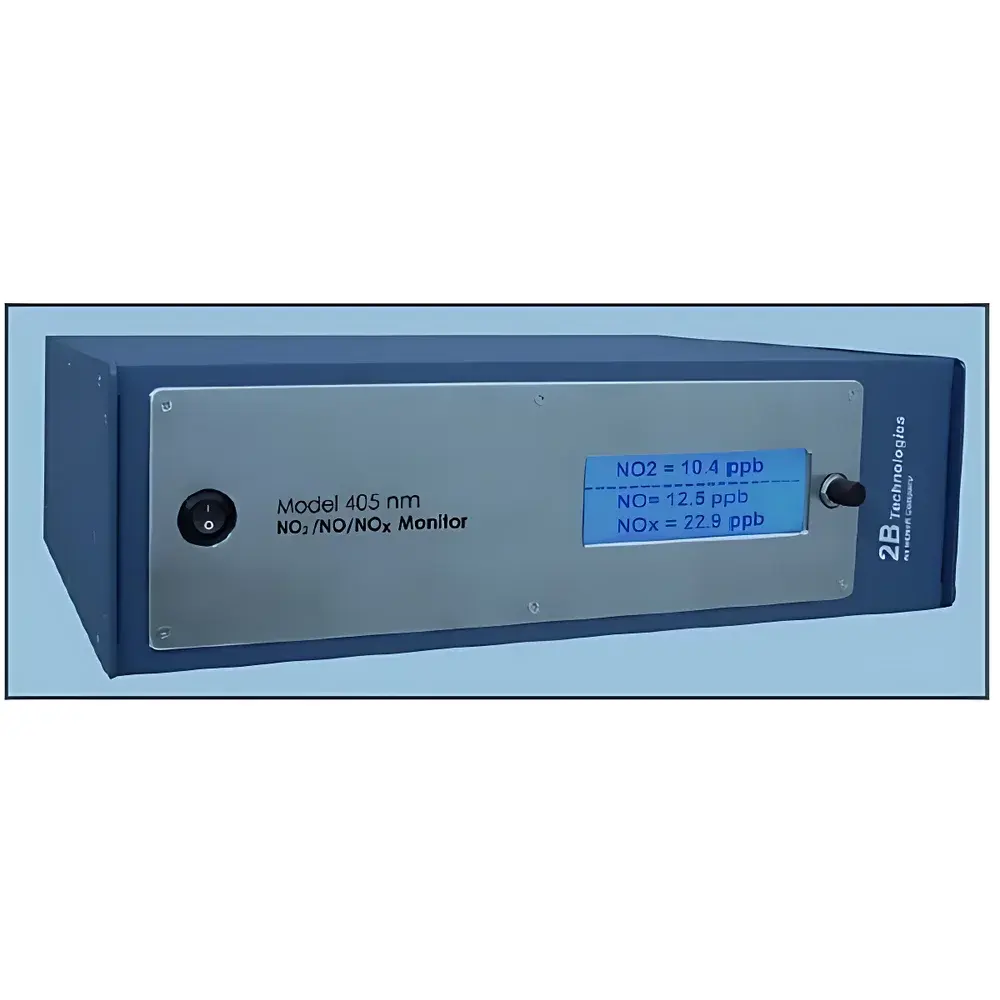
2B Tech Model 405 nm NO₂/NO/NOₓ Analyzer
| Brand | 2B Technologies |
|---|---|
| Origin | USA |
| Model | Model 405 nm |
| Detection Principle | Direct UV-Vis Absorption at 405 nm |
| Measurement Range (NO₂) | 2 ppb – 10 ppm |
| Measurement Range (NO & NOₓ) | 2 ppb – 2 ppm |
| Resolution | 0.1 ppb |
| Accuracy | ±2 ppb or ±2% of reading |
| LOD (2σ) | 4.0 ppb |
| Flow Rate | ~3 L/min |
| Response Time (100% step) | 20 s (10-s averaging) |
| Operating Temperature | 10–50 °C |
| Power | 11–14 VDC or 120/240 VAC, 24 W |
| Dimensions | 43 × 37 × 14 cm |
| Weight | 8.5 kg |
| Data Outputs | USB, RS-232, 0–2.5 V analog, optional 4–20 mA |
| Internal Memory | 16,333 records |
| DewLine™ Humidity Compensation | Yes |
| Pump Lifetime | 20,000 hours |
Overview
The 2B Tech Model 405 nm NO₂/NO/NOₓ Analyzer is a field-deployable, dual-channel optical gas analyzer engineered for high-fidelity, real-time quantification of nitrogen dioxide (NO₂), nitric oxide (NO), and total reactive nitrogen oxides (NOₓ = NO + NO₂) in ambient air. Unlike conventional chemiluminescence-based analyzers that rely on catalytic (e.g., molybdenum) or photolytic converters to transform NO₂ into NO—introducing conversion inefficiencies, hysteresis, and calibration drift—the Model 405 employs direct absorption spectroscopy at 405 nm, a wavelength selected for its exceptional selectivity toward NO₂ in the tropospheric matrix. At this spectral region, NO₂ exhibits a well-characterized absorption cross-section (~1.5 × 10⁻¹⁹ cm²/molecule), while co-occurring atmospheric species—including O₃, H₂O, SO₂, VOCs, and aerosols—show negligible absorbance. To achieve sub-ppb sensitivity despite NO₂’s relatively low extinction coefficient, the instrument integrates a miniature White cell with an effective optical path length of approximately 2 meters. This design enables detection limits comparable to those of high-performance ozone analyzers operating under identical optical principles. The analyzer operates continuously in one of four configurable modes: dedicated NO₂, dedicated NO, dedicated NOₓ, or alternating NO/NO₂ measurement (with 10-second cycle intervals), supporting both regulatory monitoring and process-level research applications.
Key Features
- Direct, interference-free NO₂ measurement via 405 nm UV-Vis absorption—eliminates reliance on conversion efficiency and associated uncertainties
- Integrated NO quantification via ozone-mediated chemiluminescent conversion (NO + O₃ → NO₂ + O₂), implemented within the same optical path without external reactors
- DewLine™ humidity compensation using Nafion® membrane dryers to stabilize refractive index and prevent water vapor-induced baseline drift
- On-board flow control with integrated mass flow sensor and precision diaphragm pump (rated for 20,000 hours MTBF)
- Configurable averaging intervals (10 s, 1 min, 5 min, 1 hr) and user-defined output scaling for analog and digital interfaces
- Robust environmental tolerance: operational from 10–50 °C and 30–1000 mbar (equivalent to sea level to ~30 km altitude)
- Comprehensive data logging: 16,333 records internally; expandable via USB flash drive for long-term unattended deployment
Sample Compatibility & Compliance
The Model 405 is validated for continuous sampling of ambient outdoor air, urban background air, and indoor environments with minimal particulate loading ( 0.9999 over full scale) support use in GLP-compliant environmental studies and QA/QC verification protocols. The instrument’s analog and digital outputs are compatible with SCADA systems and data acquisition platforms compliant with IEC 61000-4 electromagnetic immunity standards.
Software & Data Management
Data acquisition and configuration are managed via the 2B Tech PC-based Control Software (v3.x), which supports real-time telemetry, remote firmware updates, and automated calibration scheduling. All measurements include embedded timestamping, pressure and temperature metadata, and raw photodetector voltage traces. The internal memory logs time-stamped concentration values with full audit trail—enabling retrospective validation of instrument stability and environmental corrections. USB and RS-232 serial outputs support ASCII-formatted streaming at user-selectable baud rates (2400–19200 bps). Analog outputs (0–2.5 V DC, scalable) and optional 4–20 mA current loops permit integration into legacy industrial control systems. For regulated environments, the software architecture supports manual log export and does not implement FDA 21 CFR Part 11 electronic signature functionality; however, raw data files are immutable and timestamped, satisfying basic ALCOA+ (Attributable, Legible, Contemporaneous, Original, Accurate) requirements for scientific recordkeeping.
Applications
- Ambient air quality monitoring networks (EPA Core Site, EMEP, GAW)
- Mobile platform deployments (vehicle-mounted, drone-carried, balloon-borne)
- Indoor air quality assessments in schools, hospitals, and transit hubs
- Source emission characterization near traffic corridors, power plants, and industrial stacks
- Field validation of satellite-derived NO₂ column retrievals (e.g., TROPOMI, OMI)
- Atmospheric chemistry studies requiring simultaneous NO and NO₂ kinetics under variable humidity conditions
FAQ
How does the Model 405 differ from chemiluminescence NOx analyzers?
It eliminates catalytic or photolytic NO₂-to-NO conversion, measuring NO₂ directly via optical absorption—thereby avoiding conversion inefficiency, memory effects, and ozone interference.
Does the instrument require external ozone generation for NO measurement?
Yes—integrated ozone generation is provided via a solid-state UV lamp and oxygen-permeable membrane; no external O₃ source is needed.
Can the Model 405 operate unattended for extended periods?
Yes—its low power draw (24 W), internal battery option, and USB-flash expandable storage enable multi-week autonomous operation in remote locations.
Is humidity correction applied in real time?
Yes—DewLine™ uses Nafion®-based humidity equilibration upstream of the optical cell to maintain constant refractive index and minimize scattering artifacts.
What calibration standards are recommended?
NIST-traceable NO₂ permeation tubes or dynamic dilution systems calibrated against primary standard gases; zero air must be hydrocarbon-free and NOₓ-free.
Related Products







