
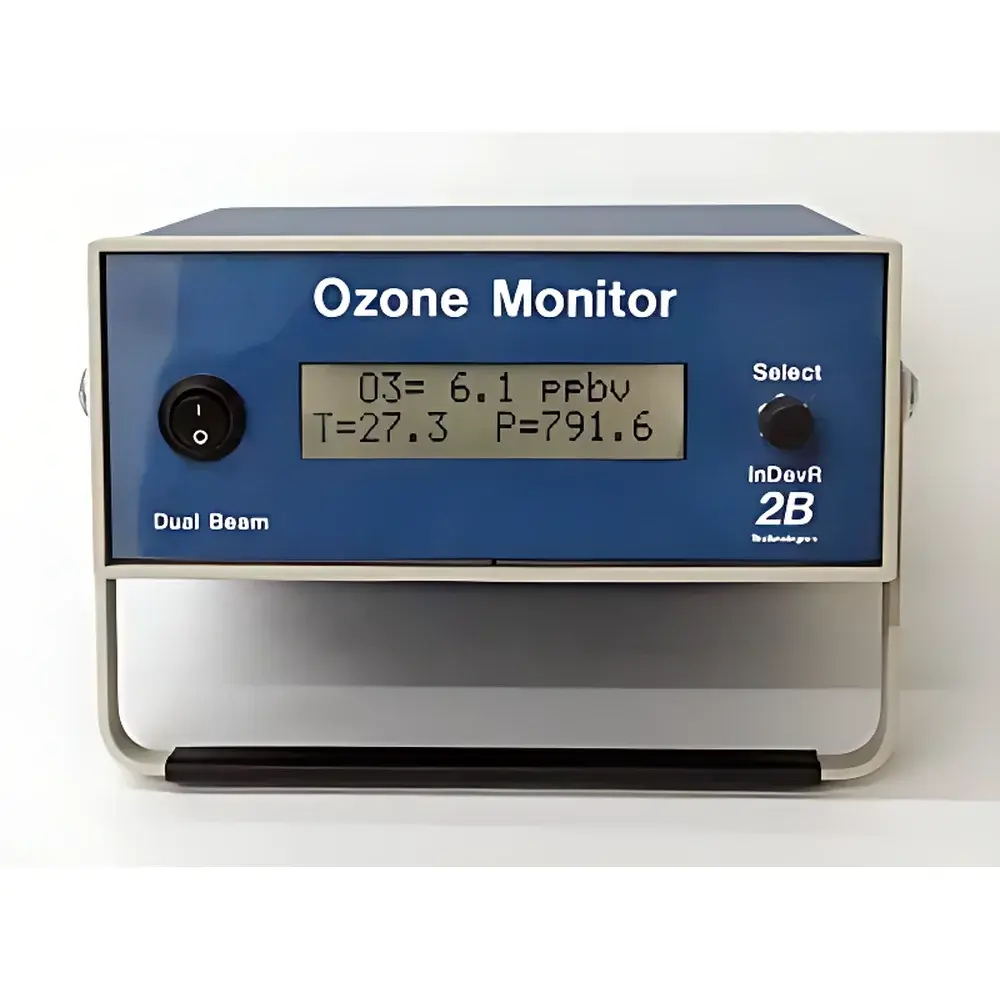
2B Technologies Model 205 Dual-Channel Ozone Analyzer
| Brand | 2B Technologies |
|---|---|
| Origin | USA |
| Model | 205 |
| Measurement Principle | UV Absorption at 254 nm |
| Linear Range | 1 ppbv to 100 ppmv |
| Precision | ±1 ppb or ±2% of reading (whichever is greater) |
| Accuracy | ±1 ppb or ±2% of reading (whichever is greater) |
| Detection Limit | 2 ppb |
| Measurement Interval | 2 s (configurable averaging: 2 s, 10 s, 1 min, 5 min, 1 hr) |
| Response Time (100% step change) | 4 s (2-point) |
| Sample Flow Rate | ~1.8 L/min (nominal), >1.2 L/min (minimum required) |
| Baseline Drift | <1 ppb/day, <3 ppb/year |
| Sensitivity Drift | <1 ppb/day, <3 ppb/year |
| Temperature & Pressure Compensation | Yes |
| Operating Temperature | 0–50 °C (–20–50 °C with optional low-temperature modification kit) |
| Operating Altitude | 0–30 km (30–1000 mbar) |
| Output Units | ppb, ppm, pphm, µg·m⁻³, mg·m⁻³ |
| Data Storage Capacity | 14,336 rows (e.g., 1.4 days at 10-s average |
| Communication Interfaces | RS232 serial, 0–2.5 V analog output, LCD display |
| Dimensions | 9 × 21 × 29 cm |
| Weight | 2.1 kg (instrument only |
| Optional Accessories | GPS module, microSD card, DewLine™ heater lamp, rotary vane pump, external pump, calibration kit |
Overview
The 2B Technologies Model 205 Dual-Channel Ozone Analyzer is a field-deployable, research-grade instrument engineered for high-fidelity, real-time measurement of ambient ozone (O3) concentration using dual-beam ultraviolet absorption photometry at 254 nm. Unlike single-beam systems susceptible to lamp intensity drift and optical contamination, the Model 205 implements a true differential measurement architecture: one optical path samples ambient air (I), while the second simultaneously measures air from which ozone has been catalytically scrubbed (I0). The logarithmic ratio ln(I0/I) yields ozone concentration independent of lamp aging, window fouling, or detector sensitivity fluctuations—ensuring long-term stability without routine zero/span recalibration. Designed for unattended operation in diverse environmental regimes—from urban monitoring networks and remote mountaintop observatories to airborne platforms and mobile laboratories—the analyzer complies with EPA EQOA-0110-188 reference method equivalency criteria and supports traceable calibration per ISO 13964 and ASTM D5012.
Key Features
- Dual-channel UV absorption architecture with real-time differential signal processing for enhanced baseline stability and reduced sensitivity drift
- Integrated DewLine™ water vapor compensation system—actively heated optical path and catalytic dryer minimize humidity-induced spectral interference without desiccant replacement
- Onboard EEPROM data logger storing up to 14,336 measurement records with user-selectable averaging intervals (2 s, 10 s, 1 min, 5 min, 1 hr)
- Configurable analog output (0–2.5 V DC) accepting external sensor inputs (temperature, pressure, relative humidity) for on-the-fly environmental correction
- Self-monitoring flow control: backup sampling pump and precision mass flow meter automatically compensate for inlet pressure drops or filter clogging to maintain nominal 1.8 L/min flow
- Ruggedized chassis (9 × 21 × 29 cm, 2.1 kg) rated for continuous operation across 0–50 °C; optional low-temperature kit extends functionality to –20 °C via heated lamp and rotary vane pump
Sample Compatibility & Compliance
The Model 205 is validated for direct analysis of ambient air, stack emissions (diluted), and indoor air matrices. Its optical design inherently rejects interferences from common atmospheric constituents including NO2, SO2, and VOCs due to the narrow-band 254 nm mercury line source and high-resolution detection. The instrument meets the performance specifications outlined in U.S. EPA Reference Method EQOA-0110-188 for ozone analyzers and is compatible with regulatory data acquisition protocols under 40 CFR Part 58. All firmware and data handling routines support audit-trail generation and time-stamped metadata logging—enabling compliance with GLP and ISO/IEC 17025 quality management requirements. Calibration traceability is maintained through NIST-traceable ozone generators (e.g., 2B Technologies Model 306) and documented uncertainty budgets per ISO/IEC 17025 Clause 7.6.3.
Software & Data Management
Data export occurs via RS232 serial interface (ASCII protocol) or buffered analog voltage output synchronized with internal clock. The included Ozone Analyst software (Windows-compatible) enables real-time visualization, remote configuration, firmware updates, and batch download of stored records. Each logged entry includes timestamp (UTC), raw absorbance values, calculated O3 concentration, temperature/pressure-corrected value, flow rate, lamp intensity, and diagnostic flags. MicroSD card expansion (optional) supports extended autonomous deployment. All data files conform to CF-1.6 netCDF conventions for interoperability with atmospheric modeling frameworks (e.g., WRF-Chem, CAMx) and comply with FAIR (Findable, Accessible, Interoperable, Reusable) data principles. Firmware versions ≥3.2.1 implement secure boot and cryptographic signature verification to satisfy cybersecurity requirements for federally funded monitoring infrastructure.
Applications
- Ambient air quality monitoring networks (AQS, EEA, national reference stations)
- Photochemical smog studies and ozone production efficiency quantification
- Indoor air quality assessment in healthcare facilities, schools, and cleanrooms
- Validation of satellite-derived tropospheric ozone products (e.g., TROPOMI, OMPS)
- Mobile platform deployments (ground vehicles, UAVs, light aircraft) with altitude-compensated algorithms
- Calibration transfer standards for secondary ozone monitors and diffusion tube validation
FAQ
What is the primary measurement principle used by the Model 205?
It employs dual-beam ultraviolet absorption photometry at 254 nm, measuring the differential attenuation between an ozone-scrubbed reference channel and an ambient sample channel.
Does the instrument require daily zero/span calibration?
No—its differential architecture and DewLine™ humidity control enable stable operation with calibration verification recommended every 7–14 days under typical field conditions.
Can the Model 205 operate at high altitude or low pressure?
Yes—it is explicitly rated for operation from sea level to 30 km (30–1000 mbar) with automatic pressure compensation applied to all concentration calculations.
Is the data output compliant with EPA data reporting formats?
Yes—ASCII output conforms to AQS Data Handling System (DHS) ingestion specifications, and netCDF exports align with EPA’s AirNow-Tech and AIRPACT data exchange protocols.
How is humidity interference mitigated without consumable desiccants?
The DewLine™ system combines active heating of the optical cell (to >40 °C) with a catalytic ozone scrubber that also decomposes water vapor, eliminating condensation and spectral overlap artifacts.







