
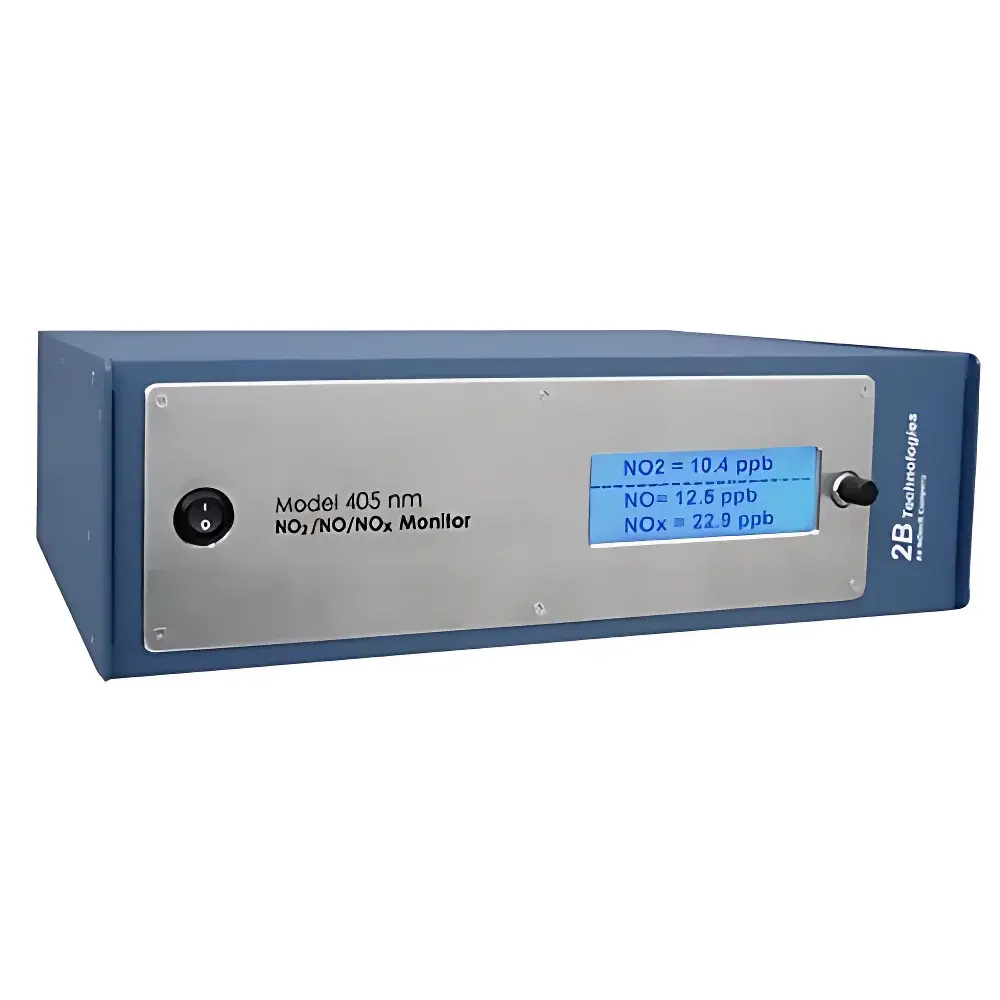
2B Technologies Model 405 UV-Photometric NO₂/NO/NOₓ Analyzer
| Brand | 2B Technologies |
|---|---|
| Origin | USA |
| Model | 405 |
| Detection Principle | UV Absorption Spectroscopy at 405 nm |
| Measurement Range | 0–10,000 ppb NO₂ |
| Resolution | 0.1 ppb |
| Accuracy | ±2.5 ppb or ±2.5% of reading (whichever is greater) |
| Detection Limit (2σ) | 3.5 ppb (60 s avg) |
| Response Time (100%) | 40 s (20 s avg) |
| Operating Temperature | 10–50 °C |
| Power Supply | 11–14 V DC or 100–240 V AC, 26 W |
| Dimensions | 43 × 37 × 14 cm (17″ × 14.5″ × 5.5″) |
| Weight | 8.4 kg (18.6 lb) |
| Data Output | USB, RS-232, 0–2.5 V analog, 4–20 mA analog |
| Internal Memory | 8,192 records |
Overview
The 2B Technologies Model 405 UV-photometric NO₂/NO/NOₓ Analyzer is a field-deployable, research-grade gas monitor engineered for high-fidelity, real-time quantification of nitrogen dioxide (NO₂), nitric oxide (NO), and total reactive nitrogen oxides (NOₓ = NO + NO₂) in ambient air. Unlike chemiluminescence-based instruments that rely on catalytic or photolytic conversion of NO₂ to NO—introducing variable and often unquantifiable conversion efficiencies—the Model 405 employs direct ultraviolet absorption spectroscopy at 405 nm, a wavelength selected for its exceptional molecular specificity to NO₂. At this spectral band, NO₂ exhibits a well-characterized absorption cross-section, while atmospheric interferents—including O₃, SO₂, H₂O, VOCs, and particulate matter—show negligible absorption. This enables interference-free, absolute concentration measurement traceable to fundamental spectroscopic constants. NO is quantified via ozone chemiluminescence-free conversion: sample air is spiked with precisely metered O₃, converting NO stoichiometrically to NO₂ (NO + O₃ → NO₂ + O₂); the resulting incremental absorbance at 405 nm is directly proportional to NO concentration. NOₓ is derived arithmetically as the sum of simultaneously resolved NO and NO₂ signals. The optical path employs a miniature White cell delivering an effective 2-meter absorption length, compensating for NO₂’s relatively low molar absorptivity and achieving detection sensitivity comparable to modern ozone analyzers.
Key Features
- Direct, calibration-free NO₂ measurement via UV absorption at 405 nm—eliminates reliance on unstable catalytic converters or photolysis lamps.
- Integrated, high-efficiency ozone generator and precise flow-controlled O₃ addition system for quantitative NO conversion without chemiluminescence electronics.
- Dual-beam optical design with active humidity compensation using Nafion® perfluorosulfonic acid membrane tubing—minimizes refractive index artifacts from water vapor across 0–100% RH.
- Automated, valve-switched NO₂ scrubber (e.g., sodium thiosulfate or carbon-based) enabling differential absorbance measurements (I vs. I₀) for robust baseline correction and drift rejection.
- Configurable measurement modes: continuous NO₂-only, continuous NO-only, or alternating NO/NO₂/NOₓ cycling every 20 seconds—optimized for regulatory compliance monitoring or process emission studies.
- Onboard temperature and pressure sensors with automatic compensation; supports user-defined correction algorithms compliant with EPA Method 205 and ISO 11095.
- Long-life diaphragm pump rated for 15,000 hours; integrated mass flow sensor with thermal compensation ensures stable 3.0 ± 0.1 L/min sampling across altitude changes up to 30 km (1000–30 mbar).
Sample Compatibility & Compliance
The Model 405 is validated for use with ambient air, stack effluents (with appropriate dilution and conditioning), and indoor air environments. Its measurement methodology conforms to the physical principles underpinning U.S. EPA Reference Method EQOA-001 (for NO₂) and aligns with performance criteria outlined in EN 14211:2012 (ambient air quality—specifications for automated measuring systems for NO₂). While not certified as a Federal Equivalent Method (FEM), its precision, accuracy, and stability meet or exceed requirements for supplemental monitoring under 40 CFR Part 58 Appendix A. The instrument operates within GLP-compliant data integrity frameworks: all raw absorbance values, timestamped valve states, O₃ injection events, and environmental metadata are logged with microsecond resolution. Audit trails support 21 CFR Part 11-compliant deployments when paired with 2B’s optional secure firmware and encrypted SD card logging.
Software & Data Management
Data acquisition and configuration are managed via 2B’s proprietary PC-based software (Windows/macOS/Linux compatible), supporting real-time visualization, remote parameter adjustment, and export in CSV, NetCDF, or EPA-compatible .dat formats. Internal memory stores 8,192 rows of time-stamped, multi-parameter records—including NO, NO₂, NOₓ, T, P, flow rate, scrubber status, and diagnostic flags—with configurable averaging intervals (20 s, 1 min, 5 min, 1 hr). Optional Bluetooth 5.0 module enables secure, low-power wireless telemetry to local gateways or cloud platforms (e.g., AWS IoT Core, Azure IoT Hub) using MQTT or HTTP(S) protocols. All analog outputs (0–2.5 V, 4–20 mA) are fully scalable via user-defined slope/offset coefficients in the instrument menu, facilitating integration into SCADA, DCS, or environmental management systems without external signal conditioning.
Applications
- Ambient air quality monitoring networks (AQS, EEA, national reference stations)
- Mobile platform deployments (vehicles, UAVs, tethered balloons) for spatial mapping of NOₓ hotspots
- Indoor air quality assessment in urban buildings, schools, and transit hubs
- Process emissions verification at combustion sources (power plants, industrial boilers, marine engines)
- Atmospheric chemistry research—e.g., NOₓ photochemical lifetime studies, ozone production efficiency analysis, and model validation campaigns (e.g., NASA ATom, NOAA SENEX)
- Calibration transfer standard for field validation of lower-cost metal oxide or electrochemical NOₓ sensors
FAQ
Does the Model 405 require daily calibration gases?
No. It operates on first-principles UV absorption and does not rely on span/zero gas standards for routine operation. Periodic verification using certified NO₂ permeation tubes or dynamic dilution systems is recommended per ISO/IEC 17025 every 3–6 months.
Can it measure NO₂ in high-humidity environments such as rainforests or coastal zones?
Yes. The Nafion™ humidity equalization system actively balances moisture content between sample and reference beams, eliminating refractive index drift—even at 95% RH and 40 °C.
What is the impact of particulate matter on optical path integrity?
An integrated 2.5 µm particle filter upstream of the White cell prevents aerosol deposition. Field tests show no measurable signal degradation after 6 months of continuous operation in PM₂.₅ concentrations exceeding 100 µg/m³.
Is the instrument suitable for unattended, solar-powered remote sites?
Yes. Its 26 W power draw, wide-input DC capability (11–14 V), and low-voltage alarm threshold enable seamless integration with battery banks and charge controllers. Average current draw at 12 V is 2.2 A.
How is data security ensured during wireless transmission?
Bluetooth pairing uses AES-128 encryption; firmware updates require signed binaries; SD card logs are write-protected by hardware switch and support FAT32/exFAT with optional full-disk encryption.







