
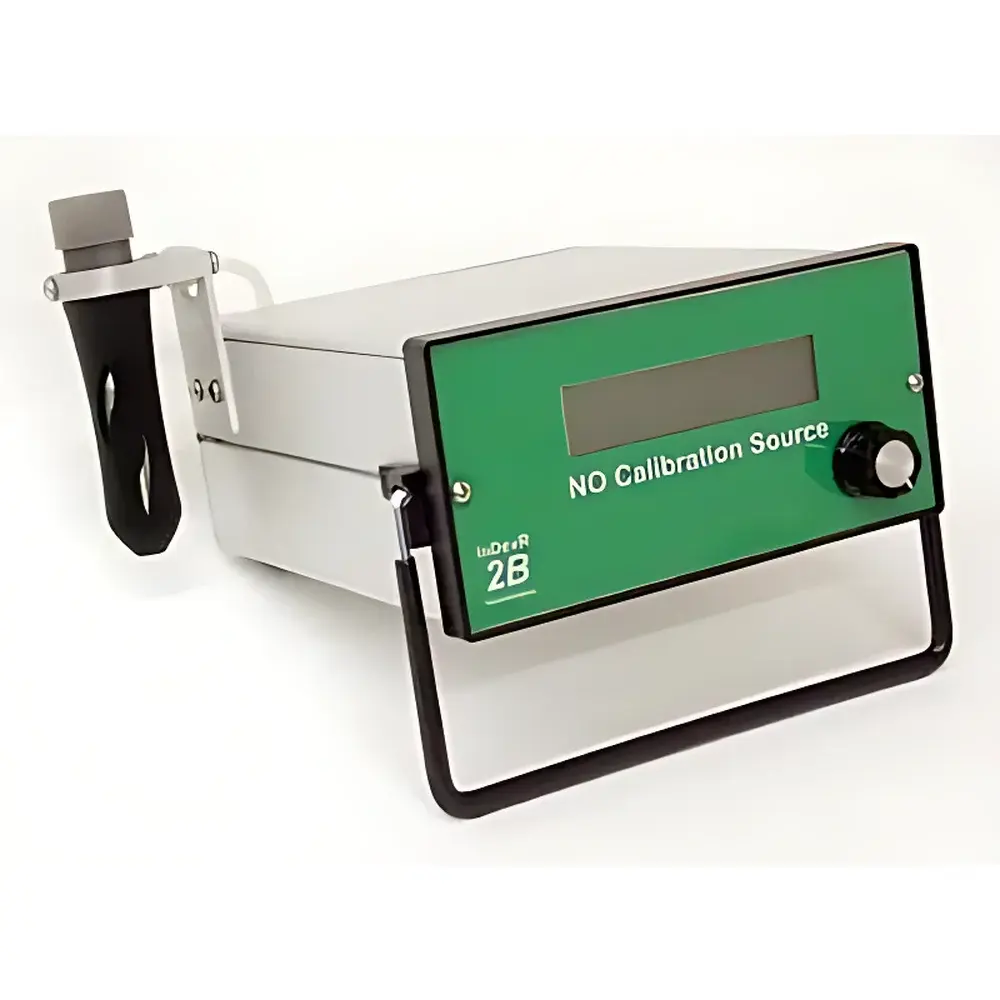
2B Technologies Model 408 Nitric Oxide (NO) Calibration Generator
| Brand | 2B Technologies |
|---|---|
| Origin | USA |
| Model | 408 |
| NO Generation Method | Photolytic decomposition of N₂O at 185 nm |
| Output Concentration Range | 0 and 10–1000 ppb |
| Accuracy | ±3 ppb or ±3% of reading (whichever is greater) |
| Flow Rate | ~3.0 L/min |
| Rise Time | <30 s (to 95% of setpoint) |
| Operating Temperature | 0–40 °C |
| Power Supply | 12 V DC or 120/240 V AC, 21 W |
| Dimensions | 9.4 × 21.6 × 24.1 cm |
| Weight | 2.4 kg |
| Diagnostic Interface | RS-232 |
| Humidity-Matched Output | Yes |
| NIST-Traceable Calibration | Yes |
Overview
The 2B Technologies Model 408 Nitric Oxide (NO) Calibration Generator is a field-deployable, photolytically driven calibration source engineered for traceable, stable, and humidity-matched NO gas generation in ambient air monitoring applications. Unlike permeation-based or gas-cylinder-dependent calibrators, the Model 408 employs vacuum ultraviolet (VUV) photolysis of nitrous oxide (N₂O) at 185 nm to quantitatively generate NO in synthetic air or ambient intake air. This principle ensures stoichiometric NO production without chemical contaminants or memory effects. The instrument delivers calibrated NO concentrations from 0 (true zero air) to 1000 ppb in discrete or programmable steps—up to ten user-defined concentration levels—with automatic timing intervals. Its integrated mass flow control and pressure-compensated photolysis chamber maintain output stability across variable environmental conditions (temperature, humidity, barometric pressure), eliminating the need for external correction algorithms during field calibration.
Key Features
- Photolytic NO generation via 185 nm UV lamp and high-purity N₂O precursor—no consumable gases, no catalytic degradation, no ozone interference.
- Humidity-matched output: Introduces NO directly into ambient intake air, preserving sample matrix water vapor content—critical for calibrating chemiluminescence detectors (CLD) and electrochemical sensors where humidity affects response linearity.
- NIST-traceable calibration architecture: Factory-calibrated against primary standards; users may reconfigure calibration coefficients to align with local reference protocols (e.g., EPA EQOA-001, ISO 12039).
- Programmable multi-level calibration sequences: Define up to 10 NO concentration steps with adjustable dwell times (1–9999 seconds per step) via intuitive front-panel menu or RS-232 command protocol.
- Robust environmental compensation: Real-time pressure and temperature sensing enable dynamic adjustment of lamp intensity and flow splitting to maintain concentration accuracy within ±3 ppb or ±3% (whichever is greater) across 0–40 °C and typical ambient RH ranges.
- Compact, battery-compatible design: 2.4 kg mass and 9.4 × 21.6 × 24.1 cm footprint support vehicle-mounted, tripod-based, or handheld deployment; dual-power capability (12 V DC / 120–240 V AC) enables unattended operation in remote sites.
Sample Compatibility & Compliance
The Model 408 is compatible with all commercially available NO analyzers utilizing chemiluminescence detection (CLD), electrochemical (EC), metal oxide semiconductor (MOS), or laser absorption (TDLAS) principles. Its 3.0 L/min total flow rate permits direct connection to analyzer inlets without external dilution—excess flow exits via built-in vent port, maintaining laminar delivery. The device meets design requirements for EPA Traceability Protocol for Gaseous Calibration Standards (EPA-600/R-12/517) and supports GLP-compliant calibration logging when paired with compliant data acquisition systems. All internal wetted materials (stainless steel, fused silica, PTFE) comply with ASTM D5012 for inertness and low adsorption. No hazardous waste generation occurs during normal operation—N₂O consumption is minimal (~10 mL/min at full output), and photolysis byproducts (N₂, O₂) are atmospheric constituents.
Software & Data Management
Calibration sequences, setpoints, and diagnostic logs are configurable via ASCII-based RS-232 serial interface (9600 baud, N-8-1). The instrument outputs real-time status parameters—including lamp voltage, chamber pressure, temperature, flow rate, and photolysis efficiency diagnostics—enabling integration into SCADA or laboratory information management systems (LIMS). Firmware supports timestamped event logging (power-on, sequence start/end, error codes) with optional external clock synchronization. While no proprietary software is required, 2B Technologies provides open-command documentation and Python/C++ API examples for automated QA/QC workflows. Audit trails satisfy FDA 21 CFR Part 11 requirements when used with validated third-party data capture platforms supporting electronic signatures and change control.
Applications
- Field calibration and verification of regulatory-grade NO monitors deployed in EPA SLAMS, EEA AirBase, or national AQMS networks.
- Multi-point linearity validation of CLD analyzers prior to regulatory compliance audits (e.g., 40 CFR Part 58 Appendix A).
- Mobile platform calibration (e.g., van-mounted, drone-carried, or aircraft-integrated NO sensors) where cylinder logistics are impractical.
- Research-grade intercomparison studies requiring humidity-matched, dynamically programmable NO standards (e.g., photochemical modeling campaigns, emission plume characterization).
- Long-term unattended calibration at remote background stations—validated for continuous operation >30 days with periodic N₂O refill (standard 500 mL cylinder lasts ~120 hours at 500 ppb output).
FAQ
How does the Model 408 achieve humidity-matched NO output?
It draws ambient air through the inlet, conditions it thermally and hygroscopically within the flow path, then injects photolytically generated NO directly into that same airstream—preserving native water vapor content without drying or rehumidification.
Is N₂O handling subject to regulatory restrictions?
N₂O is non-toxic and non-flammable at working pressures (<100 kPa); however, users must comply with local occupational exposure limits (e.g., OSHA PEL: 25 ppm TWA) and store cylinders upright with pressure relief valves. No DOT shipping restrictions apply to standard 500 mL lecture-bottle formats.
Can the Model 408 be used to calibrate NO₂ analyzers?
No—it generates only NO. For NO₂ calibration, a separate thermal converter (e.g., 2B Technologies Model 405) must be placed downstream to oxidize NO to NO₂, with appropriate residence time and temperature control per ISO 7935.
What maintenance is required for long-term field deployment?
UV lamp replacement every 6,000 operating hours; N₂O filter replacement every 6 months or after 500 refills; quarterly verification of flow sensor calibration using a NIST-traceable rotameter or thermal mass flowmeter.
Does the instrument support remote firmware updates?
Firmware upgrades require physical RS-232 connection and verified checksum files provided by 2B Technologies under technical support agreement; no over-the-air (OTA) update capability is implemented for security and regulatory integrity reasons.
Related Products







