
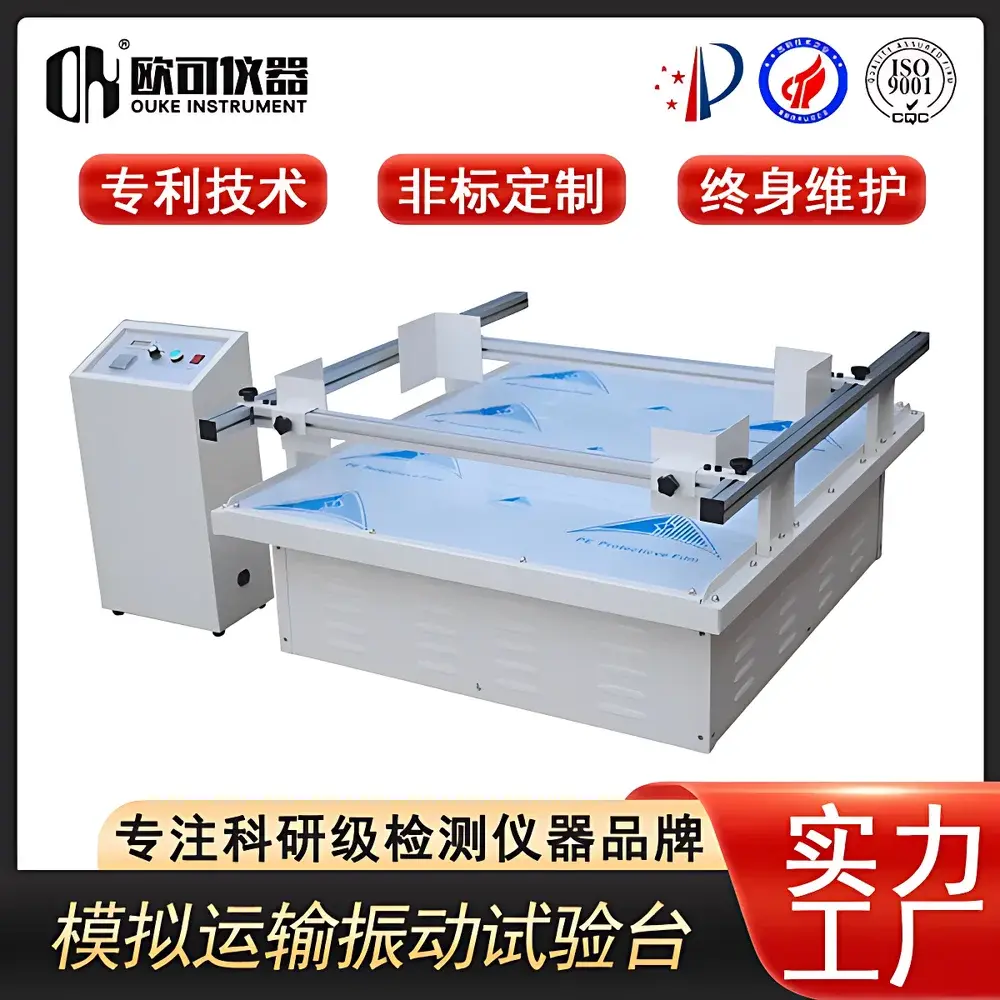
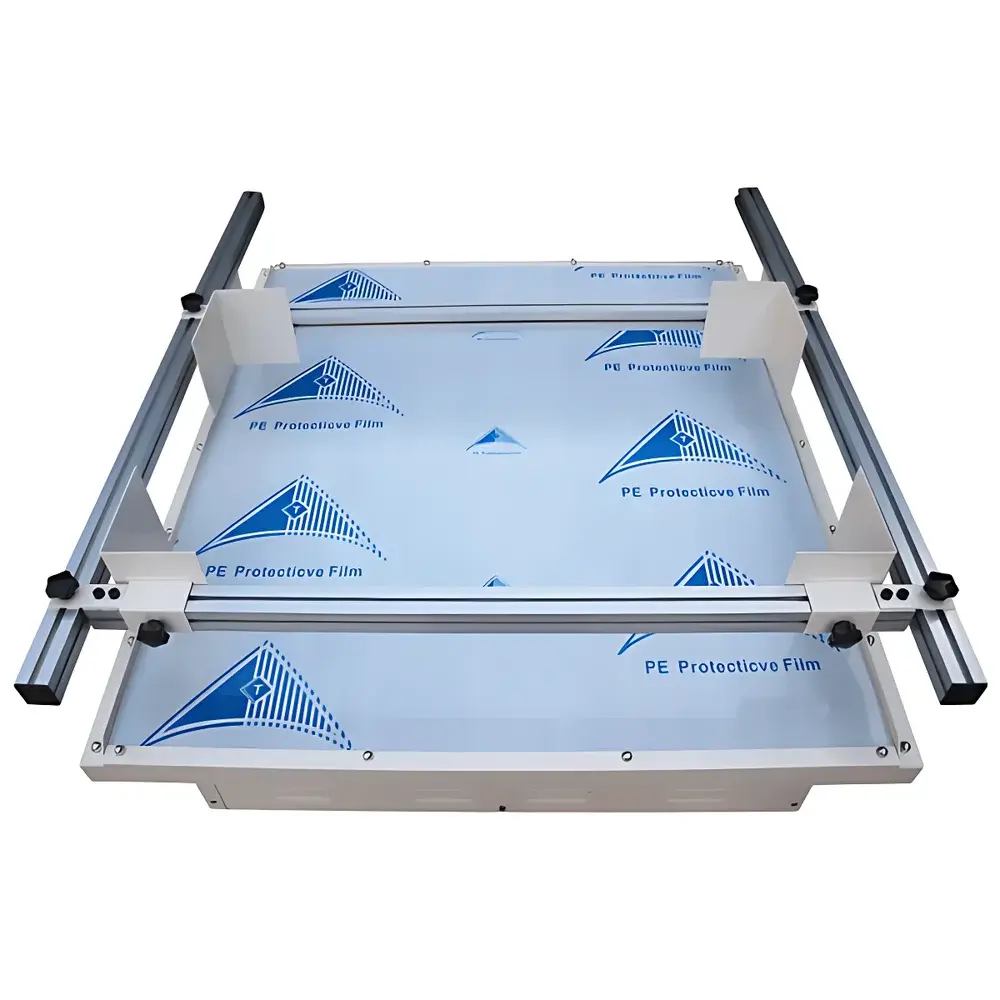
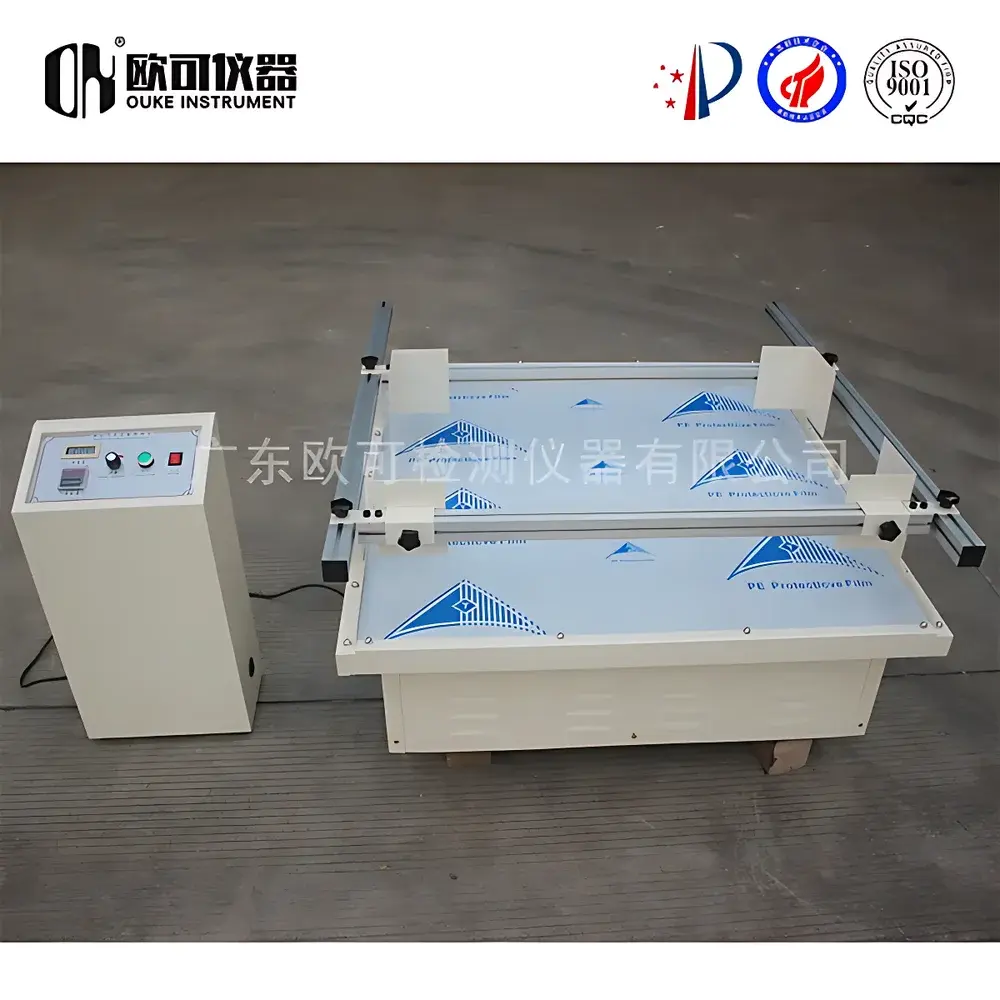
OK-300 Electromagnetic Transport Simulation Vibration Shaker
| Brand | OK Instruments |
|---|---|
| Origin | Guangdong, China |
| Manufacturer Type | Direct Manufacturer |
| Product Category | Domestic |
| Model | OK-300 |
| Instrument Type | Automotive Transport Simulation Test System |
| Rated Thrust | 1.98 kN |
| Rated Frequency Range | 5–5000 Hz |
| Maximum Test Load | 70 kg |
| Table Surface Dimensions | 1300 × 1200 mm |
| Peak Acceleration Capacity | 10 g |
Overview
The OK-300 Electromagnetic Transport Simulation Vibration Shaker is a high-fidelity electrodynamic vibration testing system engineered for laboratory-based replication of real-world transportation environments. It operates on the principle of Lorentz force actuation: a moving coil suspended within a high-intensity magnetic field generates controlled inertial forces when driven by precisely regulated alternating current. This enables faithful reproduction of complex mechanical excitations—including sinusoidal, random, and transient shock waveforms—encountered during road, rail, air, and maritime logistics. Unlike mechanically driven shakers limited to fixed-frequency sine motion, the OK-300 delivers broadband dynamic excitation across 5–5000 Hz with closed-loop acceleration feedback, making it suitable for both compliance-driven transport validation (e.g., ISTA, ASTM D4728, ISO 13355) and early-stage structural reliability assessment.
Key Features
- Electrodynamic actuation architecture with neodymium magnet array and water-cooled voice coil for thermal stability under sustained high-g operation
- Rated thrust of 1.98 kN ensures robust performance up to 10 g peak acceleration with 70 kg total payload (including fixture and test article)
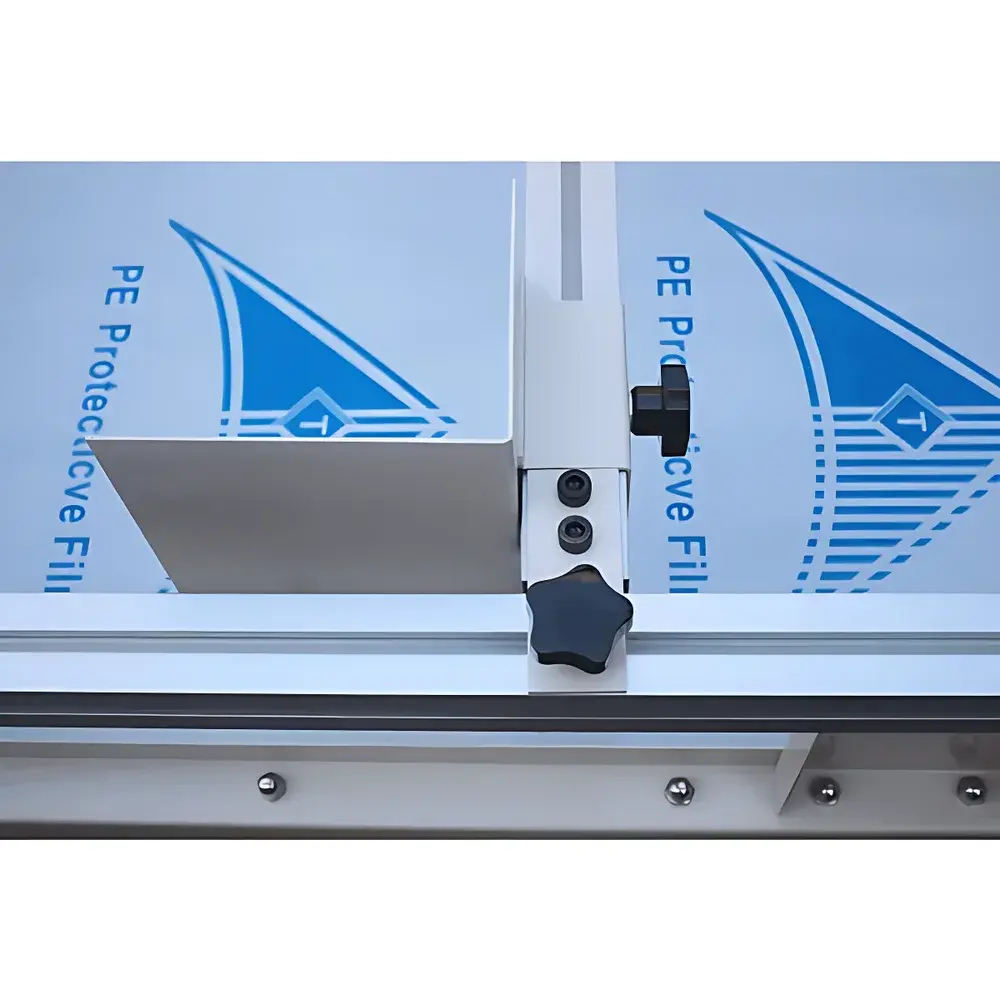
- Large horizontal table surface (1300 × 1200 mm) accommodates full-size shipping containers, palletized assemblies, or multi-unit consumer electronics packaging
- Wide frequency bandwidth (5–5000 Hz) supports resonance search, fatigue screening, and PSD-based random vibration profiles aligned with real-world road spectra
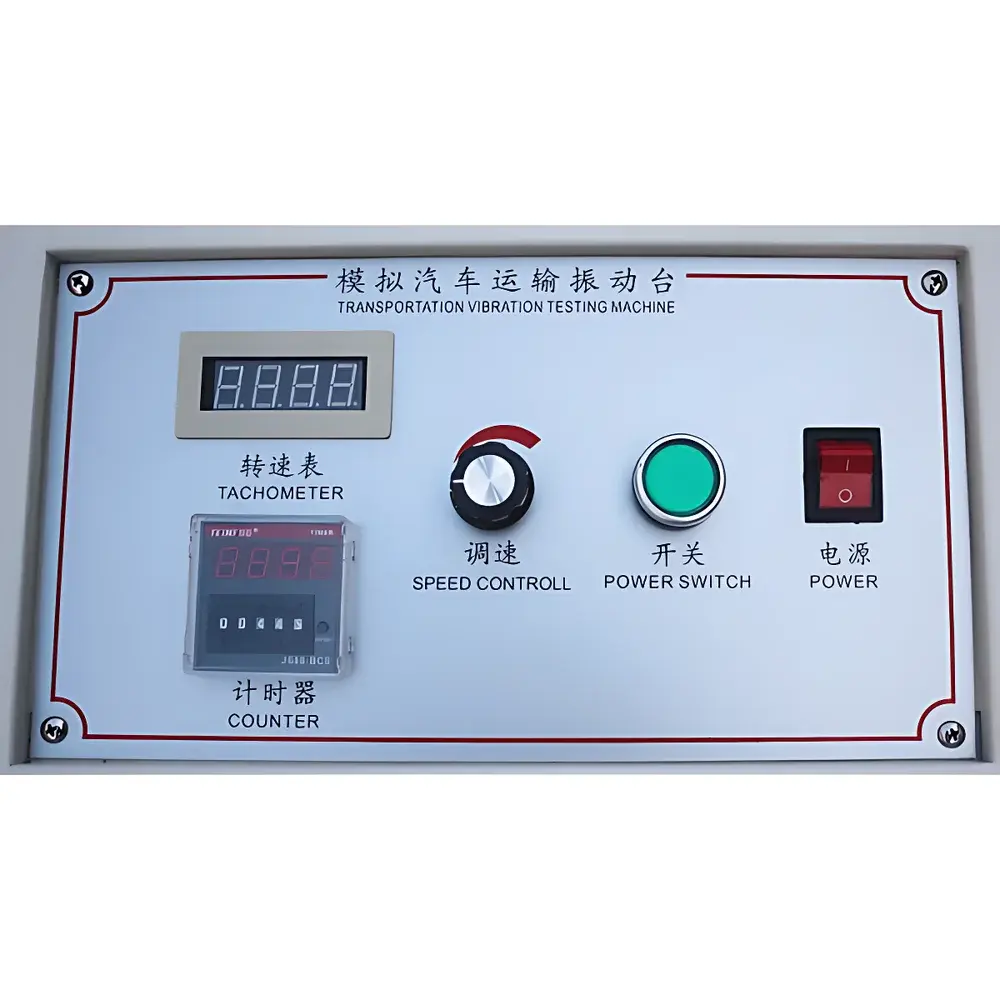
- Integrated digital controller with real-time FFT analysis, waveform synthesis capability, and programmable test sequencing (sine sweep, dwell, random PSD, classical shock)
- Compliant with electromagnetic compatibility standards (IEC 61000-6-4, IEC 61000-6-2) and designed for long-term repeatability in GLP-aligned test environments
Sample Compatibility & Compliance
The OK-300 is validated for testing packaged goods, assembled subsystems, and finished products across diverse weight classes and dimensional footprints. Its load capacity and table geometry support standard shipping configurations per ISTA 3A, 3E, and 3H protocols, as well as ASTM D999 (vibration testing of packaged-products), ASTM D4728 (random vibration testing), and GB/T 4857.7 (Chinese national standard for transport simulation). The system’s closed-loop control architecture meets traceability requirements for ISO/IEC 17025-accredited laboratories, and its data logging interface supports audit-ready records compliant with FDA 21 CFR Part 11 when paired with validated software modules.
Software & Data Management
The OK-300 integrates with OK-VibControl™ — a Windows-based test management platform supporting import of industry-standard vibration spectra (e.g., MIL-STD-810H Annex G road profiles, ISO 2041-defined PSDs), real-time spectrum editing, and automated pass/fail evaluation against user-defined thresholds. All test parameters, sensor calibration metadata, raw acceleration time histories, and FFT-derived response spectra are timestamped and stored in HDF5 format for interoperability with MATLAB, Python (SciPy), or LabVIEW. Audit trails include operator ID, session start/stop timestamps, firmware version, and hardware configuration logs—enabling full traceability for internal quality audits or regulatory submissions.
Applications
- Package integrity validation: quantifying compression creep, corner crush, and internal component displacement under simulated transit vibration
- Structural resonance mapping: identifying natural frequencies and mode shapes of enclosures, PCB mounts, and interconnect systems via swept-sine excitation
- Electronic assembly robustness: detecting solder joint fatigue, connector fretting, or MEMS sensor drift under prolonged random vibration exposure
- Automotive Tier-1 supplier qualification: verifying durability of infotainment units, ADAS sensors, and lighting modules per OEM-specific vibration specifications (e.g., GMW14872, Ford CETP)
- Medical device transport certification: ensuring functional continuity and mechanical integrity of portable diagnostics and infusion pumps per ISO 11607-2 and AAMI TIR47
- Industrial equipment pre-shipment verification: validating valve actuator retention, bearing preload stability, and housing seam integrity after simulated freight handling
FAQ
What standards does the OK-300 support out-of-the-box?
The system includes preloaded test templates for ISTA 2A, ISTA 3A, ASTM D999, ASTM D4728, ISO 13355, and GB/T 4857.7. Custom PSD profiles can be imported via CSV or SDF formats.
Can the OK-300 perform shock testing?
Yes—it supports classical shock waveforms including half-sine, trapezoidal, and terminal-peak sawtooth, with programmable pulse duration and peak acceleration up to 10 g.
Is remote monitoring and control possible?
The controller features Ethernet (TCP/IP) and RS-485 interfaces, enabling integration into factory-wide MES/QMS platforms and secure remote supervision via TLS-encrypted connections.
What maintenance is required for long-term accuracy?
Annual recalibration of the integrated triaxial accelerometer and power amplifier gain verification are recommended; the water-cooling system requires biannual coolant replacement and filter inspection.
How is test repeatability ensured across multiple operators?
All test sequences are saved as encrypted .vibproj files containing embedded calibration coefficients, sensor mounting positions, and fixture mass compensation values—eliminating setup-dependent variability.
Related Products



