
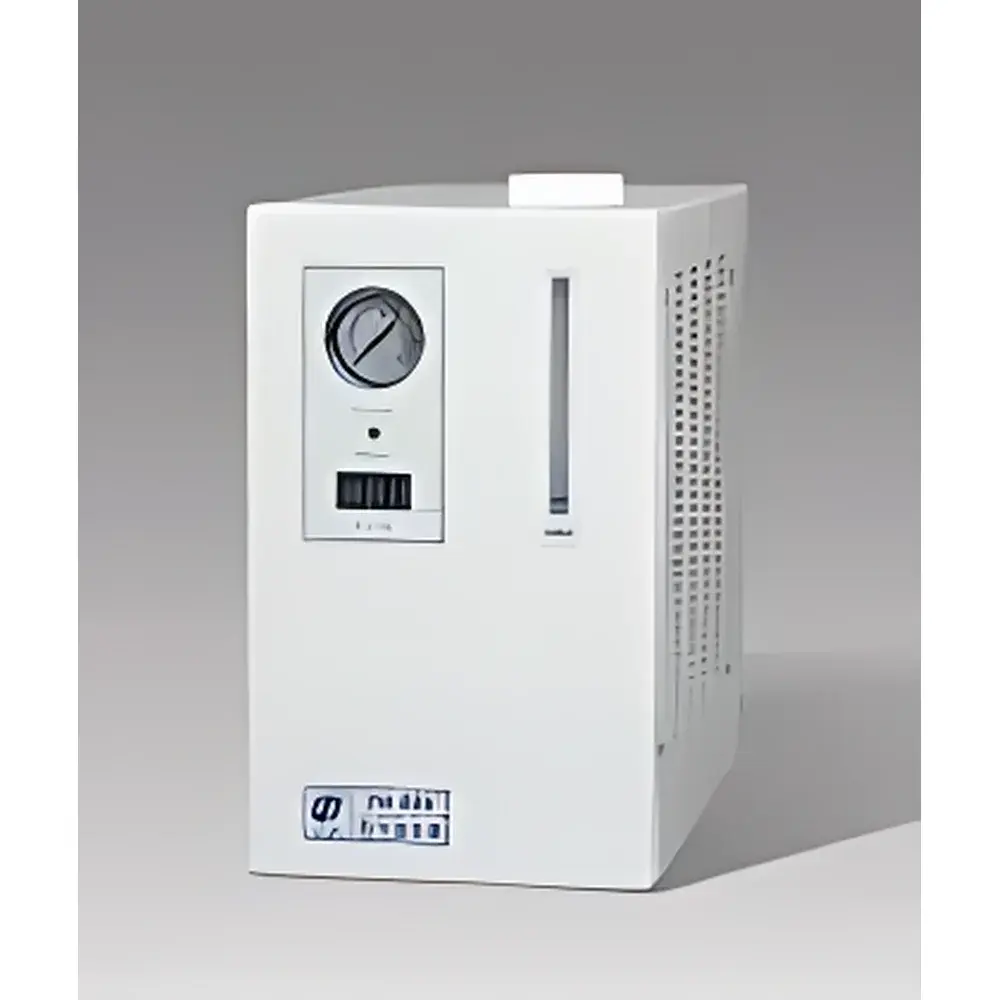
TH-300 Pure-Water-Based High-Purity Hydrogen Generator
| Origin | Beijing, China |
|---|---|
| Manufacturer Type | Authorized Distributor |
| Origin Category | Domestic (PRC) |
| Model | TH-300 |
| Pricing | Available Upon Request |
| Hydrogen Purity | 99.999% |
| Flow Rate | 0–300 mL/min |
| Output Pressure | 0–0.4 MPa |
| Pressure Stability | < 0.001 MPa |
| Power Supply | 220 V ±10%, 50 Hz |
| Power Consumption | 150 W |
| Dimensions (W×D×H) | 400 × 360 × 220 mm |
| Net Weight | ~14 kg |
| Electrolyte Technology | Solid Polymer Electrolyte (SPE) |
| Water Feed | Deionized/Distilled Water Only |
| Internal Sealing | Low-Sulfur Silicone Rubber Gaskets |
| Control System | Integrated Pressure & Flow Regulation |
| Safety Features | Auto Shut-off at Low Water Level |
Overview
The TH-300 Pure-Water-Based High-Purity Hydrogen Generator is an engineered solution for laboratories requiring a continuous, on-demand supply of ultra-high-purity hydrogen gas (≥99.999%) for analytical instrumentation—particularly gas chromatography (GC), GC–MS, and other detector applications demanding inert, sulfur-free carrier or fuel gas. Unlike traditional alkaline electrolysis systems, the TH-300 employs solid polymer electrolyte (SPE) membrane technology, enabling direct electrolysis of deionized or distilled water without caustic KOH or NaOH solutions. This eliminates alkali carryover, corrosion risks, and column contamination—critical for maintaining GC column integrity, baseline stability, and long-term system reliability. The generator operates on a closed-loop pressure-controlled architecture, delivering precise, pulse-free hydrogen flow across its full 0–300 mL/min range while maintaining output pressure within ±0.001 MPa under dynamic load conditions.
Key Features
- Solid Polymer Electrolyte (SPE) stack with imported proton exchange membrane—ensures high current efficiency, rapid start-up, and minimal maintenance.
- Alkali-free operation: Uses only ultrapure water (resistivity ≥15 MΩ·cm) as feedstock—eliminates risk of alkaline residue ingress into GC systems and prevents catalytic poisoning of detectors.
- Low-sulfur silicone rubber sealing components throughout gas path—reduces sulfur-containing volatile impurities that degrade FID/TCD baselines and compromise trace-level analysis.
- Integrated digital pressure and mass-flow regulation—enables stable, programmable delivery independent of downstream backpressure fluctuations.
- Intelligent water-level monitoring with fail-safe shutdown—halts electrolysis automatically when reservoir level falls below operational threshold, protecting the SPE cell from dry-out and thermal degradation.
- Compact benchtop design (400 × 360 × 220 mm) with vibration-damped housing—optimized for integration into crowded GC labs or mobile analytical platforms.
- Compliant with IEC 61010-1 safety standards for laboratory electrical equipment; CE-marked for EMC and low-voltage directive conformance.
Sample Compatibility & Compliance
The TH-300 is fully compatible with all major GC manufacturers’ instruments—including Agilent, Thermo Fisher Scientific, Shimadzu, PerkinElmer, and Waters—supporting both carrier gas (for capillary columns) and detector fuel gas (e.g., FID, HID) configurations. Its 99.999% H₂ purity meets ASTM D7217–18 specifications for hydrogen used in gas chromatographic analysis and aligns with ISO 8573-1:2010 Class 1 compressed air quality requirements adapted for hydrogen (particulates ≤0.1 µm, total hydrocarbons < 0.1 ppmv, moisture dew point ≤ –70 °C). No external purification cartridges are required for standard GC applications. For regulated environments, the generator’s auto-log function (via optional RS232/USB interface) supports audit-ready usage records compliant with GLP and FDA 21 CFR Part 11 data integrity guidelines when paired with validated LIMS or instrument control software.
Software & Data Management
While the TH-300 operates as a standalone unit with intuitive front-panel LED indicators and tactile controls, it supports optional digital connectivity via RS232 or USB for remote status monitoring and parameter logging. When integrated into networked lab environments, real-time metrics—including operating hours, total H₂ volume delivered, pressure setpoint deviations, and low-water event timestamps—can be exported to CSV or fed into centralized asset management systems. Firmware updates are performed via secure USB drive, ensuring traceability and version control. All operational logs retain time/date stamps with millisecond resolution, satisfying internal QA documentation requirements for instrument qualification (IQ/OQ/PQ) and routine performance verification.
Applications
- Carrier gas for capillary GC and GC–MS analyses requiring high-resolution separation and low-background detection.
- Fuel gas for flame ionization detectors (FID), helium ionization detectors (HID), and pulsed discharge detectors (PDD).
- Hydrogenation reagent supply in catalytic microreactors and online reaction monitoring setups.
- Zero-air generation support via catalytic H₂ + O₂ recombination (when coupled with certified zero-air modules).
- Research-grade hydrogen source for materials science labs conducting in situ XRD or TGA–MS coupling where gas purity directly affects phase identification fidelity.
FAQ
What type of water must be used with the TH-300?
Deionized or distilled water with resistivity ≥15 MΩ·cm and total organic carbon (TOC) < 50 ppb is mandatory. Tap water, tap-deionized water, or water from non-certified purification systems will cause rapid membrane fouling and irreversible performance loss.
Can the TH-300 replace a high-pressure hydrogen cylinder in GC applications?
Yes—provided the instrument’s maximum flow demand (≤300 mL/min) and pressure requirement (≤0.4 MPa) fall within the TH-300’s operational envelope. It is not designed for high-pressure storage or pneumatic actuation applications.
How often does the SPE membrane require replacement?
Under normal operation with compliant water quality and proper maintenance, the SPE stack is rated for ≥5,000 hours of continuous service. Replacement intervals are tracked via built-in hour-meter and flagged during annual PQ verification.
Is the TH-300 suitable for use in explosion-hazard areas?
No—the TH-300 is certified for general laboratory use only (IEC 61010-1) and lacks ATEX/IECEx certification. Installation must comply with local ventilation and hydrogen dispersion protocols per NFPA 55 and CGA G-5.4.
Does the generator produce oxygen as a byproduct?
Yes—oxygen is generated stoichiometrically at the anode and safely vented through a dedicated exhaust line. The exhaust stream must be routed to a well-ventilated area or fume hood to prevent localized O₂ enrichment.



