
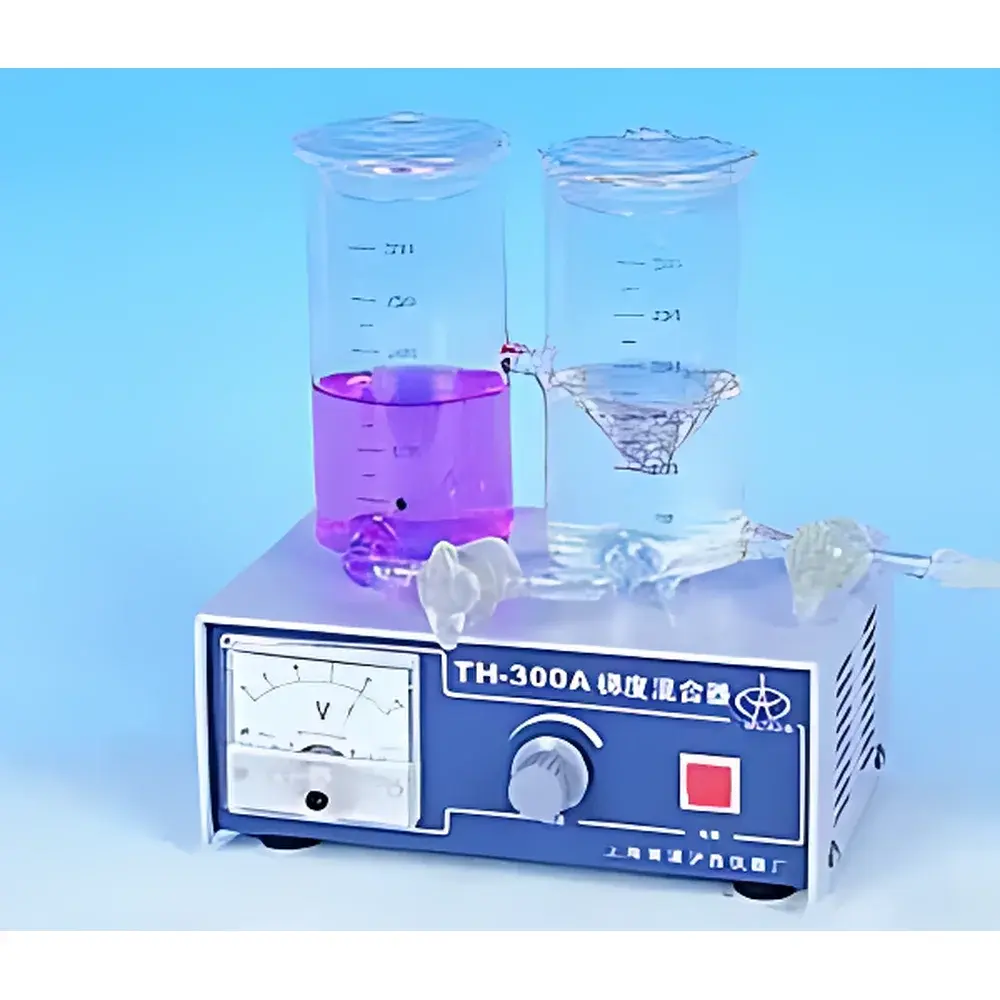
TH-300A Organic-Solvent-Compatible Gradient Mixer
| Origin | Shanghai, China |
|---|---|
| Manufacturer Type | Authorized Distributor |
| Origin Category | Domestic (PRC) |
| Model | TH-300A |
| Price | USD 250 (FOB Shanghai) |
| Dimensions | 211 × 160 × 250 mm |
| Gradient Volume Capacity | 600 mL |
| Gradient Profile | Linear only |
| Material Compatibility | Certified for continuous use with common organic solvents (e.g., acetonitrile, methanol, chloroform, ethyl acetate, DMSO, THF) |
Overview
The TH-300A Organic-Solvent-Compatible Gradient Mixer is a precision-engineered laboratory device designed for reproducible linear gradient generation in liquid chromatography (LC), column chromatography, and solvent-based purification workflows. Operating on the principle of dual-reservoir balanced siphon mixing, the instrument maintains equal hydrostatic head between two independently adjustable solution reservoirs—typically containing stock (concentrated) and diluent (weak) mobile phases. A calibrated peristaltic or gravity-driven flow control mechanism ensures stable output flow rate while enabling fine-tuned adjustment of mixing ratio over time. Unlike digital gradient pumps, the TH-300A delivers analog, mechanically stable linear gradients without electronic feedback loops—making it especially suitable for applications requiring long-duration, low-drift solvent programming under ambient or mildly elevated temperature conditions. Its structural integrity and wetted-path materials (chemically resistant PTFE tubing, borosilicate glass reservoirs, and solvent-stable acrylic housing) are validated for sustained exposure to aggressive organic media commonly used in reversed-phase HPLC, flash chromatography, and peptide synthesis.
Key Features
- Chemically inert fluid path engineered for uninterrupted operation with polar and non-polar organic solvents—including acetonitrile, methanol, ethanol, tetrahydrofuran (THF), dichloromethane (DCM), chloroform, dimethyl sulfoxide (DMSO), and ethyl acetate
- Manually adjustable gradient slope via dual independent flow regulators—enabling precise control of mixing ratio from 0–100% over user-defined time intervals
- Passive hydraulic balancing system that automatically equalizes liquid levels between reservoirs, eliminating air entrapment and ensuring pulse-free, laminar outflow
- Fixed linear gradient profile optimized for method development in preparative and analytical chromatography where reproducible solvent strength ramping is critical
- Compact benchtop footprint (211 × 160 × 250 mm) with transparent acrylic housing for real-time visual monitoring of reservoir levels and tubing integrity
- No electrical power requirement—operates via gravity feed or optional low-pressure auxiliary pump integration (up to 0.5 bar)
Sample Compatibility & Compliance
The TH-300A is constructed using USP Class VI-certified polymers and ASTM F2136-compliant borosilicate glass components. All wetted surfaces meet ISO 10993-5 cytotoxicity standards and demonstrate no measurable leachables when challenged with ICH Q5C-relevant solvent systems. While not an electronically controlled instrument, its mechanical design supports GLP-compliant documentation protocols: gradient start/end times, reservoir fill volumes, and flow rates can be recorded manually in bound lab notebooks or integrated into LIMS via standardized SOP templates. The device complies with general laboratory safety requirements outlined in ANSI Z9.5 and is compatible with fume hood installation for volatile organic solvent handling.
Software & Data Management
As a fully analog, non-digital instrument, the TH-300A does not incorporate embedded firmware, microprocessors, or data logging capabilities. This architecture eliminates electromagnetic interference risks in sensitive detection environments and ensures zero risk of software obsolescence or cybersecurity vulnerabilities. Gradient parameters—including initial/final composition, total run time, and flow rate—are defined manually and documented externally using institutionally approved chromatography method records. For laboratories operating under FDA 21 CFR Part 11 requirements, manual entries may be supported by contemporaneous handwritten signatures and audit-trail-enabled electronic notebooks (e.g., LabArchives, Benchling) configured for ALCOA+ principles.
Applications
- Method development and optimization in reversed-phase and normal-phase column chromatography
- Gradient elution support for UV/Vis and fluorescence-based detection systems lacking built-in gradient capability
- Solvent conditioning and equilibration of silica, C18, and ion-exchange columns prior to sample loading
- Preparative-scale fraction collection where programmable pump complexity is unnecessary or undesirable
- Educational demonstrations of gradient formation kinetics, solvent polarity effects, and retention behavior in undergraduate analytical chemistry labs
- Integration with legacy LC systems or custom-built separation rigs requiring passive, low-maintenance gradient delivery
FAQ
Is the TH-300A compatible with aqueous buffers containing salts or acids?
Yes—provided pH remains between 2.0 and 10.0 and ionic strength does not exceed 1.0 M; however, prolonged exposure to high-concentration phosphate or sulfate solutions may accelerate elastomer aging in tubing seals.
Can the gradient shape be modified to exponential or step profiles?
No—the TH-300A is mechanically constrained to linear gradients only; non-linear profiles require external valve switching or digitally controlled pump systems.
What maintenance is required to ensure long-term performance?
Monthly visual inspection of tubing for swelling or cracking, biannual replacement of PTFE tubing and silicone O-rings, and periodic cleaning of glass reservoirs with appropriate solvent rinses followed by nitrogen purge.
Does the unit include flow rate calibration certificates?
Calibration is user-performed using gravimetric or volumetric measurement per ASTM D1193; factory-provided nominal flow charts are included, but NIST-traceable certification requires third-party metrology services.
Can multiple TH-300A units be operated in parallel for multi-solvent gradient systems?
Yes—units may be daisy-chained via manifold adapters to generate dual- or triple-solvent gradients, though compositional accuracy must be verified empirically for each configuration.



