
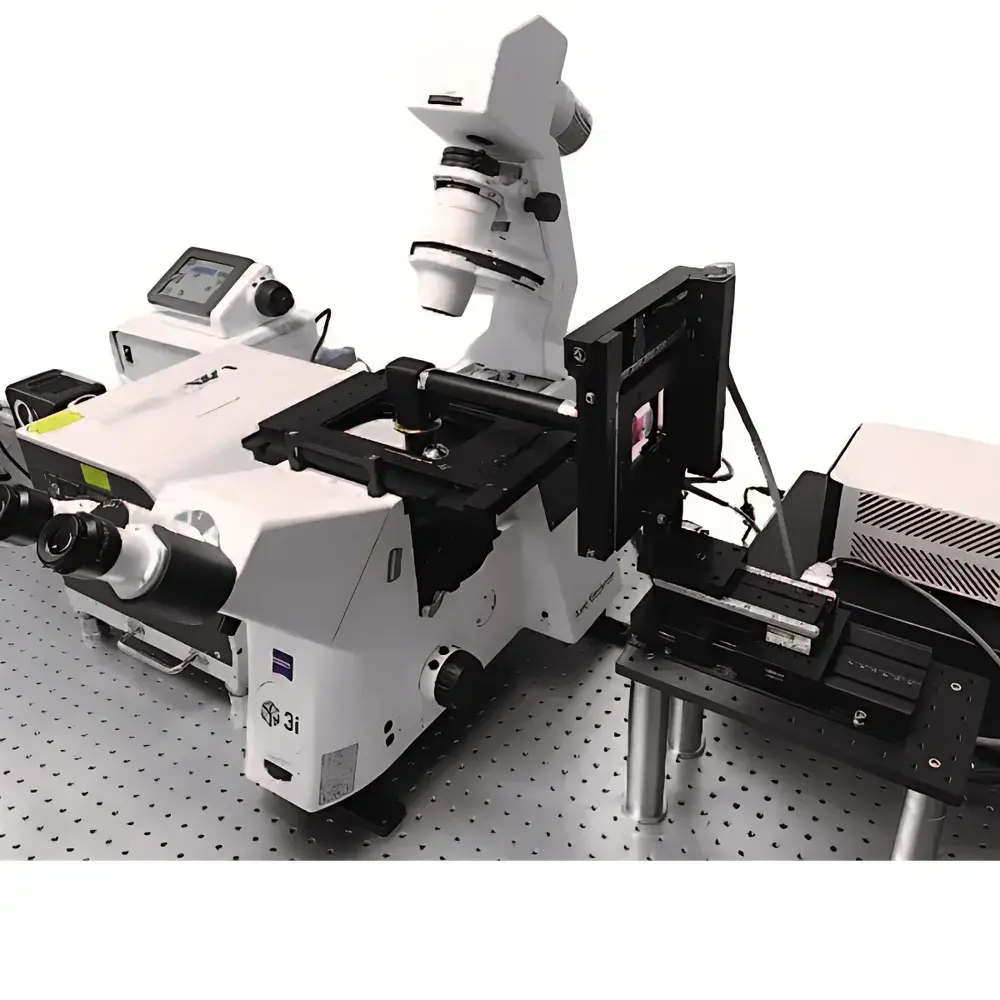
3i PlantScope Vertical Light-Sheet Microscope for Live Plant Imaging
| Brand | 3i |
|---|---|
| Origin | USA |
| Manufacturer Type | Authorized Distributor |
| Origin Category | Imported Instrument |
| Model | PlantScope |
| Pricing | Available Upon Request |
Overview
The 3i PlantScope Vertical Light-Sheet Microscope is a purpose-built, upright-configured imaging platform engineered exclusively for long-term, high-resolution 3D observation of living plants under physiologically relevant conditions. Unlike conventional inverted or horizontal light-sheet systems, PlantScope integrates vertical illumination geometry with integrated environmental control and automated dynamic tracking—enabling true longitudinal studies of plant development without compromising structural integrity or physiological function. Its core optical architecture relies on non-diffracting, ultra-thin light sheets (5–20 µm thickness) generated orthogonal to the detection axis, minimizing phototoxicity while maximizing axial resolution and penetration depth through dense, scattering plant tissues. This design adheres to the fundamental principles of selective plane illumination microscopy (SPIM), adapted specifically to address the optical and biological challenges of plant imaging—including chlorophyll autofluorescence, cell wall scattering, and gravity-dependent growth behavior. The system operates as a fully integrated instrument—not an add-on module—ensuring hardware synchronization, thermal stability, and mechanical rigidity essential for multi-day time-lapse experiments.
Key Features
- Upright sample orientation with custom periscope-optics path: Maintains natural gravitropic growth posture for Arabidopsis, barley, and other model or crop species—eliminating artifacts from forced lateral or inverted positioning.
- Vertically oriented light-sheet illumination module: Delivers diffraction-limited optical sectioning with adjustable sheet thickness (5–20 µm), optimized for deep-tissue penetration and subcellular resolution in intact roots, shoots, and meristems.
- Chlorophyll-suppression optical pathway: Includes dedicated bandpass filtering and near-infrared (NIR) trans-illumination capability (780 nm), enabling label-free structural imaging without perturbing photosynthetic activity or circadian rhythms.
- Integrated environmental chamber: Precisely regulates temperature (±0.2°C), relative humidity (±3%), CO₂ concentration (±50 ppm), and programmable photoperiods—supporting uninterrupted imaging over days to weeks while preserving physiological viability.
- Automated root-tip tracking and full-root reconstruction: SlideBook software drives real-time centroid-based tracking of root apices across time-series volumes, followed by seamless stitching of segmented root regions into unified 3D developmental trajectories.
Sample Compatibility & Compliance
PlantScope accommodates live, unsectioned specimens ranging from seedlings (Arabidopsis thaliana, Oryza sativa, Hordeum vulgare) to juvenile dicot and monocot organs up to 15 mm in height. Its upright configuration eliminates embedding, clearing, or mounting-induced stress—preserving native turgor pressure, vascular continuity, and hormonal gradients. The system complies with GLP-aligned data integrity standards: all acquisition parameters (laser power, exposure time, Z-step size, environmental setpoints) are logged with timestamps and user metadata in immutable SlideBook experiment files. Optional 21 CFR Part 11 compliance packages support audit trails, electronic signatures, and role-based access control for regulated academic core facilities and industry R&D labs.
Software & Data Management
Control, acquisition, and analysis are unified within 3i’s SlideBook 6 platform—a modular, scriptable, and publication-ready software environment widely adopted in quantitative plant science. SlideBook provides hardware-synchronized control of light-sheet generation, motorized stage movement, environmental actuators, and multi-channel fluorescence excitation. Built-in modules enable automatic focus drift correction, intensity normalization across time points, 3D deconvolution (Richardson-Lucy), volumetric rendering (isosurface + maximum-intensity projection), and quantitative morphometrics—including cell length/width measurements, growth velocity vector fields, and mitotic index mapping. Export formats include TIFF (OME-TIFF compliant), HDF5, and MATLAB-compatible .mat files—ensuring interoperability with Fiji/ImageJ, Python-based analysis pipelines (e.g., napari, scikit-image), and institutional data repositories.
Applications
- Developmental Biology: Longitudinal tracking of meristematic activity, cell division dynamics in root caps and shoot apical meristems, and organogenesis in 3D space—validated in Caltech’s Nolan Lab for A. thaliana gravitropism studies.
- Cell Physiology: Subcellular trafficking of GFP-tagged endosomal proteins, microtubule reorganization during cytokinesis, and calcium wave propagation—demonstrated at Potsdam University using MAP4-GFP and EB1-mRuby reporters.
- Environmental Response: Quantitative comparison of root growth kinetics under abiotic stress (salinity, drought, heavy metals), supporting trait-based screening in crop improvement programs.
- Systems-Level Phenotyping: Correlation of macroscopic growth phenotypes with subcellular reporter dynamics—enabling mechanistic links between gene expression, organelle behavior, and whole-plant performance.
FAQ
How does vertical light-sheet geometry improve imaging of intact plant tissues compared to horizontal SPIM?
Vertical illumination aligns with the natural growth axis, eliminating gravitational distortion of root morphology and enabling unobstructed optical access to apical meristems without physical compression or hydrogel embedding.
Can PlantScope image deep into mature root systems or thick cotyledons?
Yes—its combination of long-working-distance, high-NA water-immersion objectives (e.g., 25×/1.1 NA) and NIR-assisted trans-illumination enhances contrast and depth penetration beyond 300 µm in hydrated tissue.
Is chlorophyll autofluorescence suppression hardware-based or software-based?
It is optically implemented via notch-filtered excitation and emission pathways, plus dedicated NIR trans-illumination—reducing reliance on post-acquisition background subtraction.
Does SlideBook support batch processing of multi-day time-lapse datasets?
Yes—macro scripting and pipeline automation allow consistent application of registration, segmentation, and quantification workflows across hundreds of time points without manual intervention.
What regulatory documentation is available for lab validation or grant reporting?
3i provides ISO 9001-certified manufacturing records, CE/FCC declarations, NIST-traceable calibration reports for laser power and temperature sensors, and peer-reviewed application notes co-published with leading plant science institutions.






