
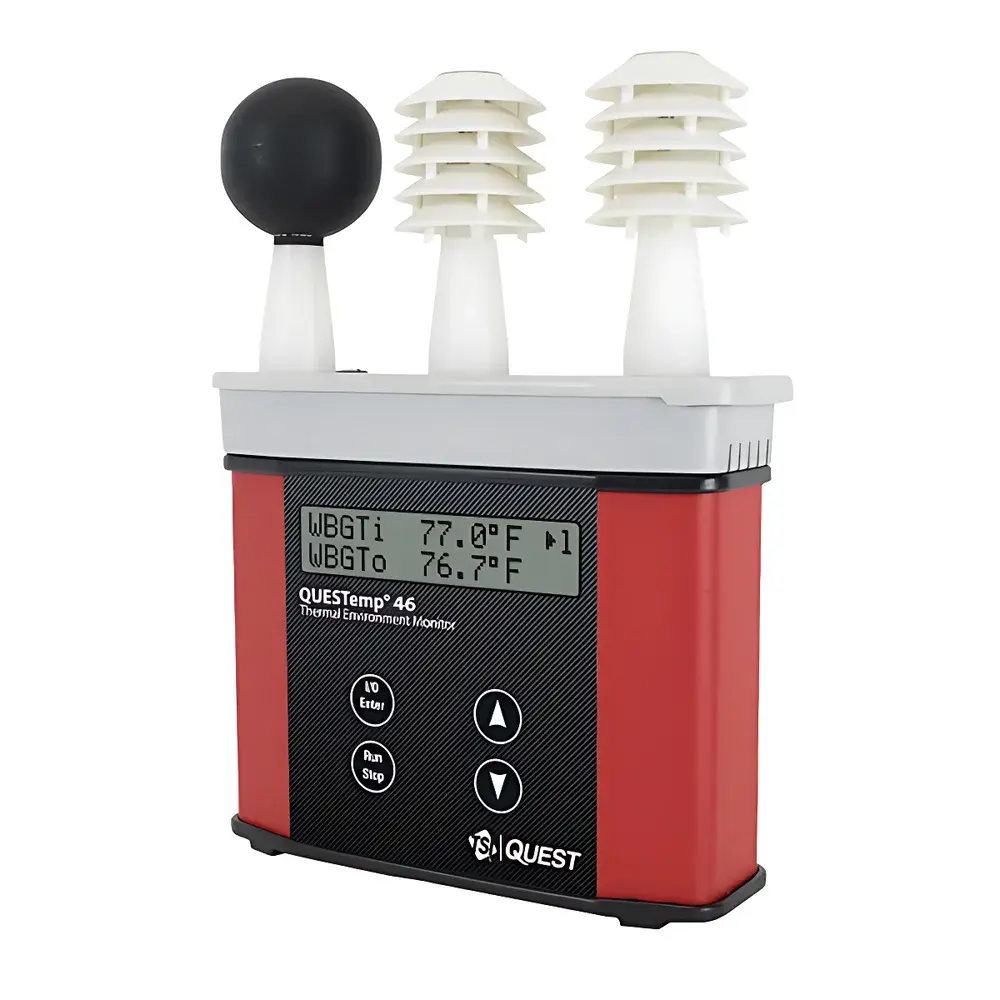
3M Quest QT-32 WBGT Heat Stress Monitor
| Brand | 3M |
|---|---|
| Origin | USA |
| Model | Quest QT-32 |
| Compliance | GB/Z T189.7-2007, ISO 7243, ACGIH TLVs®, OSHA Guidelines |
| Sensor Range | Dry-Bulb / Wet-Bulb / Black Globe Temperature (0–120°C, ±0.5°C), Relative Humidity (20–95% RH, ±5% RH, non-condensing) |
| Operating Environment | –5°C to +60°C (electronics & sensors) |
| Wireless Range | Up to 200 ft (61 m) between sensor and display unit |
| Power | 9V alkaline or NiMH rechargeable battery |
| Enclosure Rating | IP54 |
| Dimensions | 23.4 × 18.3 × 7.6 cm |
| Weight | 1.2 kg |
| Certifications | UL/CSA Class I Div 1 Groups A/B/C/D, Class II Div 1 Groups E/F/G, Class III, Temp Code T3 |
Overview
The 3M Quest QT-32 WBGT Heat Stress Monitor is an industrial-grade, portable environmental monitoring instrument engineered for precise real-time assessment of heat stress exposure in occupational settings. It operates on the fundamental principle of the Wet Bulb Globe Temperature (WBGT) index—a composite thermal metric defined by ISO 7243 and adopted globally for occupational health surveillance. The QT-32 simultaneously acquires dry-bulb temperature (ambient air), natural wet-bulb temperature (evaporative cooling effect), and black-globe temperature (radiant heat load), then applies standardized weighting algorithms—per ISO 7243 for outdoor environments (0.7×WB + 0.2×GB + 0.1×DB) and ACGIH/NIOSH protocols for indoor conditions (0.7×WB + 0.3×GB)—to compute compliant WBGT values. Unlike single-parameter thermometers, the QT-32 integrates tri-sensor architecture with field-configurable globe diameters (2″ and 6″ options), enabling accurate radiant heat capture across diverse workspaces—from foundry floors to solar-exposed construction sites.
Key Features
- Tri-sensor WBGT computation with independent dry-bulb, wet-bulb, and black-globe temperature inputs, supporting both indoor and outdoor WBGT formulas per ISO 7243 and ACGIH TLVs®.
- Modular wireless architecture: sensor head and display unit operate up to 200 feet apart, minimizing operator exposure during high-temperature measurements (e.g., near furnaces, kilns, or asphalt surfaces).
- Dual power operation: powered by standard 9V alkaline batteries or rechargeable NiMH cells—enabling continuous logging over extended shifts without interruption.
- Expandable multi-height monitoring: supports up to three synchronized sensor modules (head, abdomen, ankle positions) for stratified thermal profiling and weighted vertical WBGT averaging per ISO 7243 Annex B guidance.
- Intrinsically safe design certified to UL/CSA Class I Div 1 Groups A/B/C/D, Class II Div 1 Groups E/F/G, Class III, T3 temperature rating, and ATEX II 2 G Ex ib IIB T3 Ga—suitable for hazardous locations including petrochemical facilities and grain silos.
- IP54-rated enclosure ensures protection against dust ingress and water splashes during field deployment in humid or dusty industrial zones.
Sample Compatibility & Compliance
The QT-32 is validated for use across regulated occupational hygiene workflows requiring traceable, auditable heat stress data. It complies with GB/Z T189.7–2007 (People’s Republic of China Standard for High-Temperature Workplaces), ISO 7243:2017 (Ergonomics of the thermal environment — Estimation of the heat stress on working man, based on the WBGT-index), and ACGIH Threshold Limit Values® for heat stress. Its metrological configuration—including calibrated NIST-traceable sensors and documented uncertainty budgets—meets requirements for GLP-compliant exposure assessments. The device holds a China Metrology Type Approval Certificate (CPA), confirming conformity with national verification regulations for legal metrology applications in workplace safety inspections.
Software & Data Management
Data acquisition and reporting are managed via the proprietary DMS (Data Management Software), which supports time-stamped WBGT logging, sensor synchronization, and export to CSV or PDF formats compatible with enterprise EHS platforms. The software enforces audit-ready metadata tagging—including operator ID, location stamp, calibration date, and sensor configuration—and supports 21 CFR Part 11–compliant electronic signatures when deployed in FDA-regulated manufacturing environments. Raw sensor outputs (dry-bulb, wet-bulb, globe, RH) are retained alongside computed indices, enabling retrospective reanalysis under revised exposure guidelines without field resampling.
Applications
- Ongoing compliance monitoring for OSHA 1910.142 (hot work environments) and MSHA Part 46/48 heat stress provisions.
- Field validation of engineering controls (e.g., ventilation upgrades, radiant barrier installation) through pre- and post-intervention WBGT mapping.
- Forensic occupational health investigations following heat-related incidents, with timestamped, tamper-evident logs admissible in regulatory proceedings.
- Real-time heat stress alerts during emergency response operations (e.g., wildfire suppression, disaster recovery) using configurable WBGT threshold alarms.
- Research-grade thermal physiology studies requiring stratified vertical temperature gradients across human body zones (head–torso–ankle).
FAQ
Does the QT-32 meet ISO 7243 requirements for WBGT measurement?
Yes—the instrument implements the exact weighting coefficients and sensor placement geometry specified in ISO 7243:2017, including support for both 2-inch and 6-inch black globes depending on airflow conditions.
Can WBGT data be integrated into existing EHS information systems?
Yes—DMS software exports structured CSV files with ISO 8601 timestamps, sensor IDs, and computed indices, enabling direct ingestion into platforms such as Intelex, Sphera, or SAP EHS.
Is calibration traceable to national standards?
All factory calibrations are performed against NIST-traceable reference standards, and calibration certificates include measurement uncertainty statements per ISO/IEC 17025 requirements.
What is the maximum operational distance between sensor and display unit?
The wireless link maintains reliable communication at up to 200 feet (61 meters) in open-air conditions, with line-of-sight optimization recommended for metallic or high-RF environments.
Does the device support multi-language interfaces for international deployment?
Yes—display language options include English, Chinese, German, Italian, Spanish, Portuguese, and Korean, configurable via on-device menu without firmware update.
Related Products







