
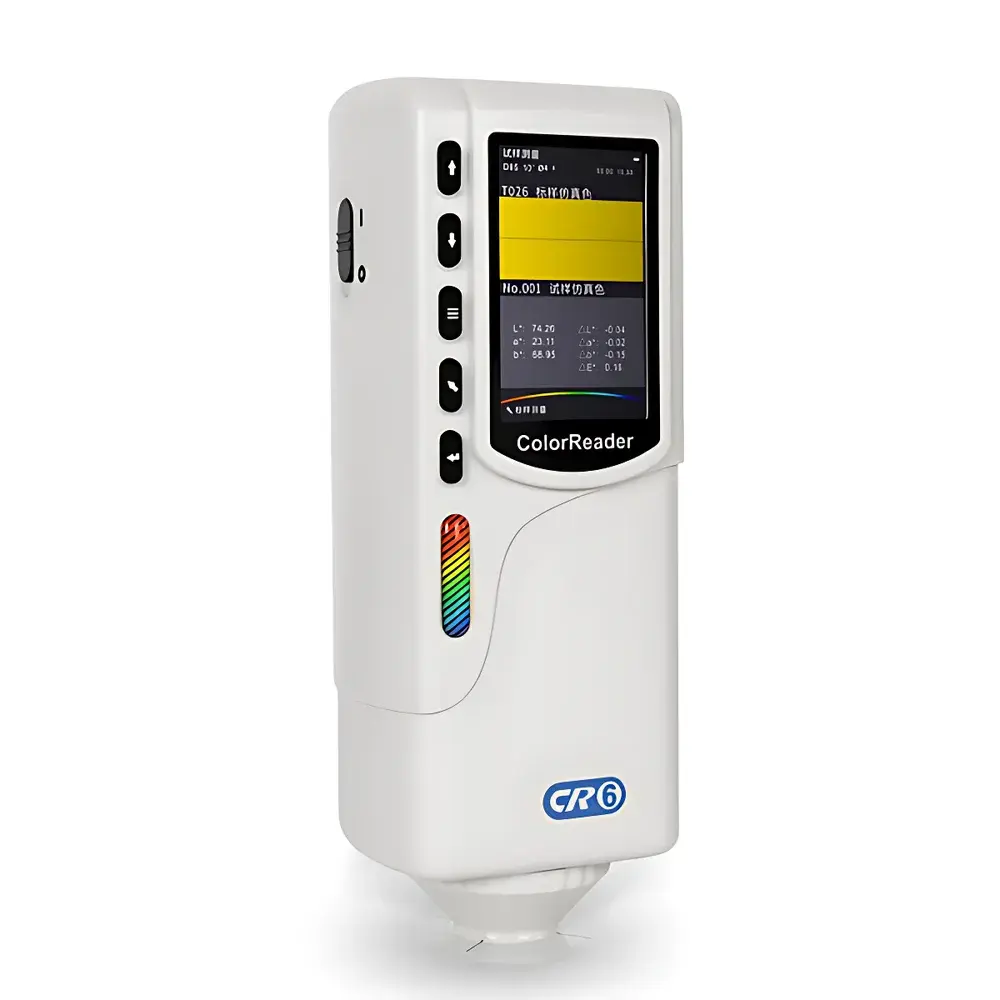
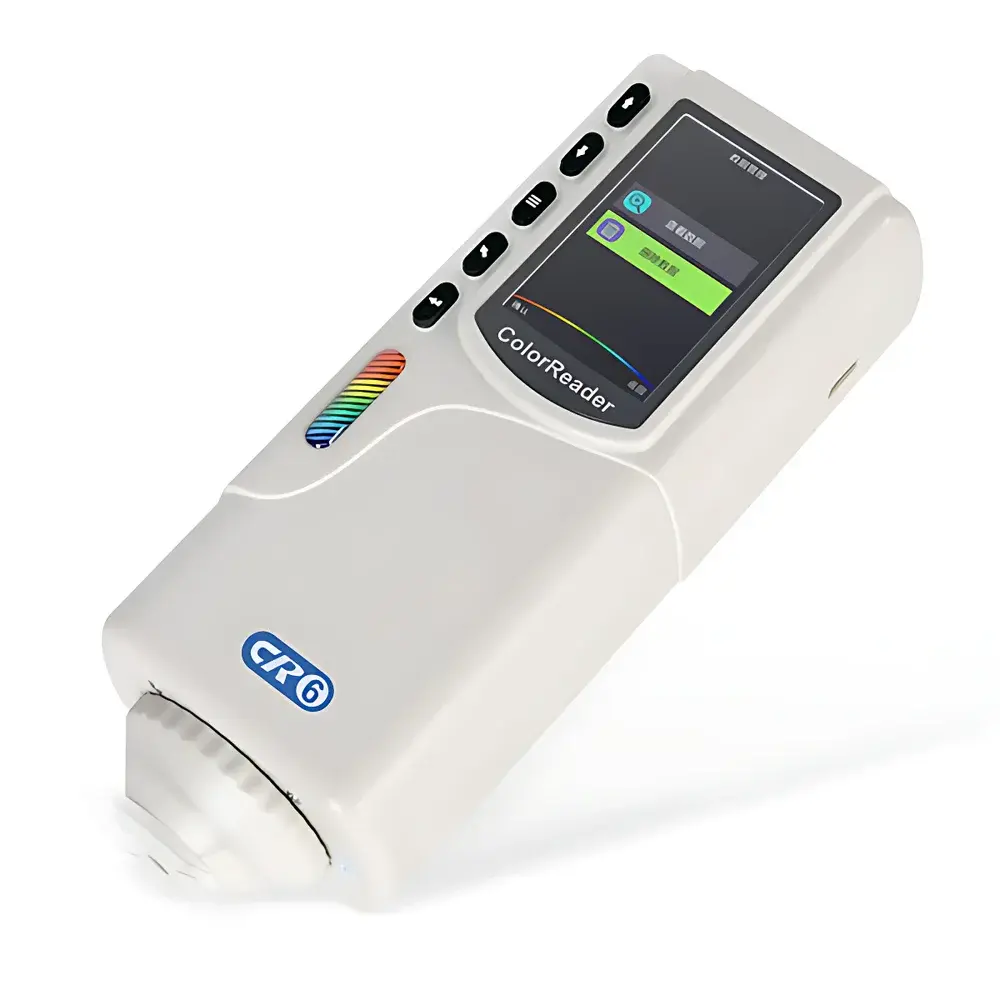
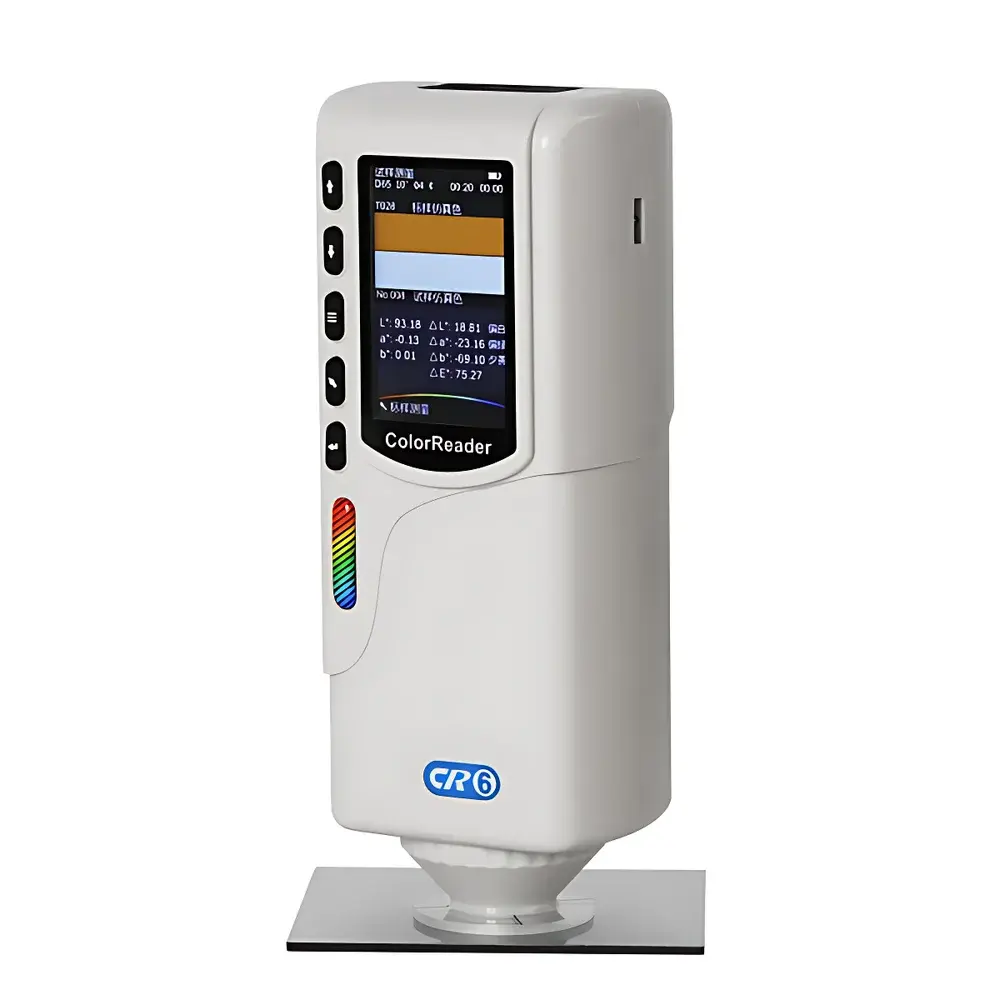
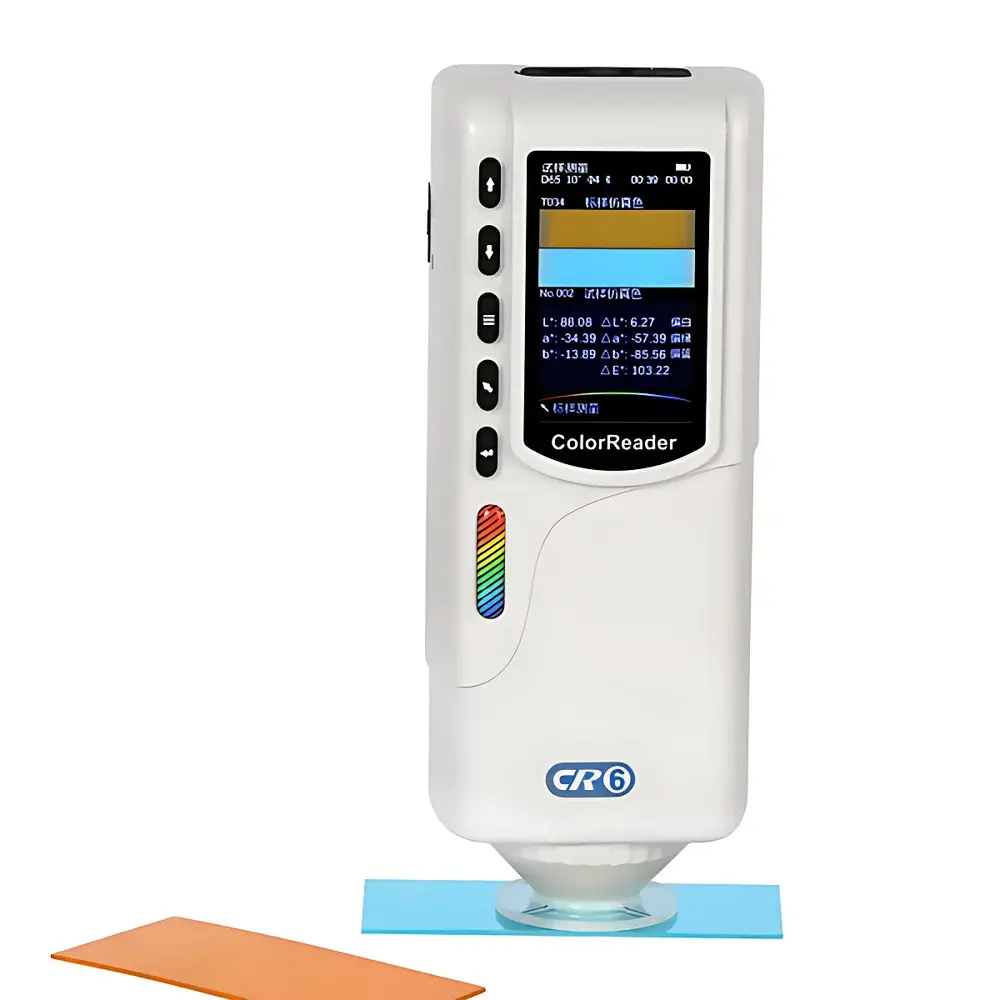
3nh CR6 Portable High-Precision Colorimeter
| Brand | 3nh |
|---|---|
| Origin | Guangdong, China |
| Manufacturer Type | Manufacturer |
| Country of Origin | China |
| Model | CR6 |
| Product Category | Colorimeter |
| Instrument Type | Portable |
| Optical Geometry | 8°/d (Diffuse Illumination, 8° Viewing Angle, SCI mode) |
| Light Sources | D65, A, C, D50, D55, D75, F1–F12 (including CWF, TL84, TL83/U30, TPL5, DLF) |
| Spectral Range | 400–700 nm |
| Repeatability | ΔE*ab ≤ 0.05 (after warm-up and calibration |
Overview
The 3nh CR6 Portable High-Precision Colorimeter is an industrial-grade handheld spectrophotometric color measurement instrument engineered for metrologically traceable color evaluation in production, quality control, and R&D environments. It operates on the CIE-compliant 8°/d (diffuse illumination / 8° viewing angle) optical geometry with Specular Component Included (SCI), enabling accurate measurement of both matte and glossy surfaces without bias from surface reflectance artifacts. The device employs a full-spectrum LED illumination system coupled with filter-based spectral separation and a high-stability CMOS linear array sensor, delivering consistent spectral response across the visible range (400–700 nm). Its design conforms to ISO/CIE standards including CIE Publication No. 15:2018, GB/T 3978–2008, and supports multiple observer angles (2° and 10°) and illuminants required for cross-industry color specification—particularly critical in plastics, coatings, textiles, ceramics, and electronics manufacturing where inter-laboratory reproducibility and supplier–customer color agreement are contractually enforced.
Key Features
- Integrated 2.8-inch TFT true-color display with real-time color simulation, enabling visual verification of measured L*a*b*, RGB, or HEX values directly on-device
- Bluetooth 5.0 + USB-C connectivity for seamless synchronization with the MOBCCS mobile application (Android), supporting firmware updates, remote configuration, and cloud-based data backup
- Onboard auto-calibration at power-on, supplemented by user-accessible manual calibration using included ceramic white and black calibration tiles—ensuring long-term stability and compliance with internal quality audits
- Dual-mode measurement: single-shot (≈1.2 s) and programmable averaging (2–99 readings), mitigating operator-induced variability and improving statistical confidence in marginal pass/fail decisions
- Robust mechanical architecture: IP52-rated enclosure with dust-resistant flip cover, ergonomic grip, and detachable calibration tile storage—designed for field use in factory floors, warehouses, and outdoor inspection points
- Extended battery life: rechargeable 3.7 V / 3200 mAh Li-ion battery supports >5,000 measurements at full screen brightness or >20,000 measurements in low-power mode, compatible with standard USB power banks and wall adapters
Sample Compatibility & Compliance
The CR6 accommodates solid, flat, or slightly curved surfaces via its Φ4 mm measurement aperture. Optional accessories—including a powder test kit and USB thermal printer—extend usability to granular materials and on-site reporting. All optical and electronic subsystems are designed to meet electromagnetic compatibility (EMC) requirements per IEC 61326-1 and environmental operating limits per IEC 60068-2 (0–40 °C, 0–85% RH non-condensing, altitude <2000 m). While not certified to FDA 21 CFR Part 11 or ISO 17025 out-of-the-box, the instrument’s audit-ready data structure—including timestamped measurement logs, calibration history, and operator ID tagging via MOBCCS—supports integration into GLP/GMP workflows when deployed with documented SOPs and periodic verification against NIST-traceable standards.
Software & Data Management
The MOBCCS mobile application serves as the primary interface for advanced color analysis, database management, and regulatory documentation. It enables creation and synchronization of proprietary color libraries (up to 1000 standards and 20,000 samples stored locally; unlimited in cloud), spectral curve visualization, multi-illuminant comparison, and automated pass/fail reporting based on configurable ΔE*ab, ΔE00, or DIN 6174 tolerances. Audit trails include metadata such as GPS coordinates (optional), ambient light conditions, and Bluetooth handshake timestamps—facilitating root-cause analysis during nonconformance investigations. Export formats include CSV, PDF reports, and XML-compatible structured data for ERP/MES integration.
Applications
The CR6 is routinely deployed in process-critical roles across industries requiring quantitative color consistency: incoming raw material inspection for pigment batches; in-line coating thickness and hue verification on automotive trim; shade matching validation in textile dye houses; batch-to-batch color release testing for consumer electronics housings; and QC gate checks for ceramic glaze uniformity. Its portability allows technicians to perform measurements directly at the point of production—eliminating sample transport delays and reducing measurement uncertainty introduced by environmental exposure or handling artifacts. The inclusion of Munsell C/2, ASTM E313 whiteness, and AATCC/YI yellowness indices further extends utility into regulated textile and paper testing protocols.
FAQ
Does the CR6 support traceable calibration against national standards?
Yes—the instrument accepts user-performed calibration using supplied NIST-traceable ceramic tiles. For formal accreditation, third-party calibration services can issue certificates aligned with ISO/IEC 17025 upon request.
Can measurement data be exported for statistical process control (SPC)?
Yes—CSV exports include all chromaticity coordinates, ΔE values, illuminant IDs, and timestamps, enabling direct import into JMP, Minitab, or custom SPC dashboards.
Is the CR6 suitable for measuring metallic or pearlescent finishes?
No—it lacks multi-angle geometry (e.g., goniospectrophotometry) and is optimized for diffuse-dominant surfaces. Metallic, flake-based, or retroreflective materials require specialized instruments compliant with ASTM D2244 or ISO 18314-2.
How frequently should the white calibration tile be cleaned or replaced?
Clean with isopropyl alcohol and lint-free cloth after every 50 measurements in dusty environments. Replace every 24 months or if scratch depth exceeds 0.1 µm (verified under 10× magnification).
Does the MOBCCS app support multi-user login with role-based permissions?
Not natively—user accounts are local to each Android device. Enterprise deployment requires integration with MDM platforms or custom API wrappers for LDAP/Active Directory authentication.





