
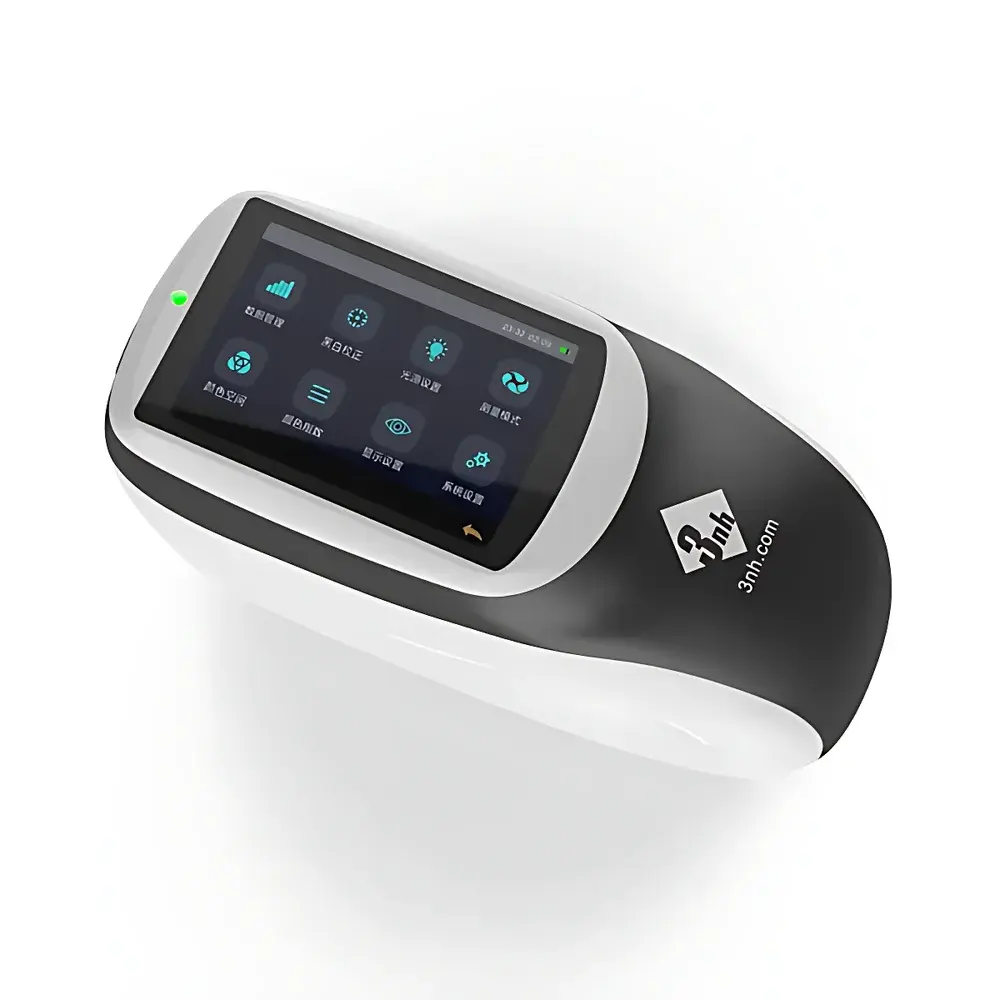
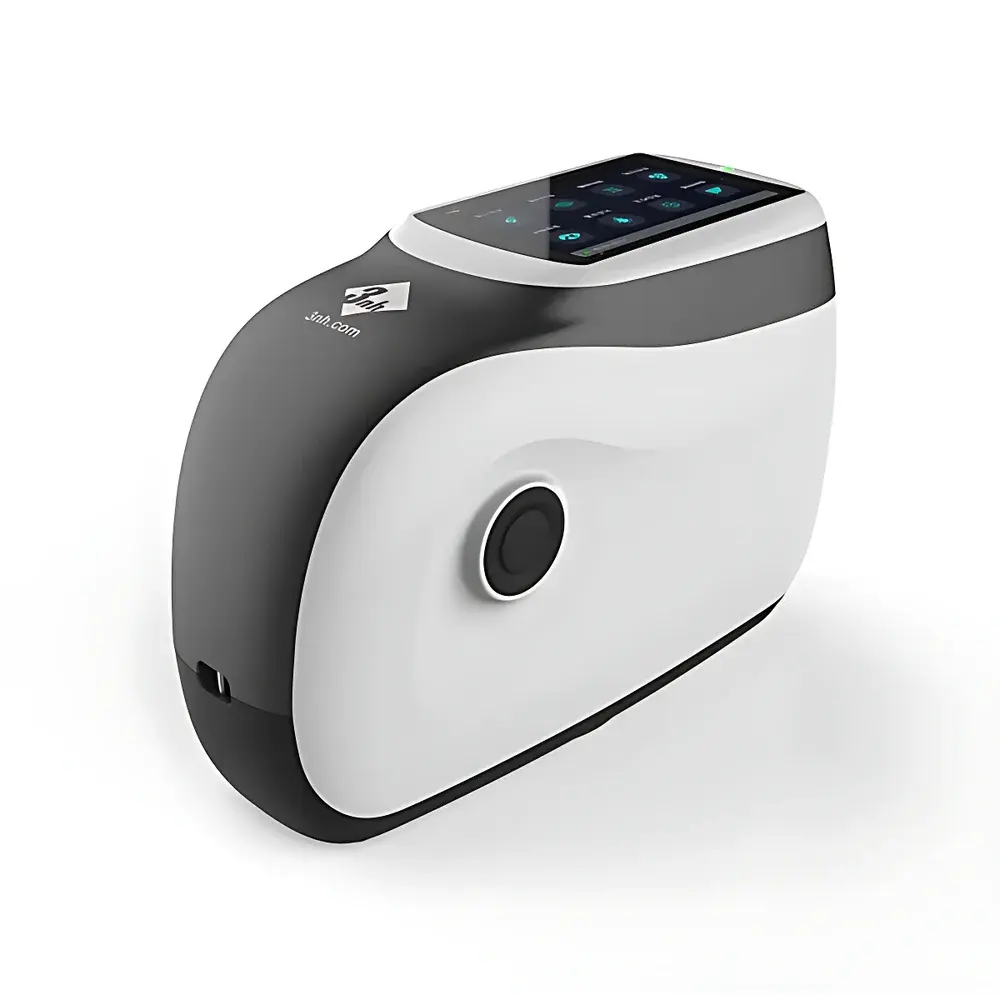
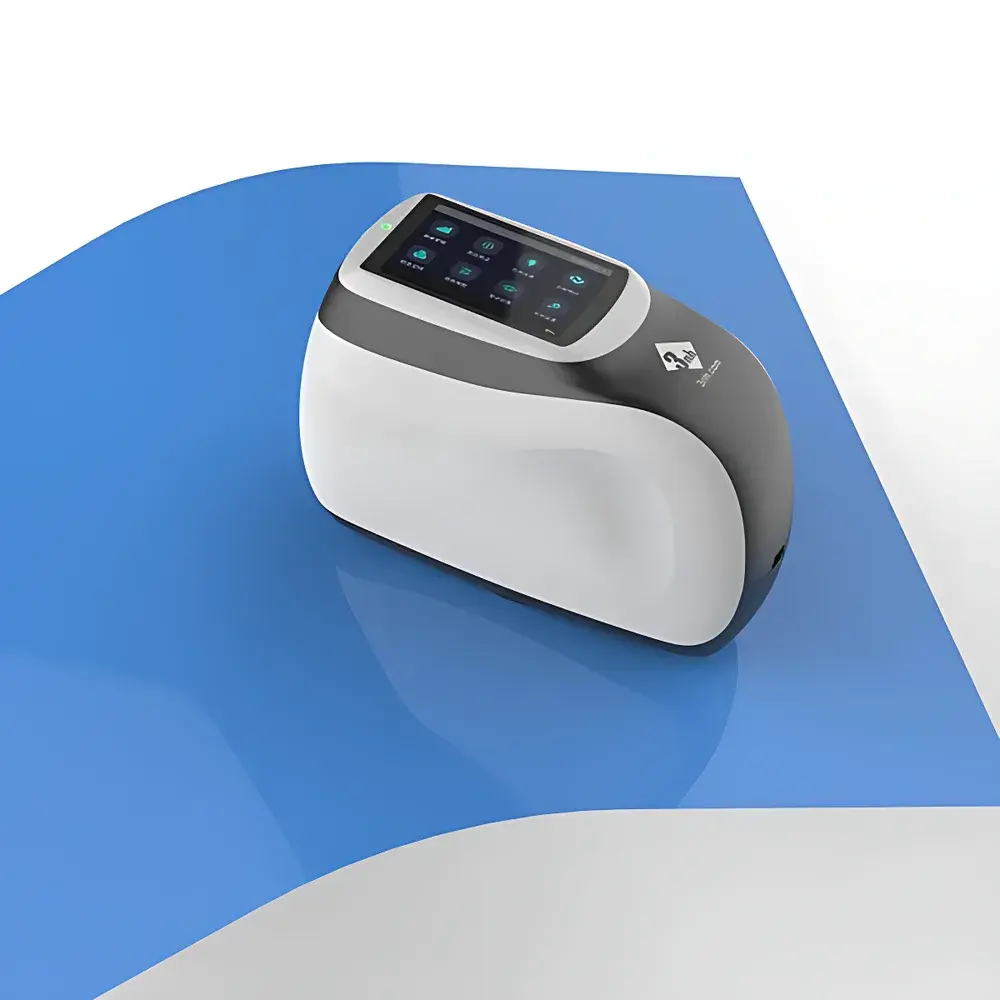
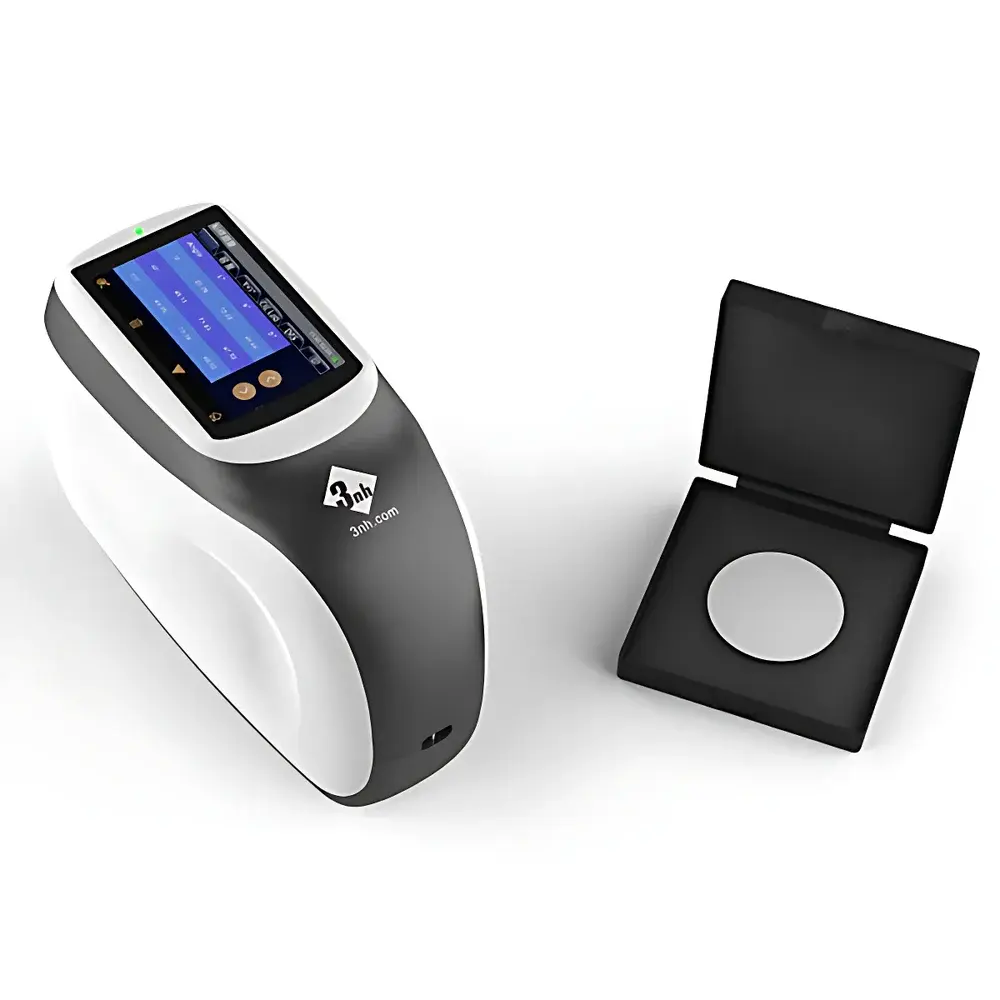
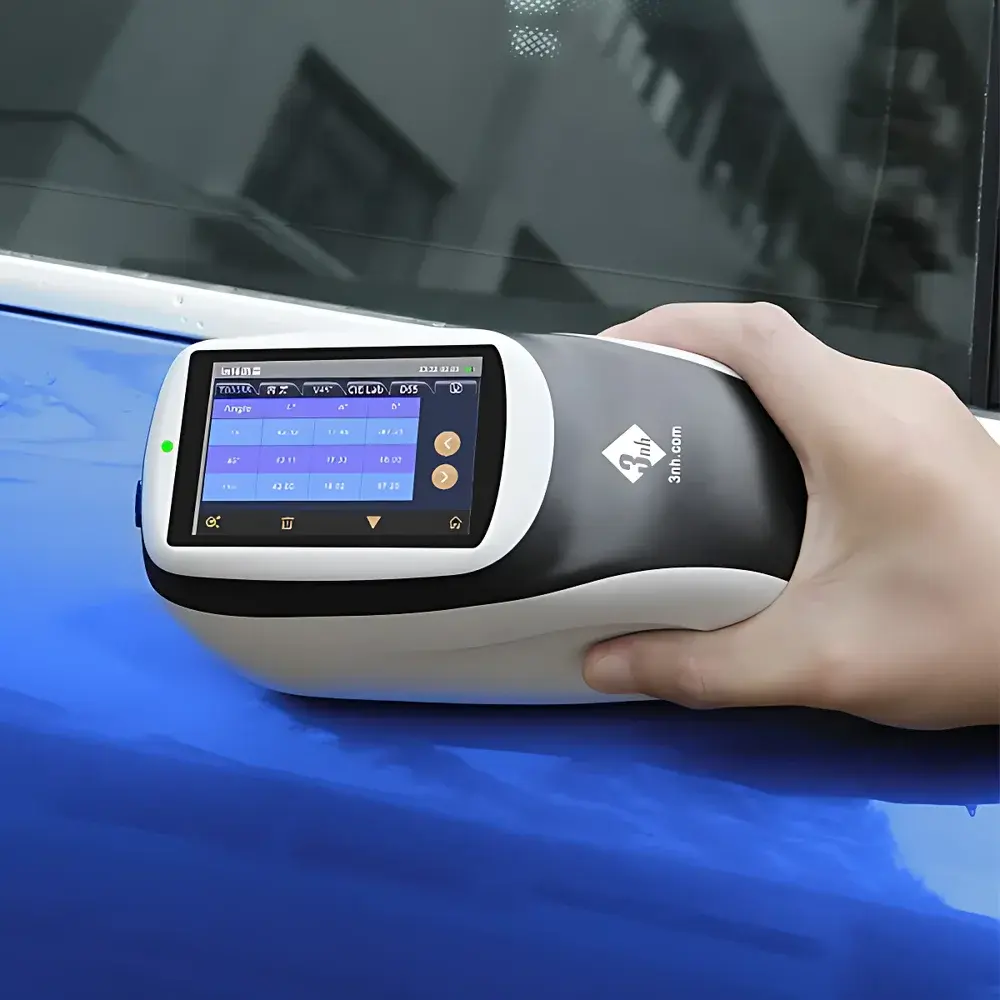
3nh MS3000 Tri-Angle Spectrophotometric Colorimeter
| Brand | 3nh |
|---|---|
| Origin | Guangdong, China |
| Manufacturer Type | Manufacturer |
| Product Category | Domestic |
| Model | MS3000 |
| Product Type | Spectrophotometric Colorimeter |
| Instrument Type | Portable |
| Optical Geometry | 45°/0° (Tri-Angle Configuration) |
| Light Source | Blue-Enhanced Full-Spectrum LED |
| Spectral Range | 400–700 nm |
| Wavelength Interval | 10 nm |
| Spectral Bandwidth | 10 nm |
| Reflectance Repeatability | ≤0.08% SD (Spectral Reflectance) |
| Colorimetric Repeatability | ≤0.04 ΔE*ab (after warm-up & calibration, 30 measurements of white tile at 5 s intervals) |
| Inter-Instrument Agreement | 0.2 ΔE*00 (BCRA Series II, 12 tiles, avg.) |
| Measurement Aperture | Illumination Ø23 mm / Sampling Area 9 × 12 mm |
| Observer Angle | 2°/10° |
| Compliance Standards | ASTM D2244, E308, E1164, E2194, E2539 |
Overview
The 3nh MS3000 Tri-Angle Spectrophotometric Colorimeter is engineered for high-fidelity measurement of effect coatings—particularly metallic, pearlescent, and goniochromatic finishes—whose appearance varies significantly with illumination and viewing geometry. Unlike conventional 0°/45° or d/8° spectrophotometers, the MS3000 implements a fixed tri-angle optical architecture (45°a–15°, 45°a–45°, 45°a–110°) compliant with ASTM D2244 and ISO 11664-4, enabling simultaneous acquisition of spatially resolved reflectance data under standardized geometric conditions. Its core measurement principle relies on spectral reflectance sampling across the visible range (400–700 nm) using a concave holographic grating and dual-array 256-pixel CMOS detector, delivering high signal-to-noise ratio and wavelength stability essential for effect color quantification. The instrument is calibrated to CIE standard observers (2° and 10°) and supports full spectral reconstruction for calculation of multiple color spaces and difference formulas—critical for R&D labs, automotive OEMs, and Tier-1 suppliers validating visual metamerism and flop behavior.
Key Features
- Tri-angle optical configuration with three dedicated LEDs and a single high-precision receiver—enabling concurrent capture of three angular reflectance profiles in <3 seconds.
- Blue-enhanced full-spectrum LED illumination ensures uniform spectral power distribution across 400–700 nm, eliminating gaps common in narrow-band LEDs and improving accuracy for blue-rich pigments and interference-based effect pigments.
- Concave holographic grating with 10 nm FWHM bandwidth provides superior spectral resolution and long-term optical stability, minimizing drift during extended operation.
- Integrated 3.5-inch capacitive touchscreen with real-time spectral graphing, color simulation, pass/fail flagging, and side-by-side comparison of up to three angles.
- Onboard color camera for precise target preview and ROI confirmation—reducing operator-induced positioning error on curved or textured surfaces.
- Industrial-grade MCU with real-time processing capability and Bluetooth 5.0 connectivity for secure, low-latency wireless data transmission to QA/QC software platforms.
- Ergonomic handheld form factor (195 × 83 × 128 mm, ~1 kg), pressure-sensitive trigger, and tactile button layout optimized for one-handed operation in production environments.
Sample Compatibility & Compliance
The MS3000 is validated for flat, curved, and moderately textured substrates—including painted automotive panels, plastic trim, coated metal parts, and powder-coated architectural components. Its 23 mm illumination spot and 9 × 12 mm sampling area accommodate typical industrial sample geometries while maintaining compliance with ASTM E2194 (multi-angle color measurement) and ISO 7724-2 (spectrophotometric colorimetry). All firmware and calibration routines adhere to GLP-aligned traceability requirements: built-in white calibration tile (certified per ISO 13655), optional black trap for specular component exclusion, and user-accessible calibration logs with timestamp and operator ID. Instrument inter-compatibility is verified against BCRA Series II reference tiles per ISO/TR 11664-8, ensuring consistent results across multi-site manufacturing networks subject to IATF 16949 or ISO 9001 audits.
Software & Data Management
The MS3000 interfaces natively with 3nh’s QC-Cloud™ Quality Management Software (Windows/macOS), supporting FDA 21 CFR Part 11–compliant audit trails, electronic signatures, and role-based access control. Raw spectral data (31-point reflectance curves at 10 nm intervals) are exportable in CSV and XML formats for integration into LIMS, SAP QM, or custom statistical process control (SPC) dashboards. The software enables advanced analysis including flop index calculation (FI), distinctness-of-image (DOI) estimation via derivative spectral slope, and multi-angle ΔE mapping against master standards. All stored data—up to 1,000 references and 4,000 samples—retain full metadata: measurement time, geometry, observer angle, illuminant, and calibration status. Firmware updates preserve historical calibration records and maintain backward compatibility with legacy spectral libraries.
Applications
- Automotive OEM paint qualification: Quantifying angular dependency of aluminum-flake orientation and mica-based pearlescence in basecoat/clearcoat systems.
- Plastic part color matching: Validating batch-to-batch consistency of effect pigments in injection-molded interior trim under multiple lighting conditions (D65, TL84, F11).
- Coatings R&D: Correlating spectral angular response with pigment particle size distribution, film thickness, and binder refractive index.
- Quality assurance in Tier-2 suppliers: Enforcing color tolerances per DIN 6175-2 for metallic finishes on wheels, grilles, and emblems.
- Architectural coating validation: Assessing weathering-induced flop shift in fluoropolymer-coated aluminum panels per AAMA 2605.
FAQ
What angular configurations does the MS3000 measure?
It measures three fixed geometries: 45°a–15°, 45°a–45°, and 45°a–110°, all referenced to the 45° annular illumination plane per ASTM D2244.
Does the MS3000 support spectral data export for third-party analysis?
Yes—full 31-channel spectral reflectance data (400–700 nm at 10 nm intervals) is exportable in CSV and XML formats with metadata tags.
How is inter-instrument agreement maintained across a fleet of MS3000 units?
Each unit ships with NIST-traceable BCRA Series II verification tiles; inter-unit deviation is ≤0.2 ΔE*00 (average across 12 tiles), and field recalibration uses the same certified white tile.
Is the MS3000 suitable for measuring textured or curved surfaces?
Yes—the 23 mm illumination spot and integrated color camera enable reliable targeting on radiused body panels and molded plastic parts without requiring mechanical fixtures.
What regulatory standards does the firmware support for audit readiness?
Calibration history, measurement logs, and user actions are time-stamped and immutable per GLP/GMP guidelines; software supports 21 CFR Part 11 electronic signature workflows.






