
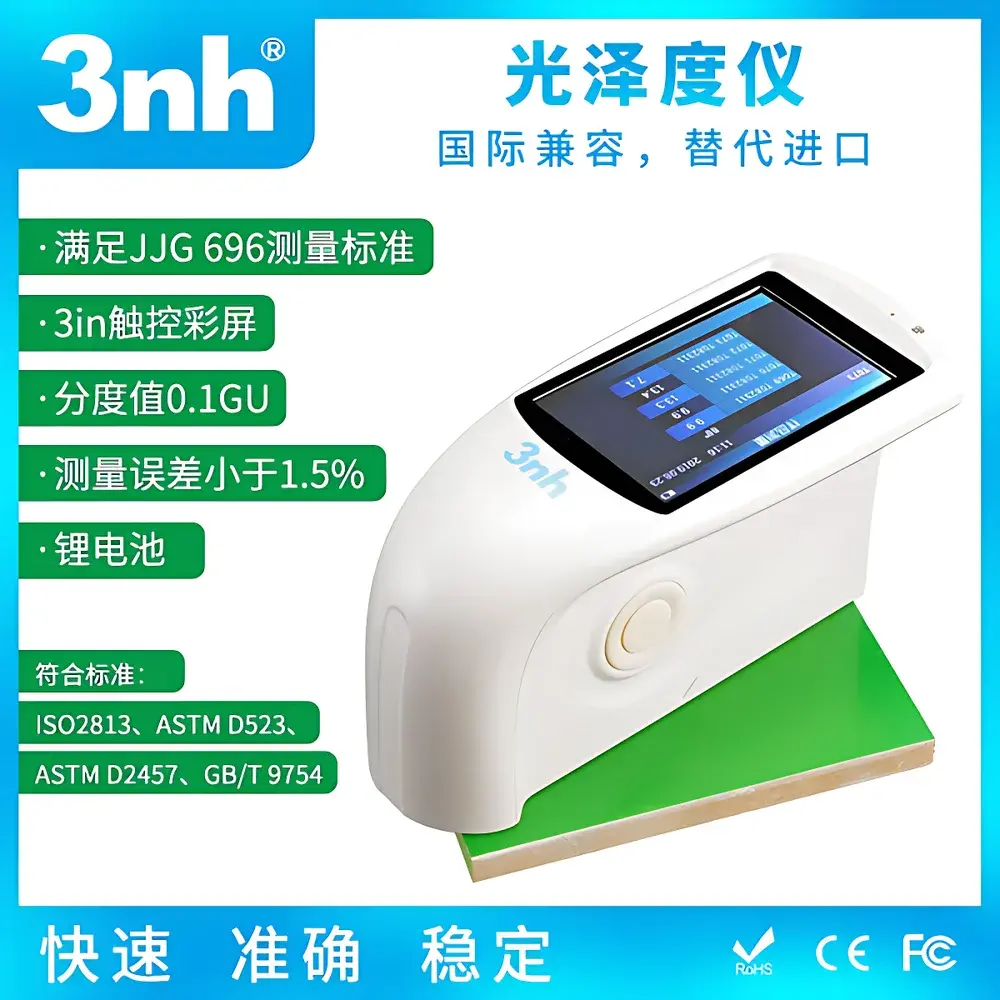
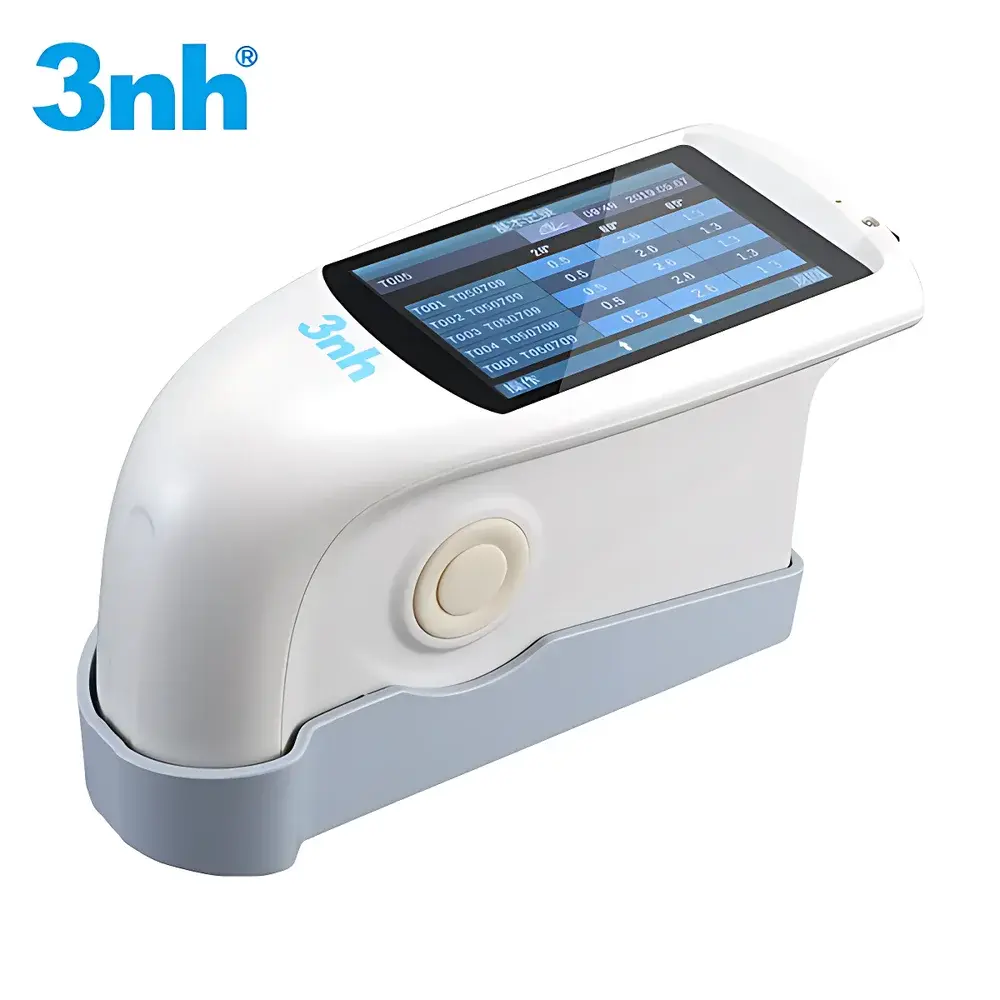
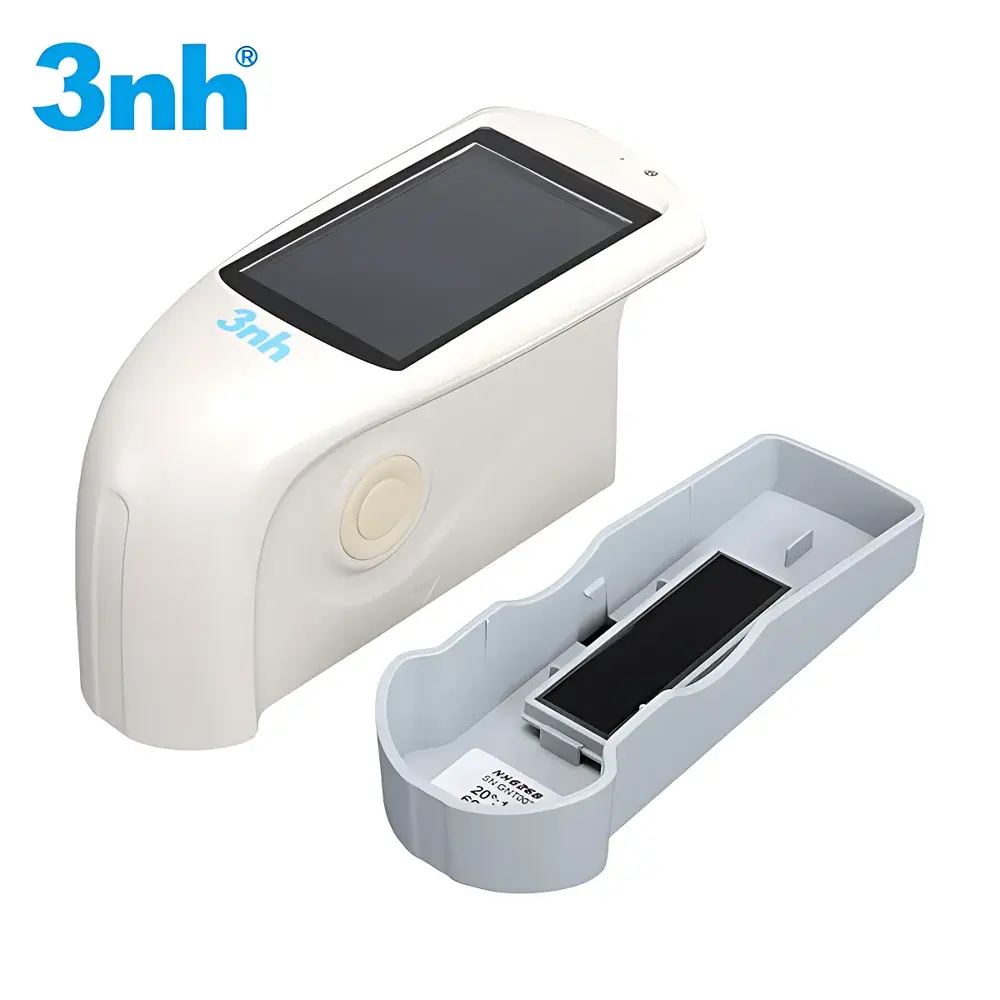
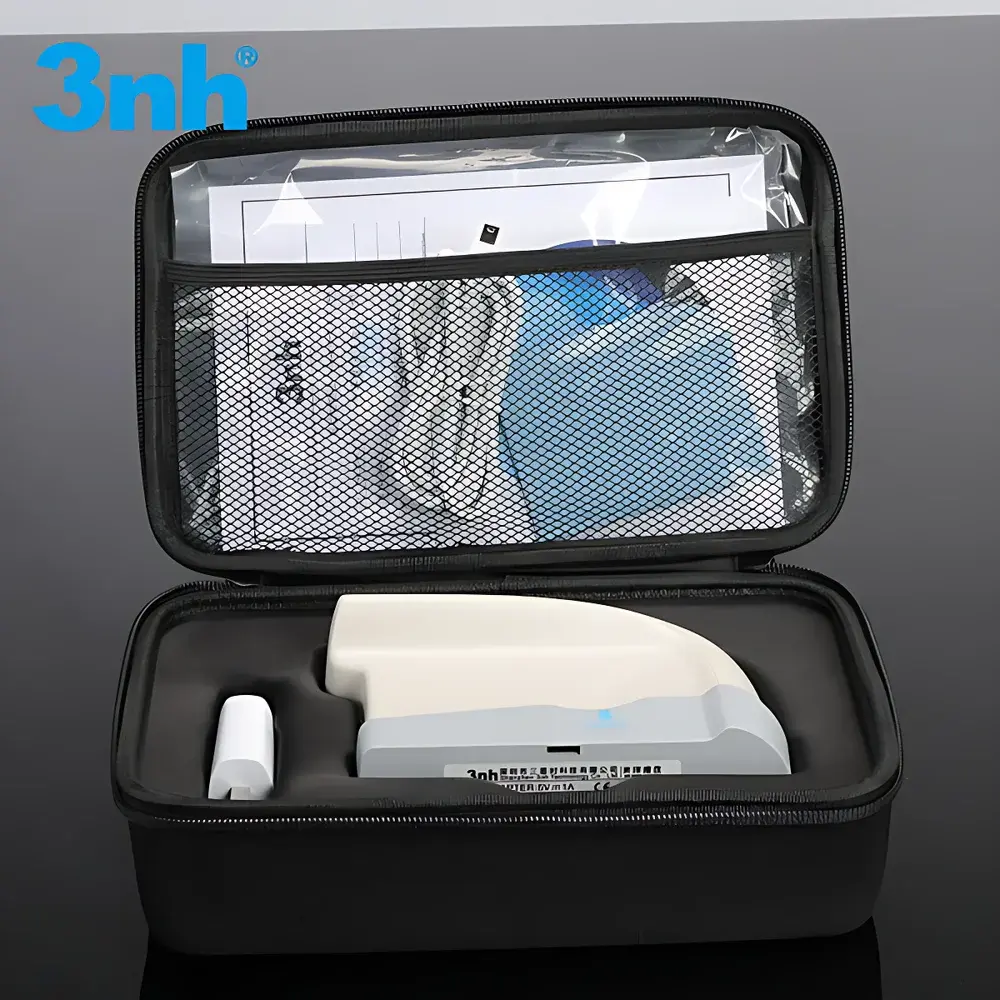
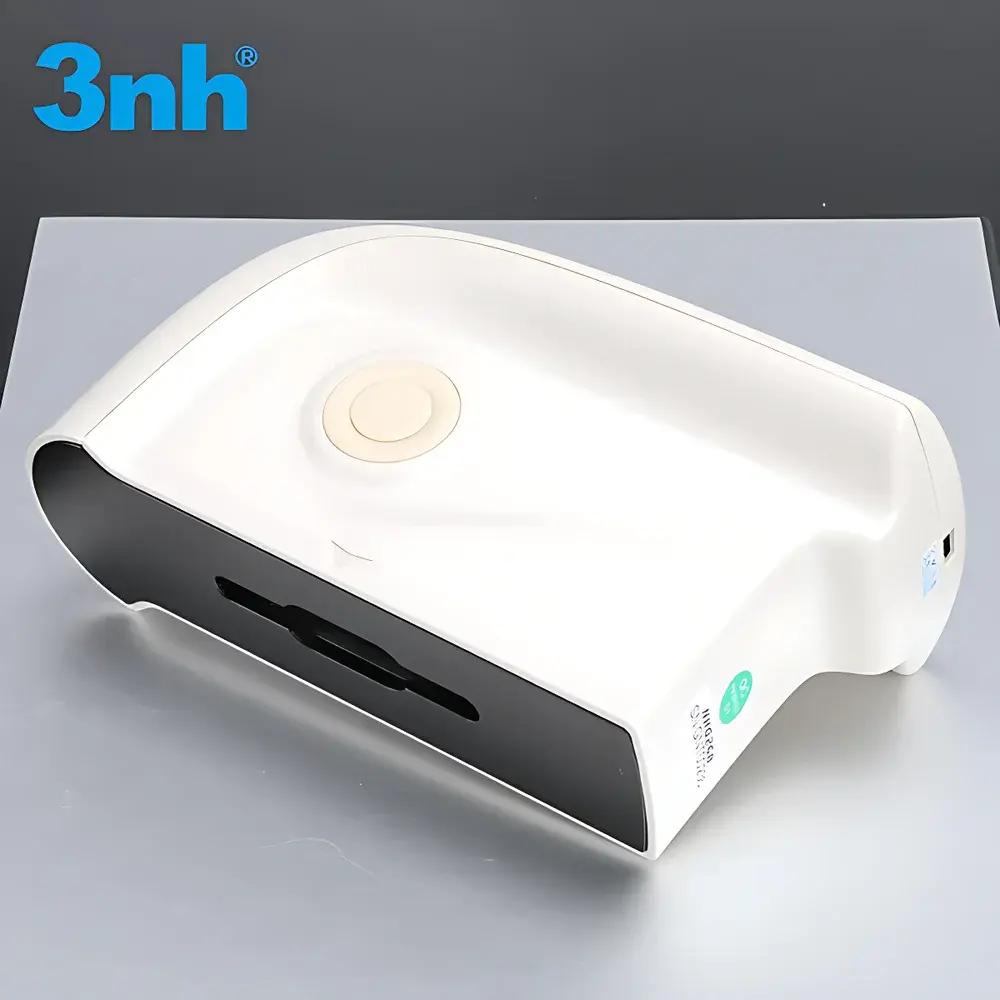
3nh NHG268 Touchscreen Tri-Angle Gloss Meter
| Brand | 3nh |
|---|---|
| Model | NHG268 |
| Measurement Angles | 20°, 60°, 85° |
| Display | 3.5-inch TFT color LCD (480 × 320 resolution) |
| Compliance | ISO 2813, GB/T 9754, ASTM D 523, ASTM D 2457 |
| Power | Rechargeable Li-ion battery with auto-off function |
| Operating Environment | Dry, stable temperature & illumination |
| Instrument Class | Manual portable gloss meter |
| Origin | Shenzhen, China |
| Manufacturer | 3nh Co., Ltd. |
Overview
The 3nh NHG268 Touchscreen Tri-Angle Gloss Meter is a precision optical instrument engineered for reliable, repeatable surface gloss evaluation across industrial quality control, R&D, and manufacturing environments. It operates on the principle of specular reflectance measurement—quantifying the ratio of reflected luminous flux to incident luminous flux at defined geometric angles under controlled CIE standard illuminant D65 conditions. Designed in strict accordance with ISO 2813 and GB/T 9754, and validated against ASTM D 523 (for high-gloss surfaces) and ASTM D 2457 (for low-to-medium gloss), the NHG268 delivers traceable, standards-aligned results without requiring external calibration references during routine use. Its tri-angle configuration (20°, 60°, and 85°) enables comprehensive characterization of diverse material classes—from mirror-polished metals and automotive clear coats (best assessed at 20°) to matte plastics and paper stocks (optimized at 85°)—with all three angles measured sequentially in a single placement, minimizing operator-induced variability.
Key Features
- Integrated 3.5-inch high-resolution TFT color display (480 × 320 pixels) with full-viewing-angle capability for clear data visualization under varied ambient lighting.
- Simultaneous support for three standardized measurement geometries: 20° (for high-gloss surfaces ≥ 70 GU), 60° (universal reference angle for mid-gloss materials), and 85° (for low-gloss or textured surfaces ≤ 10 GU).
- Ergonomic, handheld housing designed per human factors engineering principles—balanced weight distribution and contoured grip reduce fatigue during extended QC inspections.
- Onboard rechargeable lithium-ion battery with intelligent power management, including programmable auto-shutdown after user-defined idle periods (1–10 minutes).
- Internal memory stores up to 2,000 measurement records with timestamp, angle identifier, and statistical grouping (e.g., batch ID, sample number).
- One-touch automatic calibration using included ceramic standard plate (certified at 100 GU @ 60°); optional startup auto-calibration enhances measurement consistency across shifts.
- Multi-value display mode shows real-time comparison of current reading against mean, max/min, and standard deviation of up to 99 stored values per group.
Sample Compatibility & Compliance
The NHG268 is suitable for non-porous, planar, or gently curved surfaces—including painted panels, plastic injection-molded parts, coated papers, laminated films, and anodized aluminum. It is not intended for highly scattering, translucent, or wet specimens. All measurements adhere to the geometric and photometric requirements specified in ISO 2813:2014 (Plastics — Determination of gloss) and GB/T 9754–2007 (Paints and varnishes — Determination of specular gloss). The instrument’s optical path meets the aperture size (Ø9 mm), beam divergence (< 0.2°), and spectral response constraints defined in ASTM D 523–14 and ASTM D 2457–16. While not certified to ISO/IEC 17025, its design supports GLP-compliant workflows when used with documented calibration logs, environmental monitoring, and operator training records.
Software & Data Management
The NHG268 interfaces seamlessly with 3nh’s PC-based Quality Management Software (QMS v3.2+), supporting Windows OS. The software enables advanced statistical process control (SPC) functions—including X-bar & R charts, capability indices (Cp/Cpk), and trend analysis across multiple instruments and sites. Raw data export is available in CSV and Excel-compatible formats, preserving metadata such as date/time stamp, instrument serial number, operator ID, and calibration status. Audit trail functionality complies with basic FDA 21 CFR Part 11 expectations for electronic records (user authentication, action logging, and immutable data archiving), though full Part 11 validation requires site-specific implementation protocols.
Applications
- Automotive OEM and Tier-1 suppliers: Monitoring gloss uniformity of basecoats, clearcoats, and interior trim components across production lines.
- Coatings & ink manufacturers: Verifying batch-to-batch consistency and validating formulation changes against specification limits.
- Packaging converters: Assessing gloss retention after lamination, embossing, or UV-curing processes on flexible films and cartons.
- Plastics processors: Evaluating surface finish stability across injection molding cycles and mold maintenance intervals.
- Academic & government labs: Supporting materials science research on surface topography–gloss correlations and weathering degradation studies.
FAQ
What standards does the NHG268 comply with?
It conforms to ISO 2813, GB/T 9754, ASTM D 523, and ASTM D 2457 for gloss measurement methodology and instrumentation requirements.
Can the NHG268 measure curved or textured surfaces?
It is optimized for flat or gently curved surfaces with radius > 200 mm; strongly textured, rough, or highly curved substrates may yield non-representative readings due to beam scatter and aperture averaging effects.
Is the instrument suitable for use in humid environments?
No—operation is restricted to non-condensing relative humidity below 80% RH; moisture ingress may damage optics and electronics.
How often should calibration be performed?
Daily verification using the supplied standard tile is recommended before first use and after any significant temperature shift; full recalibration by an accredited lab is advised annually or per internal QA schedule.
Does the device support GLP/GMP documentation workflows?
Yes—the onboard data logging, QMS software audit trails, and calibration traceability enable integration into regulated quality systems when supported by appropriate procedural controls and personnel training.



