
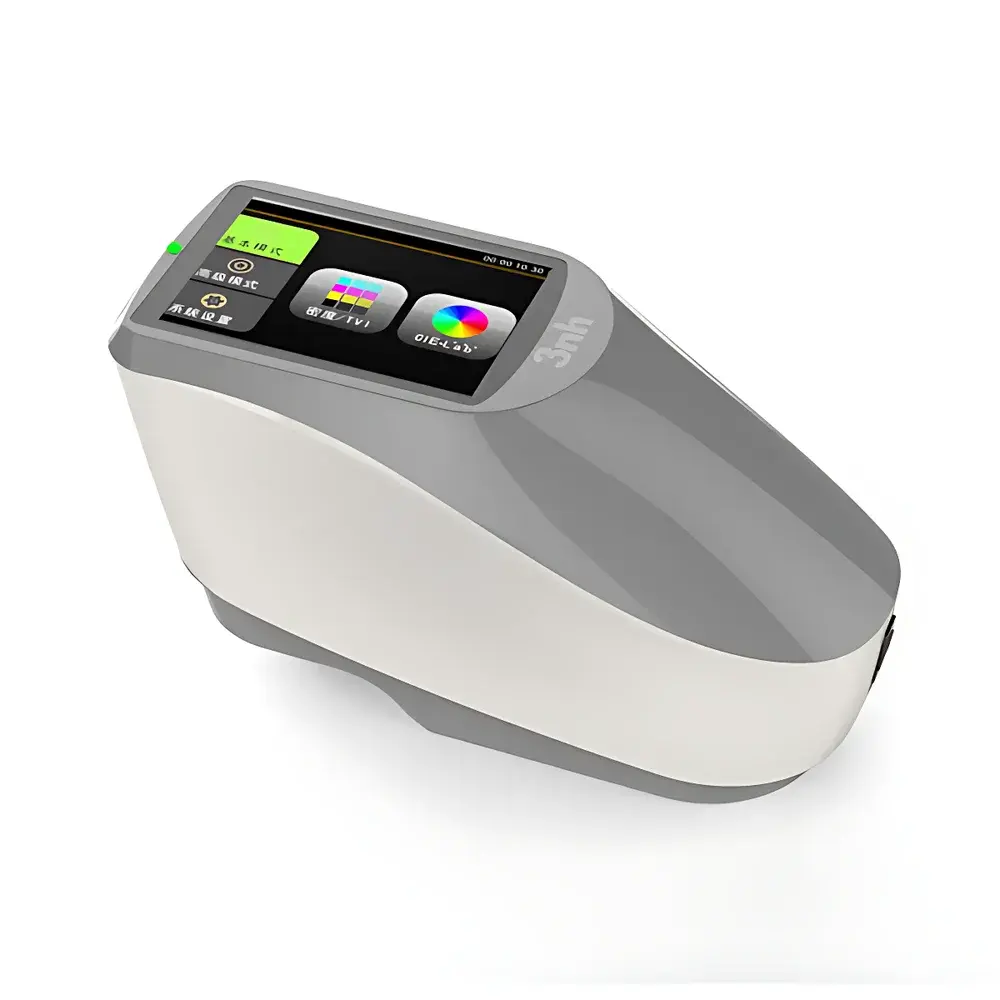
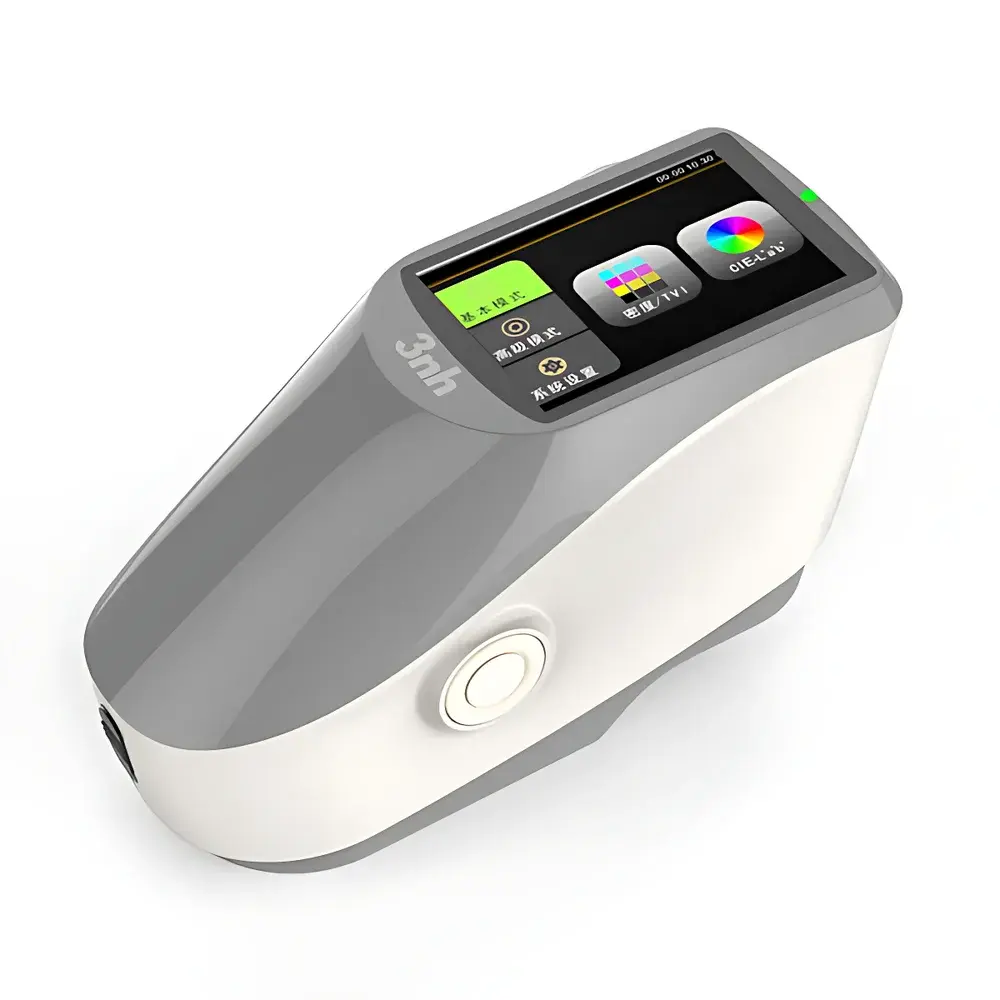
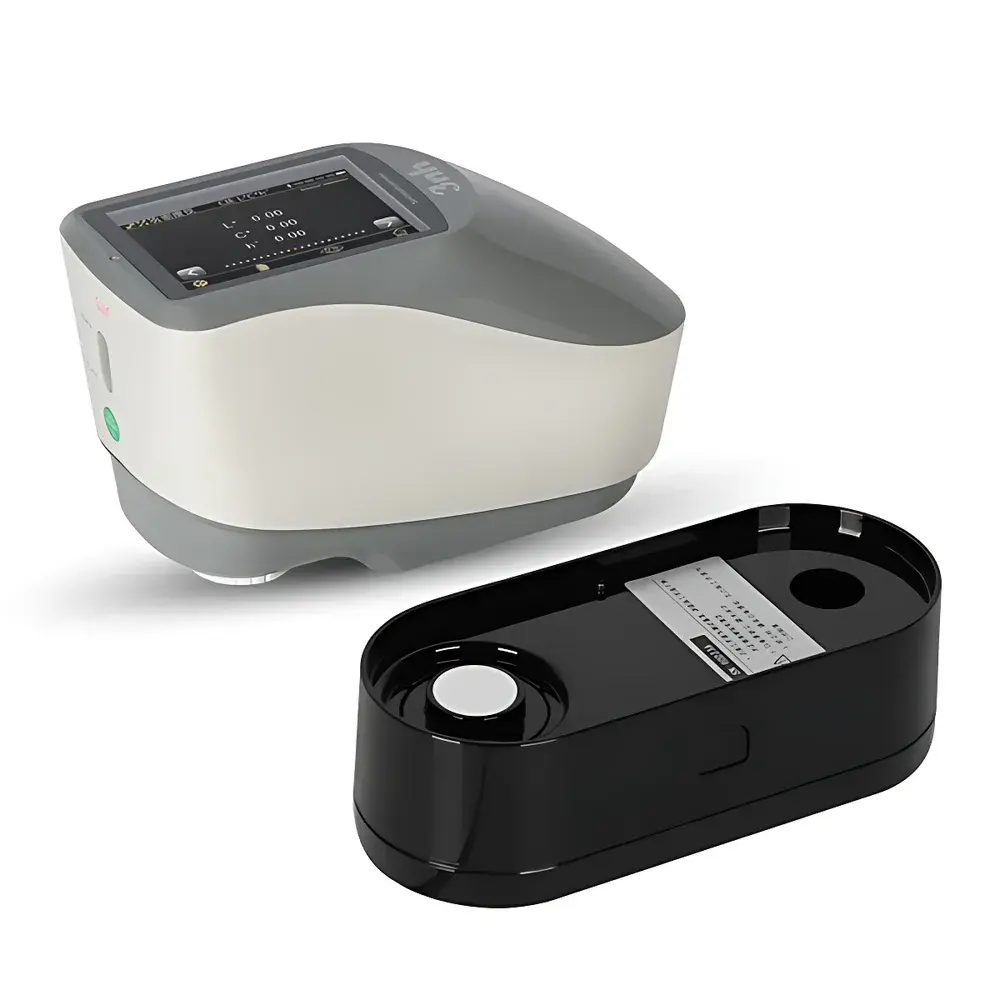
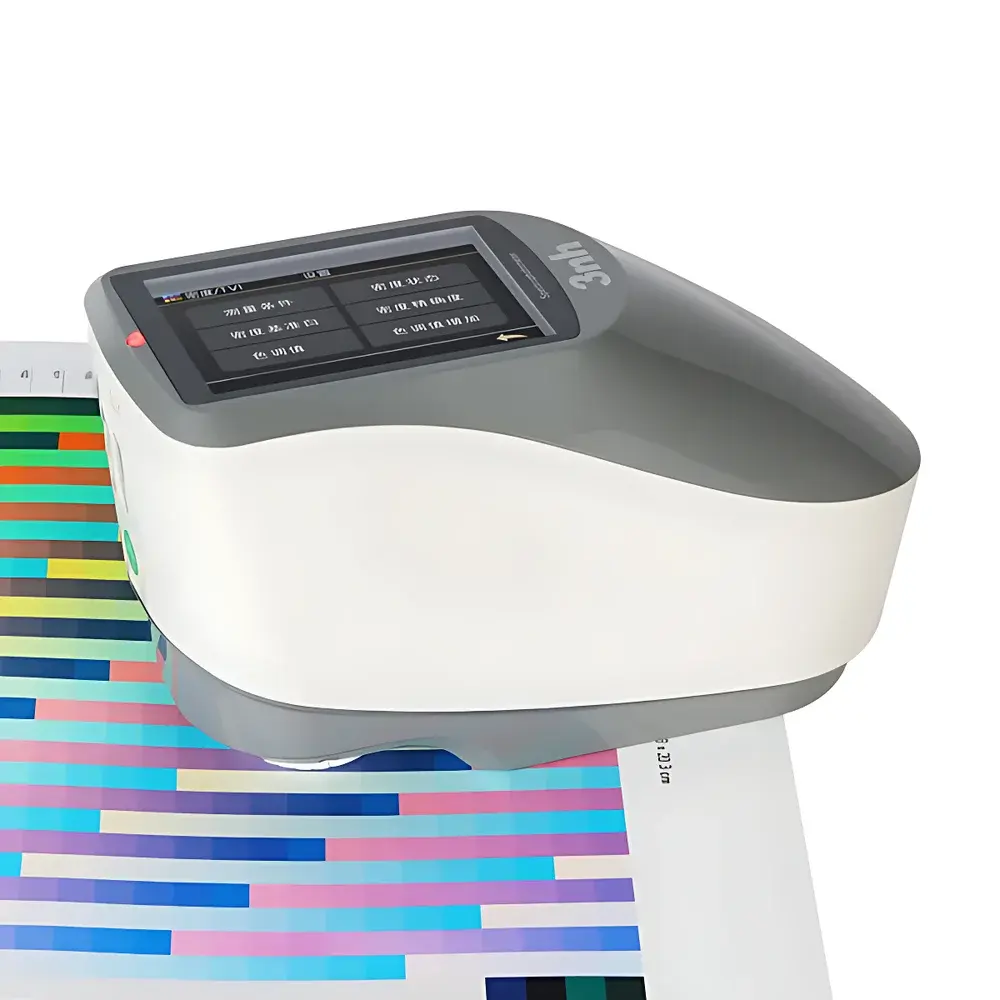
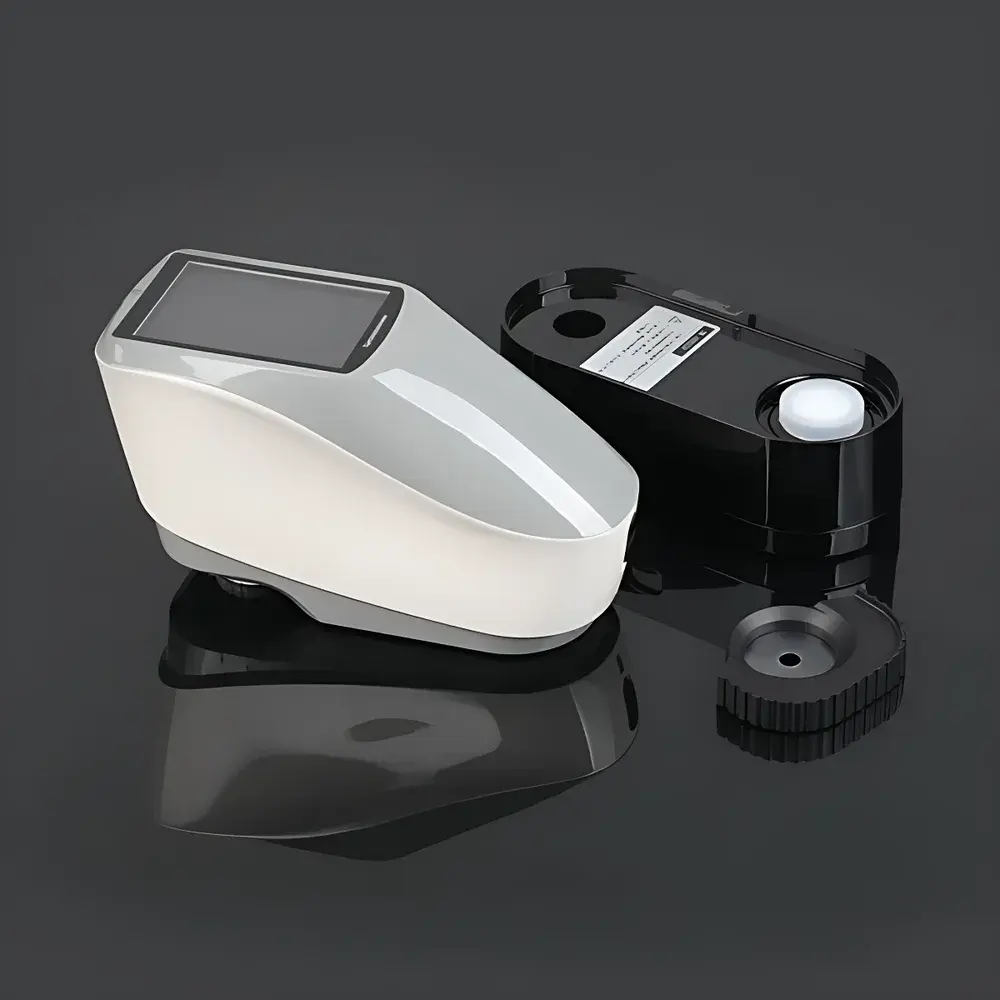
3nh YD5000 Spectrodensitometer & Color Difference Meter
| Brand | 3nh |
|---|---|
| Origin | Guangdong, China |
| Manufacturer Type | Manufacturer |
| Product Category | Domestic |
| Model | YD5000 |
| Product Type | Spectrodensitometer |
| Instrument Type | Portable |
| Optical Geometry | 45/0° (45° annular illumination, 0° viewing) |
| Light Source | Combined LED + UV LED |
| Spectral Range | 400–700 nm |
| Repeatability | Density ≤ 0.01 D |
Overview
The 3nh YD5000 Spectrodensitometer & Color Difference Meter is an ISO-compliant, portable optical measurement instrument engineered for precision density and colorimetric analysis in industrial quality control environments. Based on the standardized 45/0° optical geometry—defined in ISO 5-4 and CIE Publication No. 15—the YD5000 eliminates directional bias from surface texture and gloss, delivering high reproducibility for reflective samples such as printed substrates, films, textiles, and coated surfaces. Unlike simple tristimulus meters, the YD5000 employs a concave grating spectrophotometric engine with a 256-element dual-array CMOS sensor, enabling full spectral acquisition at 10 nm intervals across the visible spectrum (400–700 nm). This spectral foundation supports calculation of status-specific optical densities (T, E, A, I), dot gain, trapping, print contrast, hue error, and grayness per ISO 13655, while simultaneously generating CIE XYZ, CIELAB, and CIELCh coordinates. Its design targets laboratories and production floors where traceable, multi-metric evaluation of ink, toner, dye, and pigment systems is required under controlled or field conditions.
Key Features
- ISO-Compliant 45/0° Optical Architecture: Annular 45° illumination ensures uniform incident light distribution; 0° detector collects diffuse reflectance without specular component—ideal for matte to semi-gloss printed materials and films.
- M0/M1/M2/M3 Measurement Modes: Switchable illumination conditions per ISO 13655: M0 (CIE Illuminant A), M1 (D50), M2 (UV-filtered), and M3 (M2 + polarizing filter) enable consistent evaluation across substrate types and UV-fluorescent inks.
- High-Repeatability Spectral Engine: 10 nm spectral resolution, 10 nm FWHM, and dual-array CMOS detection yield density repeatability ≤ 0.01 D and colorimetric repeatability ΔE*ab ≤ 0.04 (after warm-up and white calibration, M3 excluded).
- Compact, Field-Ready Design: Dimensions 184 × 77 × 105 mm; weight ≈ 600 g; integrated 3.5″ capacitive touchscreen display; rechargeable Li-ion battery supporting ~5,000 measurements per charge.
- Multi-Metric Reporting: Simultaneous output of optical density (Status T/E/A/I), dot area (%), tone value, dot gain, trapping ratio, print contrast, hue error, and grayness—aligned with G7, GRACoL, and ISO 12647 workflows.
- Robust Data Infrastructure: On-device storage for up to 10,000 measurements; USB interface for firmware updates and data export; optional thermal printer support for real-time reporting.
Sample Compatibility & Compliance
The YD5000 is optimized for flat, opaque, or semi-opaque reflective samples with a 2 mm measurement aperture. It meets ISO 5-4 (geometry), ISO 13655 (spectral measurement conditions), and ASTM E308 (color computation) requirements. Its M3 mode satisfies ISO 15397 for polarized densitometry of halftone prints, while its UV-enabled M1 mode accommodates fluorescent brighteners in paper and textile substrates. The instrument is routinely deployed in GMP-aligned printing facilities, where its traceable calibration (via included ceramic white/black calibration tiles) and stable thermal design (operational range: 0–40°C, <85% RH non-condensing) support audit-ready operation. Though not FDA 21 CFR Part 11 certified out-of-the-box, its data export protocols (CSV, XML) integrate with validated LIMS and QMS platforms for regulated documentation.
Software & Data Management
The YD5000 operates with PC-based QC software (freely downloadable from 3nh’s official website), which provides advanced spectral analysis, batch comparison, tolerance mapping (with customizable ΔE*ab, ΔE*94, ΔE*00 limits), and SPC charting (X-bar/R, Cp/Cpk). All measurement metadata—including timestamp, operator ID, sample ID, illumination mode, and calibration history—is embedded in exported files. The software supports GLP-style audit trails when used with networked file servers and version-controlled configuration templates. Raw spectral data (.spc) and processed reports (.csv, .pdf) are structured for compatibility with enterprise color management systems (e.g., X-Rite Color iMatch, GMG ColorProof) via standard import filters.
Applications
- Offset, flexographic, gravure, and digital print shops performing daily press checks, ink formulation verification, and contract proof validation.
- Film and foil converters measuring density uniformity and spectral consistency of metallized or laminated substrates.
- Textile dye houses validating batch-to-batch color consistency under multiple illuminants (D65, A, F11) and assessing metamerism risk.
- Plastics and electronics manufacturers inspecting colored housings, membrane switches, and display overlays for hue stability and aging resistance.
- Prepress service bureaus conducting G7 calibration, ICC profile generation, and ISO 12647-2 compliance audits.
FAQ
What density standards does the YD5000 support?
It complies with ISO Status T (for newsprint), E (for European paper), A (for photographic materials), and I (for ink on plastic), all calculated per ISO 5-3 and ISO 13655.
Can the YD5000 measure fluorescent inks?
Yes—its integrated UV LED enables M1 mode measurements, critical for evaluating papers with OBAs and UV-reactive inks.
Is inter-instrument agreement quantified?
Yes: typical inter-instrument agreement is ΔE*ab ≤ 0.22 (BCRA Series II 14-color tile set, M3 excluded), supporting multi-site deployment.
How is calibration maintained in production environments?
The device includes a sealed ceramic white calibration tile and black trap; daily zero and white calibration is recommended before critical measurements.
Does the YD5000 support custom tolerance sets for different product lines?
Yes—the QC software allows creation of product-specific tolerance profiles with independent limits for density, ΔE, dot gain, and print contrast.





