
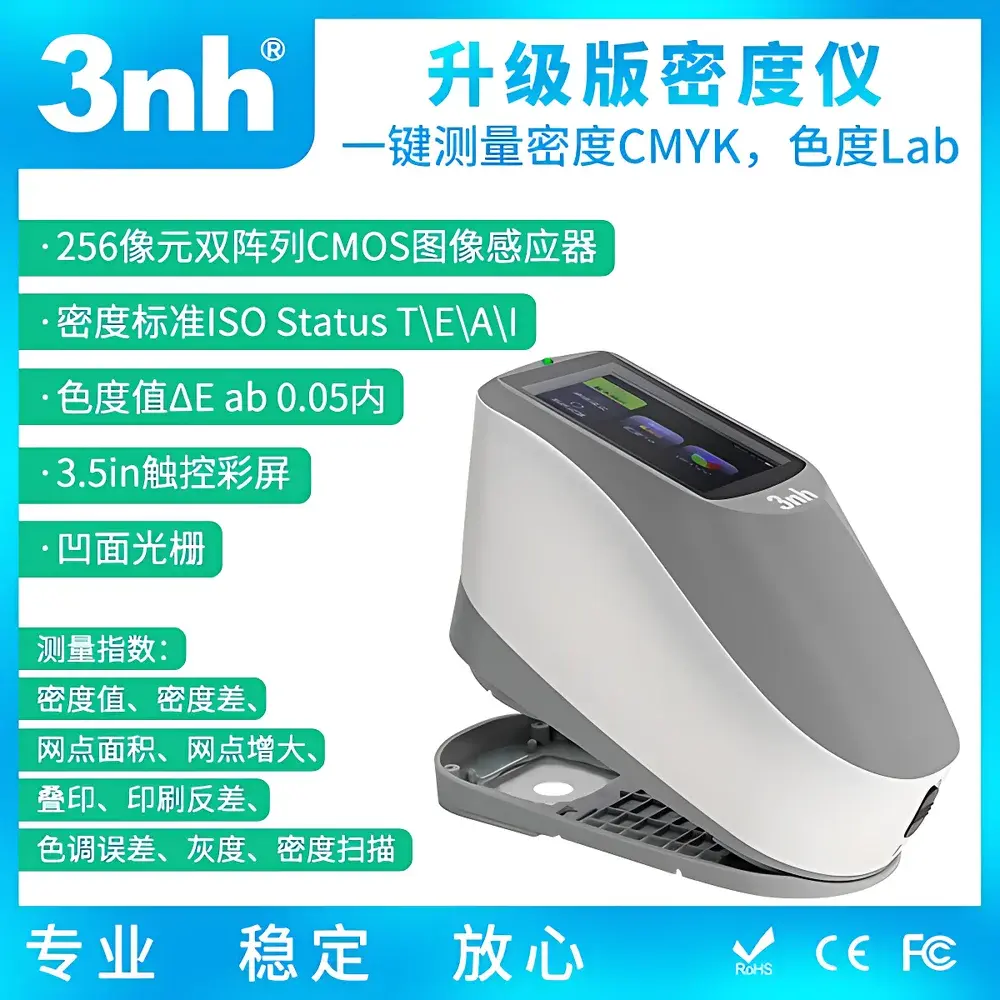
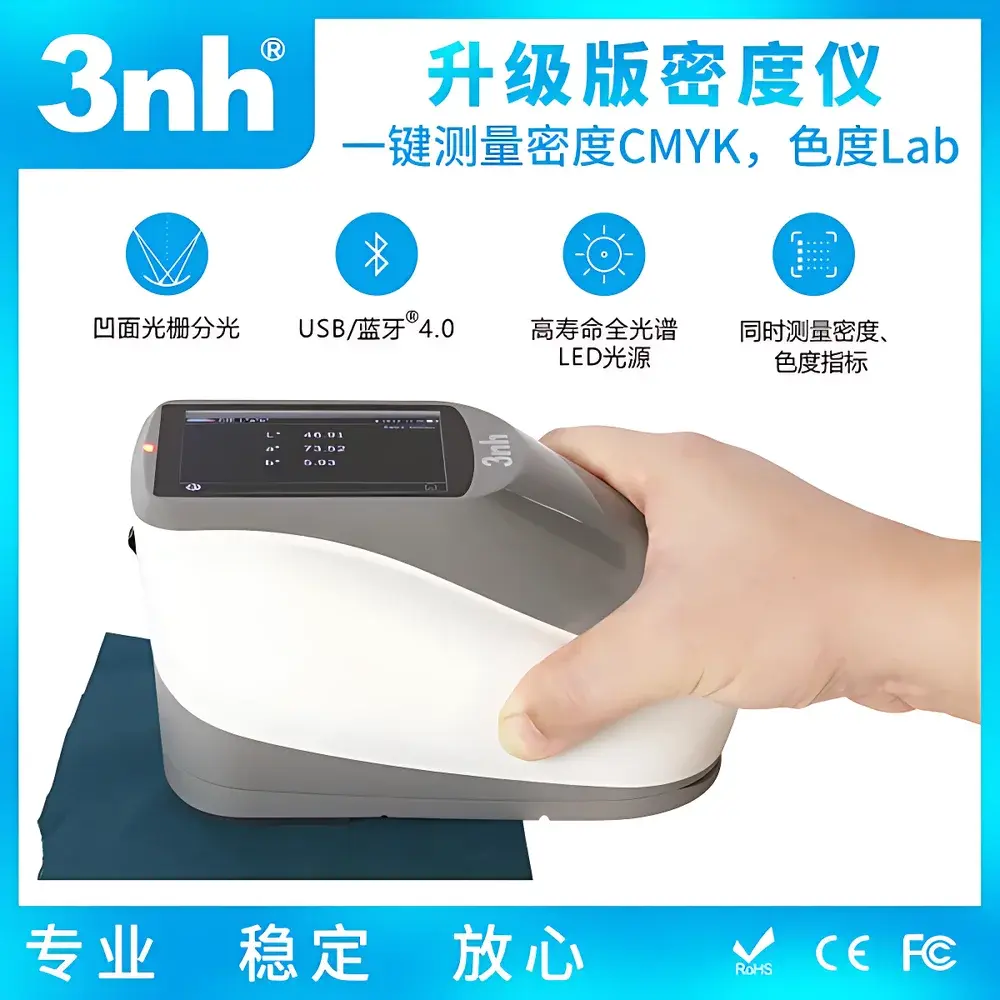
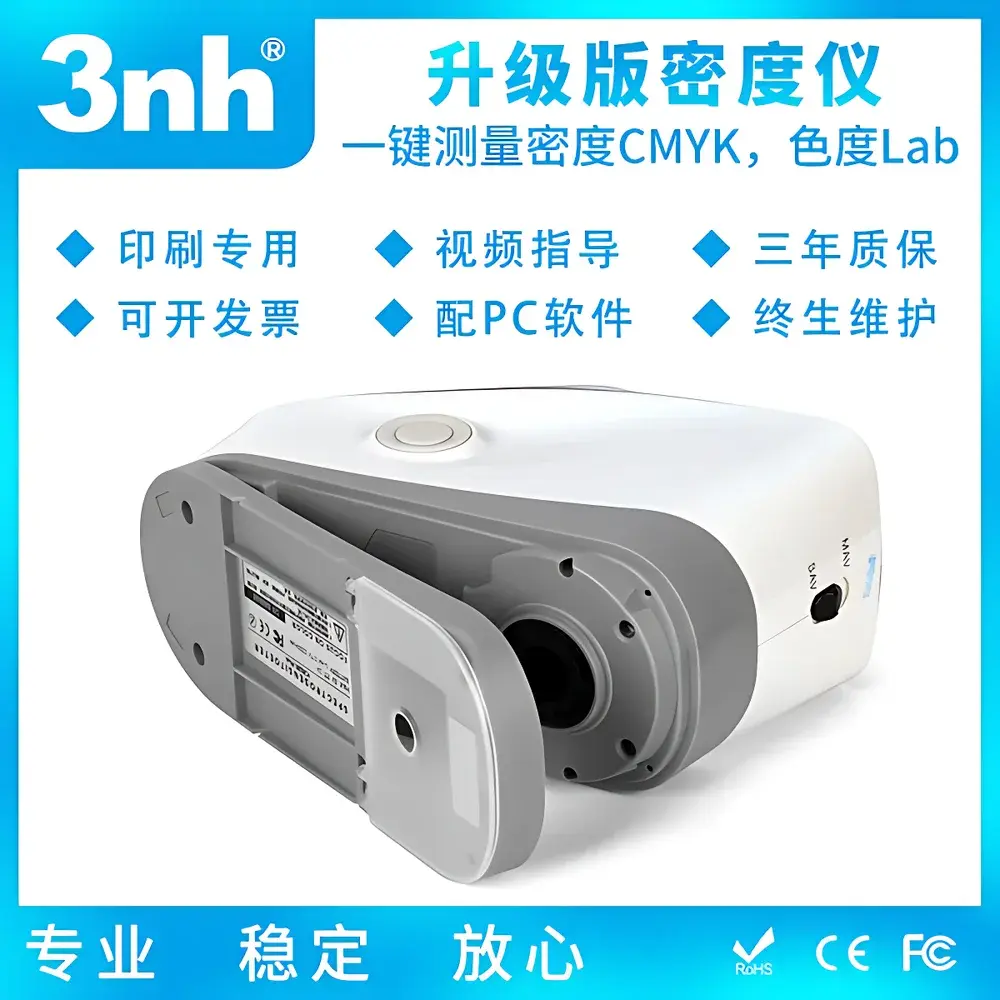
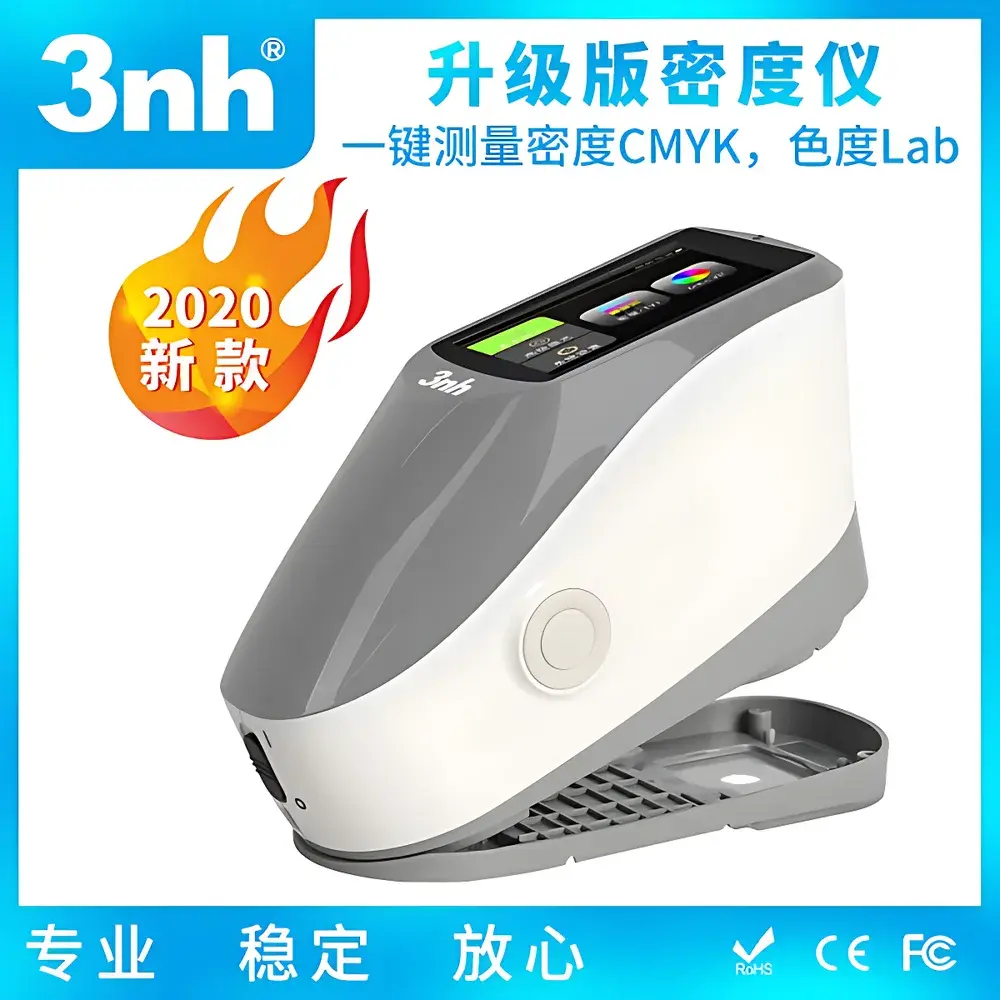
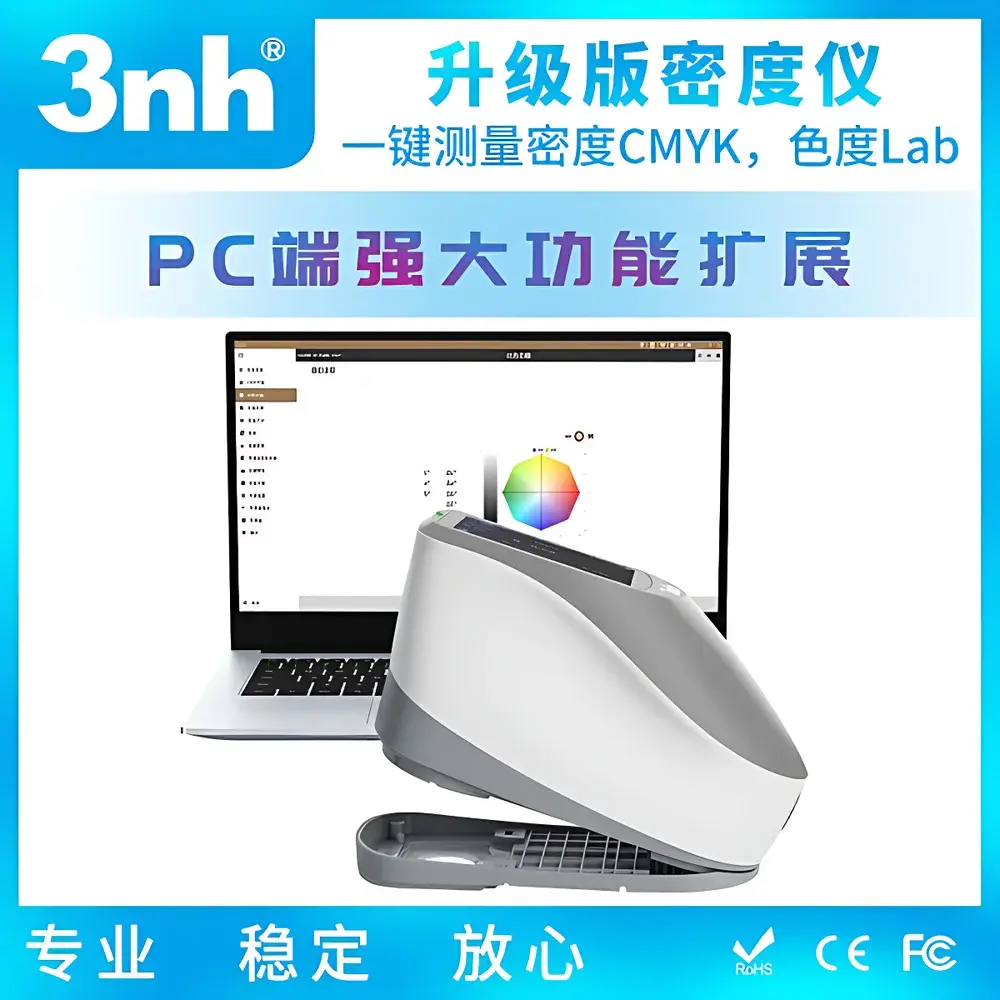
3nh YD5010 / YD5050Plus Spectrophotometric Densitometer
| Brand | 3nh |
|---|---|
| Origin | Guangdong, China |
| Manufacturer Type | Original Equipment Manufacturer (OEM) |
| Product Category | Spectrophotometric Densitometer |
| Instrument Type | Portable |
| Optical Geometry | 45/0° (45-degree annular illumination, 0-degree viewing) |
| Illuminants | A, C, D50, D55, D65, D75, F2, F7, F11, F12 |
| Spectral Range | 400–700 nm |
| Repeatability | ΔE*ab ≤ 0.04 (after instrument warm-up and calibration |
Overview
The 3nh YD5010 and YD5050Plus are portable spectrophotometric densitometers engineered for high-precision colorimetric and density measurement in graphic arts, packaging, printing, and quality assurance environments. Based on the CIE-recommended 45/0° optical geometry—compliant with ISO 5-4 and ISO 13655—the instruments deliver traceable spectral reflectance data across the visible spectrum (400–700 nm). Unlike traditional filter-based densitometers, these models employ a grating spectrophotometer architecture to acquire full-spectrum data, enabling simultaneous calculation of status T, E, A, and I densities per ISO 5-3 and ISO 13655. The 45/0° configuration ensures consistent illumination independent of surface texture or gloss, minimizing directional bias in reflective measurements—a critical requirement for standardized evaluation of printed substrates, coated papers, textiles, and traffic signage.
Key Features
- Compliance with international standards: Fully aligned with ISO 5-4 (geometric requirements), ISO 13655 (spectral measurement conditions M0, M1, M2, M3), and ISO 5-3 (density definitions).
- Dual-mode operation: Supports both spectrophotometric color measurement (CIELAB, CMC, ΔE00, etc.) and status-specific density calculation (T, E, A, I) within a single instrument platform.
- Multi-illuminant support: Built-in spectral power distribution libraries for A, C, D50, D55, D65, D75, F2, F7, F11, and F12—enabling accurate metamerism assessment and industry-specific lighting simulation.
- High repeatability: ΔE*ab ≤ 0.04 under controlled conditions (post-warm-up, calibrated against reference tile; 30 consecutive readings at 5 s intervals), ensuring statistical reliability for QC pass/fail decisions.
- Modular aperture design: Interchangeable measurement ports accommodate varying sample geometries and industry-standard field sizes (e.g., 3 mm, 6 mm, 8 mm), supporting ASTM D2244, ISO 11664-4, and GRACoL-certified workflows.
- Rugged portable form factor: Designed for benchtop and on-site use—with integrated battery, ergonomic grip, and IP52-rated enclosure suitable for production floor environments.
Sample Compatibility & Compliance
The YD5010/YD5050Plus is validated for opaque, semi-opaque, and matte-to-glossy reflective surfaces—including offset inks, gravure films, flexographic plates, coated/uncoated paper stocks, textile dyeings, and retroreflective road markings. Its 45/0° geometry eliminates specular component exclusion artifacts common in 0/45° systems, making it especially suited for non-Lambertian materials where surface finish impacts perceived color. All density algorithms conform to ISO 5-3:2009 and ANSI IT8.7/1–2015. For regulated industries, the instrument supports audit-ready data export formats (CSV, XML) compatible with GLP/GMP documentation frameworks and FDA 21 CFR Part 11–compliant software environments when paired with 3nh’s optional SpectraMagic NX or Color iQC integration modules.
Software & Data Management
The instrument operates standalone or connects via USB/Bluetooth to Windows-based color management platforms. The bundled software provides full spectral data visualization, batch comparison reports, tolerance mapping (ΔE, ΔL*, Δa*, Δb*, density deviation), and automated compliance checking against ISO, DIN, or customer-defined specifications. Exported datasets include wavelength-resolved reflectance curves, CIE XYZ tristimulus values, and metadata tags (illuminant, observer angle, measurement condition, timestamp, operator ID). Software logs maintain full traceability—including calibration history, user actions, and firmware version—supporting internal audits and external accreditation (e.g., ISO/IEC 17025 laboratories).
Applications
- Print production control: Real-time monitoring of ink density, dot gain, trapping, and gray balance across CMYK process workflows.
- Paper and board manufacturing: Quantification of brightness, yellowness (ASTM E313), and whiteness indices (CIE WH, Ganz) alongside spectral reflectance uniformity.
- Textile and apparel QA: Batch-to-batch consistency verification for dyed fabrics under multiple illuminants to assess metamerism risk.
- Traffic safety materials: Evaluation of retroreflective sheeting chromaticity and luminance factor per EN 12899-1 and ASTM E808.
- Academic and metrology research: Reference-grade spectral acquisition for model validation, pigment dispersion analysis, and substrate interaction studies.
FAQ
What density standards does the YD5050Plus support?
It calculates Status T, E, A, and I densities per ISO 5-3:2009 and supports M0 (incandescent), M1 (daylight), M2 (UV-cut), and M3 (polarized) measurement conditions as defined in ISO 13655:2017.
Is the instrument suitable for measuring transparent or translucent films?
No—it is designed exclusively for reflective, opaque, or semi-opaque samples. Transmissive measurement requires a dedicated transmission densitometer or spectrophotometer with dual-beam optics.
How is calibration traceability maintained?
Each unit ships with NIST-traceable ceramic calibration tiles. Users perform daily zero and white calibration; full spectral verification is recommended quarterly using certified reference standards.
Can measurement data be integrated into LIMS or ERP systems?
Yes—via CSV/XML export or API-enabled third-party middleware. Raw spectral data and calculated metrics are fully structured for ingestion into laboratory information management systems compliant with ISO/IEC 17025 Annex A.2.
Does the device meet FDA or EU regulatory requirements for color-critical manufacturing?
While the hardware itself is not FDA-cleared, its measurement methodology, data integrity features, and software audit trails align with 21 CFR Part 11 and EU Annex 11 expectations when deployed within validated quality systems.




