
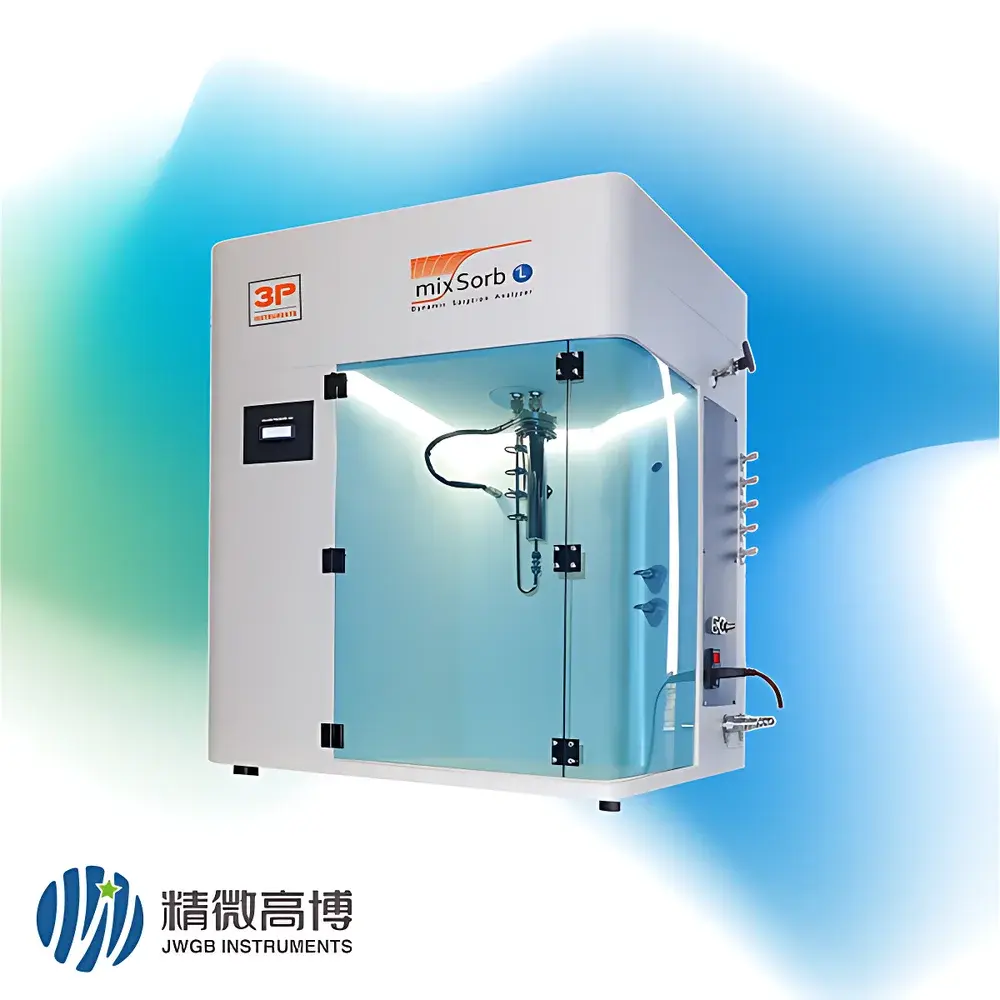
3P mixSorb L Multicomponent Dynamic Breakthrough Curve Analyzer (Up to 68 bar)
| Brand | 3P Instruments |
|---|---|
| Origin | Germany |
| Model | mixSorb L |
| Maximum Adsorption Pressure | 68 bar |
| Number of Mass Flow Controllers (MFCs) | 4 |
| Detector Type | TCD (Thermal Conductivity Detector) |
| Column Dimensions (Standard) | 30 mm ID × 200 mm length |
| Gas Range | Customizable |
| Column Configuration | Customizable |
| Temperature Pre-treatment Range | Up to 400 °C |
| Heating Rate | Up to 10 K/min |
| Software | mixSorb Manager & 3P sim |
| Compliance | Designed for GLP/GMP-aligned operation with audit-trail-capable data logging |
Overview
The 3P mixSorb L Multicomponent Dynamic Breakthrough Curve Analyzer is an engineered platform for quantitative, time-resolved investigation of competitive adsorption behavior under industrially relevant pressure and temperature conditions. Operating on the principle of dynamic breakthrough chromatography, the system introduces precisely controlled gas mixtures—comprising two to four components—into a fixed-bed adsorption column while continuously monitoring effluent composition via high-stability thermal conductivity detection. This enables direct measurement of component-specific breakthrough times, saturation profiles, mass transfer zones, and axial concentration gradients. With a maximum operating pressure of 68 bar and pre-treatment capability up to 400 °C, the mixSorb L supports rigorous characterization of advanced porous materials—including metal–organic frameworks (MOFs), covalent organic frameworks (COFs), zeolites, activated carbons, and functionalized silica gels—under realistic process conditions representative of pressure swing adsorption (PSA), vacuum swing adsorption (VSA), and natural gas upgrading applications.
Key Features
- Four independently programmable mass flow controllers (MFCs) enabling precise, real-time blending of multi-component gas streams with full traceability of individual flow rates and total mixture composition.
- Standard adsorption column (30 mm internal diameter × 200 mm length) fabricated from high-grade stainless steel, rated for sustained operation up to 68 bar and compatible with custom column geometries and packing configurations.
- Integrated TCD detector with low-noise electronics and temperature-compensated signal processing, delivering stable baseline performance across wide-ranging thermal and pressure transients.
- Automated differential pressure monitoring between column inlet and outlet, supporting concurrent analysis of pressure drop evolution and adsorption kinetics.
- In-situ thermal pre-conditioning module with programmable heating ramp (up to 10 K/min) and isothermal hold capability up to 400 °C—essential for activation, regeneration, and moisture removal protocols.
- Full pneumatic valve sequencing with fail-safe interlocks, redundant pressure relief pathways, and integrated safety sensors (temperature, pressure, gas leak) compliant with IEC 61508 SIL 2 functional safety principles.
Sample Compatibility & Compliance
The mixSorb L accommodates granular, pelletized, or monolithic adsorbent forms in standard or user-defined column configurations. Its modular architecture permits rapid adaptation to varying particle size distributions (typically 0.2–5 mm), bed void fractions, and thermal mass requirements. The system adheres to foundational standards governing adsorption testing methodologies, including ISO 15901-2 (physisorption), ASTM D3663 (activated carbon activity), and ISO 20875 (gas separation performance). Data acquisition and storage conform to ALCOA+ principles (Attributable, Legible, Contemporaneous, Original, Accurate, Complete, Consistent, Enduring, Available), supporting regulatory readiness for FDA 21 CFR Part 11 and EU Annex 11 environments when deployed with appropriate IT validation protocols.
Software & Data Management
Control and analysis are unified through two dedicated software modules: mixSorb Manager and 3P sim. mixSorb Manager provides real-time visualization of all hardware states—including MFC setpoints, valve positions, column temperatures, inlet/outlet pressures, and TCD response—via a deterministic, event-driven interface with full command logging and electronic signature support. 3P sim implements physics-based modeling of breakthrough dynamics using linear driving force (LDF), Langmuir, and extended dual-site Langmuir formulations. It supports simultaneous fitting of multi-component breakthrough curves, estimation of binary/multi-component selectivity coefficients, calculation of effective diffusivities, and prediction of column service life under cyclic operation. All raw and processed data are stored in vendor-neutral HDF5 format with embedded metadata, ensuring long-term archival integrity and third-party interoperability.
Applications
- Quantification of competitive adsorption isotherms and kinetics for CO₂ capture sorbents under flue gas or direct air capture conditions (e.g., CO₂/N₂/O₂/H₂O mixtures).
- Evaluation of hydrocarbon separation selectivity in light olefin/paraffin systems (e.g., C₃H₆/C₃H₈, C₂H₄/C₂H₆) at elevated pressures relevant to petrochemical purification.
- Performance benchmarking of MOF-based methane storage media under ANG (adsorbed natural gas) conditions (CH₄/C₂H₆/N₂ mixtures, up to 68 bar).
- Thermal stability assessment and regeneration cycle endurance testing of adsorbents subjected to repeated adsorption–desorption sequences.
- Validation of process simulation models (e.g., Aspen Adsorption, gPROMS) using experimentally derived transport and equilibrium parameters.
FAQ
What gas compositions can be analyzed with the mixSorb L?
The system supports customizable binary, ternary, or quaternary gas mixtures; common configurations include CO₂/N₂, CH₄/N₂, C₃H₆/C₃H₈, and H₂/CO₂/CH₄ blends. Optional integration with quadrupole mass spectrometry extends detection to trace impurities and reaction byproducts.
Is column temperature uniformity actively controlled?
Yes—the standard furnace features axial zone control with independent thermocouple feedback loops, maintaining ±1 °C isothermality over the active bed length during steady-state operation.
Can breakthrough data be exported for external modeling?
All time-series sensor outputs (TCD voltage, pressure, temperature, flow) are exportable in CSV and HDF5 formats, including calibrated units and timestamped metadata required for model parameterization.
Does the system support automated regeneration cycles?
Through programmable sequence logic in mixSorb Manager, users can define multi-step purge-heating-cooling protocols with pressure and temperature ramp constraints, enabling unattended cyclic testing.
How is calibration traceability maintained for MFCs and TCD?
Each MFC is factory-calibrated against NIST-traceable standards; TCD sensitivity is verified using certified reference gas mixtures prior to critical experiments, with calibration logs retained in the audit trail.
Related Products



