
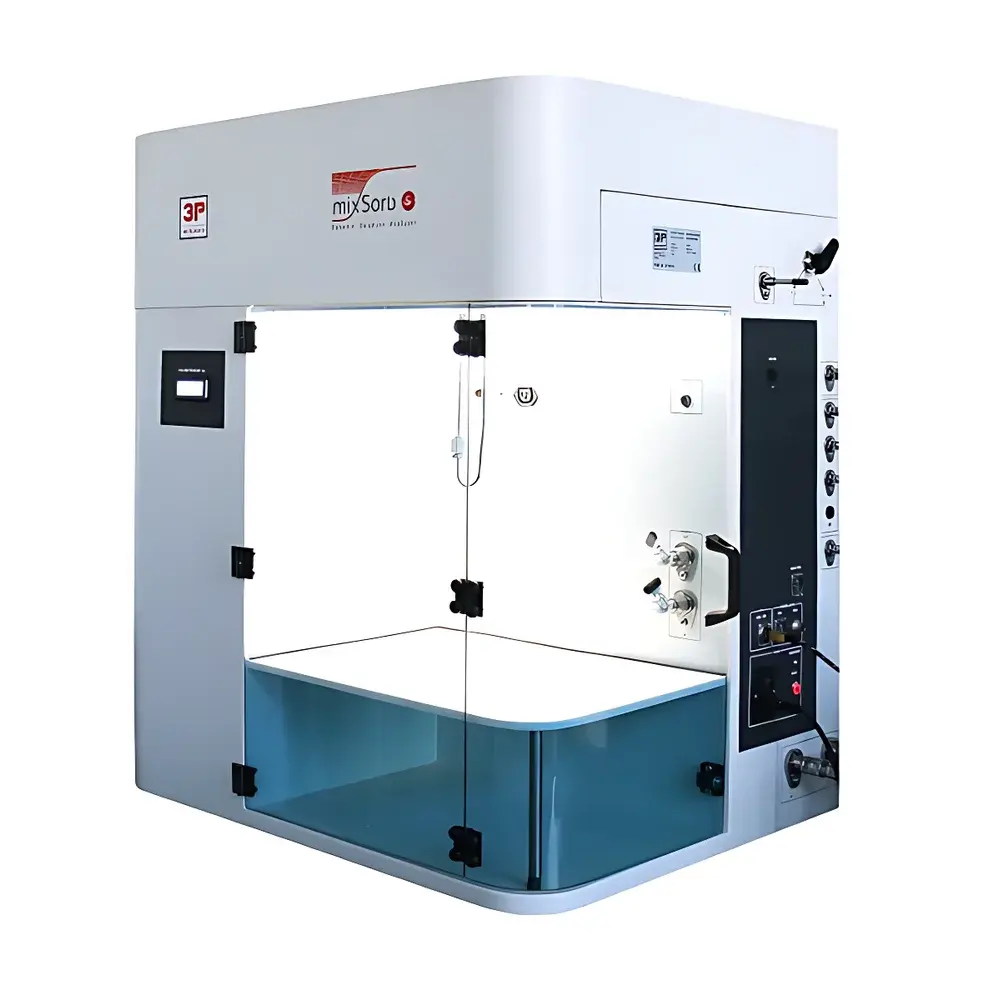
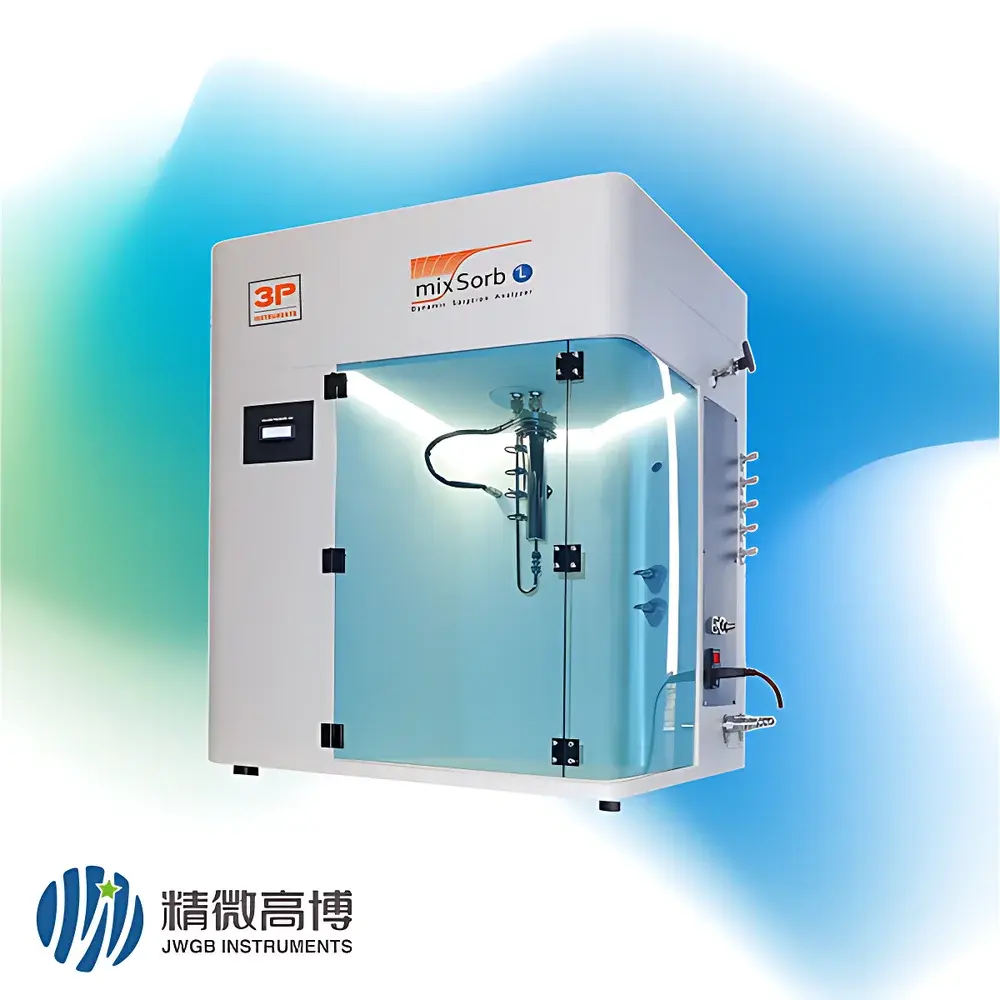
3P mixSorb S Multicomponent Competitive Adsorption Analyzer
| Brand | 3P Instruments |
|---|---|
| Origin | Germany |
| Model | mixSorb S |
| Maximum Adsorption Pressure | 68 bar |
| Mass Flow Controllers (MFCs) | 4 |
| Detector | TCD (Thermal Conductivity Detector) |
| Temperature Control | Up to 400 °C pre-treatment, Linear Heating Rate: 10 K/min |
| Software | mixSorb Manager (real-time control & programmable operation), 3P sim (data fitting, breakthrough curve simulation, multicomponent adsorption modeling, selectivity/affinity/kinetics calculation) |
Overview
The 3P mixSorb S Multicomponent Competitive Adsorption Analyzer is a high-precision, modular gas-phase dynamic adsorption system engineered for quantitative investigation of competitive adsorption behavior under industrially relevant conditions. It operates on the principle of dynamic breakthrough chromatography—where precisely controlled multicomponent gas mixtures are passed through a packed adsorbent bed at defined temperature and pressure, while real-time effluent composition is monitored via integrated thermal conductivity detection. This enables direct measurement of component breakthrough times, saturation capacities, and competitive displacement kinetics—critical parameters for evaluating advanced porous materials such as metal–organic frameworks (MOFs), covalent organic frameworks (COFs), zeolites, and functionalized carbons. The system supports operation across a wide thermodynamic envelope (ambient to 400 °C pre-treatment; up to 68 bar absolute pressure), ensuring experimental fidelity for applications ranging from carbon capture process screening to hydrogen purification and VOC recovery optimization.
Key Features
- Four independently calibrated mass flow controllers (MFCs) enabling precise, programmable blending of up to four gaseous components with sub-sccm resolution and <±1% full-scale accuracy.
- Automated, closed-loop pressure regulation with simultaneous inlet and outlet column pressure monitoring—allowing real-time ΔP tracking and isobaric or gradient-pressure operation modes.
- Modular breakthrough column architecture: compatible with standardized micro-columns (4.57 mm ID × 4.5 cm), small columns (10 mm ID × 6 cm), and scalable configurations for method transfer.
- Integrated TCD detector with high thermal stability and low noise floor (<0.5 µV baseline drift over 24 h), optimized for permanent gases (N₂, O₂, CO, CH₄, H₂, CO₂) and light hydrocarbons.
- Onboard pre-treatment furnace with programmable heating profiles (max. 400 °C, linear ramp rate up to 10 K/min) and automated purge-gas sequencing for in situ adsorbent activation.
- Full hardware interlocking and redundant safety sensors—including overpressure cutoff, temperature limit switches, and gas leak detection—compliant with IEC 61508 SIL 2 functional safety requirements.
Sample Compatibility & Compliance
The mixSorb S accommodates powdered, pelletized, or extruded adsorbents with particle sizes ranging from 20 µm to 2 mm. Column packing protocols are validated per ASTM D3803-20 (Standard Test Methods for Activated Carbon Adsorption Capacity) and ISO 12213-3 (Natural gas—Calculation of compression factor—Part 3: Calculation using physical properties). System architecture and software workflows support audit-ready data integrity in accordance with FDA 21 CFR Part 11 (electronic records/signatures), including user access controls, electronic audit trails, and immutable raw-data archiving. All pressure vessels conform to PED 2014/68/EU and ASME BPVC Section VIII Division 1 certification standards.
Software & Data Management
Control and analysis are unified within two complementary software modules: mixSorb Manager and 3P sim. mixSorb Manager provides real-time visualization of all hardware states—including valve positions, MFC setpoints, temperature gradients, and pressure differentials—with full scripting capability for sequence-based automation (e.g., multi-step adsorption-desorption cycles). 3P sim implements physics-based modeling engines for nonlinear regression of multicomponent Langmuir, extended Langmuir, and ideal adsorbed solution theory (IAST) isotherms. It generates predictive breakthrough curves, calculates component selectivity ratios (αi/j), quantifies adsorption affinity constants (Ki), and extracts intraparticle diffusion coefficients (De) via pore-diffusion modeling. Export formats include CSV, HDF5, and native MATLAB .mat files—ensuring seamless integration with third-party modeling environments.
Applications
- Screening MOF/COF materials for post-combustion CO₂ capture under flue-gas-relevant conditions (15% CO₂ / 85% N₂, 40–60 °C, 1–2 bar).
- Determining binary and ternary selectivity of zeolite 13X for H₂/CO₂/CH₄ separation in blue hydrogen purification streams.
- Quantifying water vapor inhibition effects on activated carbon performance in VOC abatement systems.
- Validating kinetic models for pressure swing adsorption (PSA) cycle design using experimentally derived mass-transfer zone (MTZ) lengths.
- Supporting GLP-compliant adsorbent qualification for pharmaceutical-grade nitrogen generation (USP <857> and ISO 8573-1 Class 0 air purity verification).
FAQ
Can the mixSorb S be interfaced with a quadrupole mass spectrometer (QMS)?
Yes—the system includes a dedicated vacuum-compatible bypass port with heated transfer line (up to 200 °C) and analog/digital output interfaces for synchronized QMS triggering and signal acquisition.
Is calibration traceable to NIST standards?
All MFCs are factory-calibrated against NIST-traceable reference gases (certified mixtures from Linde or Air Liquide); calibration certificates are supplied with each instrument shipment.
What column dimensions are supported for the mixSorb S configuration?
Standard configurations include micro-columns (4.57 mm ID × 45 mm length) and small columns (10 mm ID × 60 mm length); custom geometries (e.g., tapered, segmented, or multi-zone beds) can be implemented upon request.
Does the software support automated isotherm generation?
Yes—via programmed stepwise pressure increments at constant temperature, with automatic equilibrium detection based on TCD signal stabilization thresholds and user-defined convergence criteria.
How is data security ensured during remote operation?
Remote access is restricted to TLS 1.3-encrypted connections; all sessions require dual-factor authentication, and no data resides on cloud infrastructure—local storage adheres to ISO/IEC 27001 encryption-at-rest policies.



