
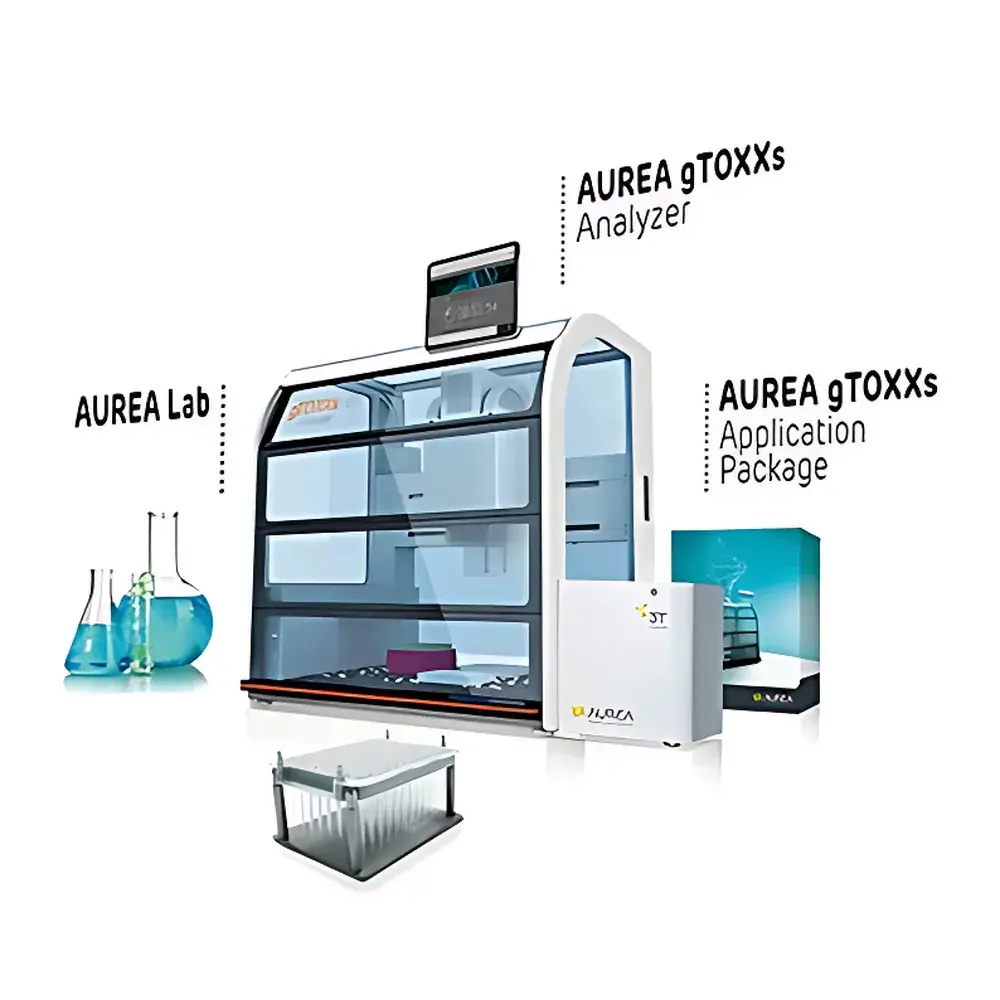
3T analytik AUREA gTOXXs Automated High-Throughput DNA Damage Analyzer
| Brand | 3T analytik |
|---|---|
| Origin | Germany |
| Model | AUREA gTOXXs |
| Category | Imported Instrument |
| Distributor Type | Authorized Distributor |
| Pricing | Available Upon Request |
Overview
The 3T analytik AUREA gTOXXs is an automated, high-throughput analytical platform engineered for quantitative assessment of DNA strand breaks in mammalian cells using the Fluorimetric Detection of Alkaline DNA Unwinding (FADU) principle. This method exploits the differential denaturation kinetics of intact versus damaged DNA under controlled alkaline conditions: single-strand breaks accelerate unwinding, increasing the proportion of single-stranded DNA available for fluorescent intercalator binding. The AUREA gTOXXs measures fluorescence intensity—proportional to the extent of unwinding—and converts it into a normalized DNA damage index (e.g., % unwound DNA or lesion frequency per 109 Da), enabling absolute quantification without radiolabeling or electrophoresis. Designed for regulatory-grade genotoxicity screening, the system delivers traceable, reproducible results aligned with OECD Test Guideline 489 and ISO 10993-3 requirements for genetic toxicity evaluation of pharmaceuticals, chemicals, and biomaterials.
Key Features
- Fully automated liquid handling with integrated centrifugation, lysis, alkaline denaturation, neutralization, and fluorometric readout—eliminating manual pipetting variability
- Parallel processing of up to 96 samples per run with <1.5% intra-assay CV and <3.2% inter-assay CV across biological replicates
- On-board temperature-controlled incubation (4–40 °C ±0.3 °C) for standardized cell lysis and enzymatic repair step integration (e.g., Fpg or EndoIII for oxidized base detection)
- Optimized optical path with dual-wavelength excitation/emission (480/520 nm) and auto-gain adjustment to accommodate dynamic fluorescence ranges from 102 to 106 RFU
- Modular architecture supporting GLP-compliant audit trails, electronic signatures (21 CFR Part 11 compliant), and instrument qualification documentation (IQ/OQ/PQ templates included)
Sample Compatibility & Compliance
The AUREA gTOXXs accepts cultured adherent or suspension cells (human, rodent, or non-mammalian lines), primary isolates (e.g., peripheral blood lymphocytes), and ex vivo tissue homogenates. Sample input ranges from 1×10⁴ to 5×10⁵ viable cells per well, with optional cryopreserved cell bank integration. All assay protocols adhere to Good Laboratory Practice (GLP) principles and support validation against reference mutagens (e.g., methyl methanesulfonate, hydrogen peroxide, UV-C). Data output formats comply with CDISC SEND standards for regulatory submission, and instrument firmware includes built-in calibration verification using NIST-traceable fluorescent microbeads.
Software & Data Management
Control and analysis are executed via gTOXXs Control Suite v4.2—a validated Windows-based application featuring role-based access control, real-time run monitoring, and automated QC flagging (e.g., outlier wells, insufficient cell viability, buffer carryover). Raw fluorescence data undergoes background subtraction, kinetic curve fitting (first-order unwinding model), and lesion quantification using internal standard curves generated from gamma-irradiated reference samples. Reports include summary statistics, dose–response modeling (log-logistic regression), and export to CSV, PDF, or XML for LIMS integration. Audit logs record all user actions, parameter changes, and calibration events with immutable timestamps.
Applications
- Regulatory genotoxicity screening of drug candidates (ICH S2(R2) compliant)
- Quantitative assessment of DNA repair kinetics following exposure to ionizing radiation or chemotherapeutics
- Detection of oxidative DNA damage in models of aging, neurodegeneration (e.g., Alzheimer’s), and metabolic stress
- High-content profiling of CRISPR/Cas9 off-target effects and base editor fidelity
- Supporting 3R principles by replacing in vivo micronucleus assays with predictive in vitro endpoints
- Pharmacodynamic monitoring of PARP inhibitor activity in BRCA-deficient tumor models
FAQ
Does the AUREA gTOXXs require specialized training for operation?
No formal certification is required; however, 3T analytik provides a 2-day on-site installation and competency verification program covering assay setup, troubleshooting, and data interpretation.
Can the system be integrated with existing laboratory automation infrastructure?
Yes—it supports ANSI/SLAS microplate footprints and communicates via RS-232, Ethernet, and OPC UA protocols for seamless integration with robotic arms and central LIMS.
Is the FADU method validated against the comet assay?
Multiple peer-reviewed studies demonstrate strong correlation (r² > 0.94) between AUREA gTOXXs-derived damage indices and comet tail moment across >200 compound–cell line combinations, as published in Mutagenesis (2021) and Toxicological Sciences (2023).
What maintenance is required to ensure long-term measurement stability?
Quarterly optical alignment verification and annual photomultiplier tube gain calibration—both guided by embedded diagnostic routines and documented in the service logbook.




