
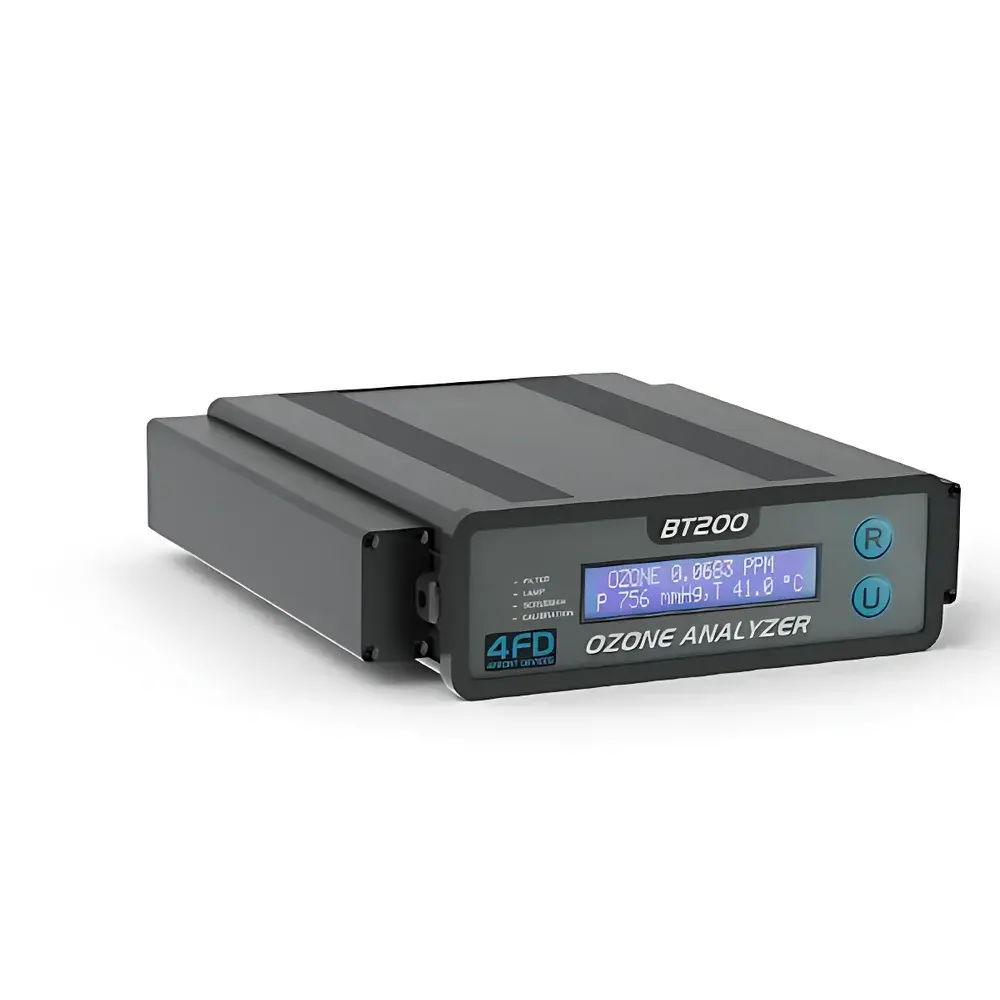
4FD BT200 UV Absorption Ozone Analyzer
| Brand | 4FD |
|---|---|
| Origin | USA |
| Model | BT200 |
| Instrument Type | Online |
| Measurement Range | 0–1 ppmv to 0–20 vol.% |
| Detection Limit | 0.0001 ppmv (at 0–1 ppmv range) |
| Response Time (t95) | <30 s (low-concentration mode) |
| Zero Drift Compensation | Automatic zero-cleaning cycle |
| Resolution | 0.0001 ppmv |
| Analog Output | 4–20 mA or 0–10 V |
| Power Supply | DC 12 V, 1.5 A (AC 100–240 V, 50–60 Hz) |
| Operating Temperature | 0–40 °C |
| Operating Humidity | <90% RH (non-condensing) |
| UV Lamp Lifetime | 20,000 hours (50% output degradation) |
| Calibration Interval | 12 months |
| Accuracy | ±1% of reading or ±10% of full scale, whichever is greater (within validated range |
Overview
The 4FD BT200 UV Absorption Ozone Analyzer is an online, laboratory-grade gas monitoring instrument engineered for continuous, real-time quantification of ozone (O3) concentration in ambient air, process streams, and controlled environments. It operates on the principle of ultraviolet absorption spectroscopy at the characteristic 253.7 nm wavelength — where ozone exhibits its strongest molar absorptivity. By applying the Beer-Lambert law to the attenuation of UV light passing through a precisely defined optical path, the analyzer converts photometric signal loss into quantitative ozone concentration with high linearity and minimal interferences. This physical measurement principle eliminates reliance on chemical reagents or consumables, ensuring long-term stability and metrological traceability. Designed for integration into environmental compliance systems, cleanroom monitoring networks, and industrial oxidation process control loops, the BT200 delivers NIST-traceable accuracy under ISO/IEC 17025–aligned validation protocols.
Key Features
- Multi-range dynamic measurement capability: front-panel selectable spans from 0–1 ppmv up to 0–20 vol.%, supporting low-, mid-, and high-concentration applications without hardware modification
- High-resolution detection: 0.0001 ppmv resolution at the lowest range (0–1 ppmv), scalable across six decades of concentration with auto-adjusting digitization
- Optimized optical architecture: temperature-stabilized UV lamp (253.7 nm Hg line) with dual-beam reference path to compensate for lamp aging and window fouling
- Integrated sampling system: built-in diaphragm pump delivering consistent 1.0–1.5 L/min flow, coupled with pressure- and temperature-sensing for real-time compensation of gas density effects
- Automatic zero stabilization: programmable zero-cleaning cycle using internal catalytic scrubber or external zero-air source, minimizing manual intervention and drift accumulation
- Full-range unit flexibility: on-device switching between ppmv, ppbv, vol.%, µg/m³, mg/m³, and g/m³ — all calculated in real time using ideal gas law and user-defined molecular weight
- Rapid response performance: t95 < 30 seconds for low-concentration modes; < 10 seconds for mid- and high-range configurations
- Robust environmental tolerance: operational within 0–40 °C and <90% RH (non-condensing), with optional heated sample line interface for humid or particulate-laden streams
Sample Compatibility & Compliance
The BT200 is compatible with dry or moderately humid gas matrices containing ozone as the primary analyte. It exhibits negligible cross-sensitivity to common atmospheric constituents including NOx, SO2, CO, VOCs, and water vapor below saturation — verified per ASTM D5012 and ISO 11130 interference testing protocols. The analyzer meets requirements for regulatory reporting under U.S. EPA Method EQOA-01 and EU Directive 2008/50/EC for ambient ozone monitoring. Its calibration traceability to NIST Standard Reference Material (SRM) #30 satisfies ISO/IEC 17025 accreditation criteria for testing laboratories. For GMP/GLP environments, optional audit-trail logging and 21 CFR Part 11–compliant software modules are available via firmware upgrade.
Software & Data Management
Data acquisition and configuration are managed via the embedded 2-line × 20-character backlit LCD display with intuitive menu navigation. All operational parameters — including span selection, zero cycle frequency, analog output mapping, and alarm thresholds — are configurable without external software. Analog outputs (4–20 mA or 0–10 V) support direct integration with PLCs, SCADA systems, and DCS platforms. Optional USB or RS-232 interfaces enable periodic data export for QA/QC review. Firmware supports time-stamped event logging (zero events, calibration alerts, power cycles) with onboard memory retention for ≥30 days of 1-minute averaged data. Remote diagnostics and over-the-air firmware updates are supported via optional Ethernet module (BT200-E).
Applications
- Ambient air quality monitoring networks (AQS) compliant with national regulatory standards
- Indoor air quality (IAQ) assessment in healthcare facilities, laboratories, and semiconductor cleanrooms
- Real-time feedback control of ozone generators in water treatment and surface disinfection systems
- Validation and routine verification of ozone sterilization chambers (e.g., ISO 14937, ISO 11135)
- Research applications requiring stable, traceable ozone dosimetry in atmospheric chemistry and material degradation studies
- Stack emission monitoring for industrial oxidation processes where ozone is a byproduct or intermediate
FAQ
What is the recommended calibration interval for the BT200?
The manufacturer specifies an annual calibration interval under normal operating conditions. However, calibration frequency should be adjusted based on application criticality, regulatory requirements (e.g., EPA, EN 14625), and observed drift trends — particularly in high-humidity or high-particulate environments.
Can the BT200 measure ozone in humid or corrosive gas streams?
The analyzer is rated for operation up to 90% RH non-condensing. For sustained exposure to saturated or corrosive gases, optional heated sample lines, Nafion dryers, or stainless-steel inlet filters are recommended to prevent condensation and optical path contamination.
Is the UV lamp replaceable in the field?
Yes — the mercury-vapor UV lamp is a user-replaceable module with factory pre-alignment. Replacement requires no optical recalibration and is supported by step-by-step instructions in the service manual.
How does the automatic zero-cleaning function work?
The system periodically diverts sample flow through an internal catalytic converter that decomposes ozone to oxygen, generating true zero-gas for baseline verification. Cycle duration and frequency are programmable to match site-specific stability requirements.
Does the BT200 support digital communication protocols?
Standard models include analog outputs only. Modbus RTU (RS-485), Ethernet/IP, or OPC UA connectivity is available via optional communication modules (BT200-COM series), enabling integration into enterprise-level automation infrastructures.
Related Products







