
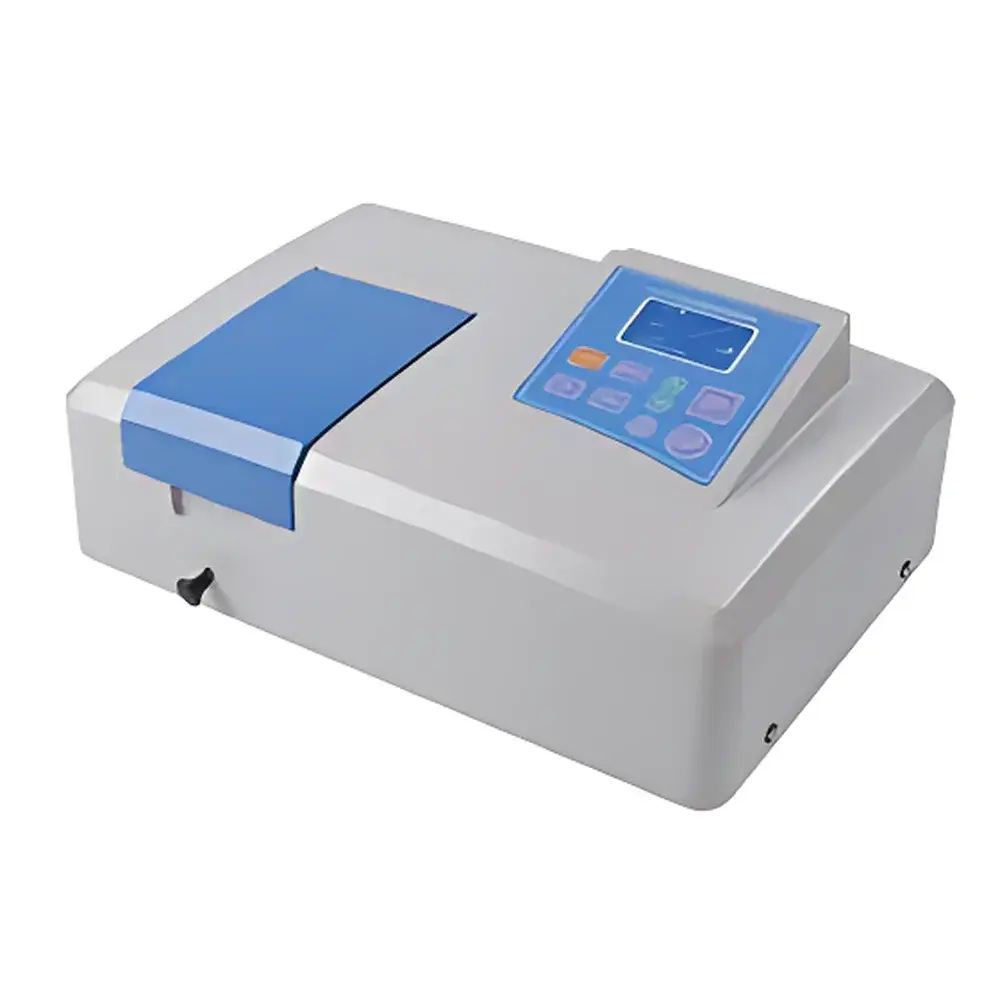
V-5100 Visible Spectrophotometer
| Brand | Jihepu |
|---|---|
| Origin | Shandong, China |
| Model | V-5100 |
| Optical System | Double-beam |
| Detector | Photodiode Array (PDA) |
| Wavelength Range | 190–1100 nm |
| Wavelength Accuracy | ±2 nm |
| Spectral Bandwidth | 4 nm |
| Stray Light | ≤0.05%T |
| Wavelength Repeatability | ≤0.5 nm |
| Photometric Accuracy | ±0.5%T |
| Photometric Repeatability | ≤0.2%T |
| Baseline Stability | ±0.001 A/30 min (at 500 nm, after warm-up) |
| Photometric Range | 0–200%T, –0.3–3 A, 0–9999 C |
| Wavelength Resolution | 0.1 nm |
| Display | 128×64 dot-matrix LCD |
| Data Storage | 200 measurement sets + 200 calibration curves |
| Interface | USB port + parallel printer port |
| Lamp | Long-life imported tungsten lamp (socket-type, optical alignment-free replacement) |
| Dimensions | 420 × 280 × 180 mm |
| Weight | 10 kg |
| Power Supply | AC 85–250 V |
Overview
The Jihepu V-5100 Visible Spectrophotometer is a double-beam, microprocessor-controlled spectrophotometric instrument engineered for routine quantitative analysis in academic teaching laboratories, quality control environments, and industrial R&D settings where visible-range absorbance measurements are required. While optimized for the visible spectrum (380–780 nm), its extended wavelength coverage from 190 nm to 1100 nm enables limited UV and near-infrared applications—such as detection of transition metal complexes, organic chromophores, and certain biological macromolecules—without requiring dedicated UV-grade optics or deuterium lamps. The instrument employs a fixed-grating monochromator coupled with a photodiode array (PDA) detector, delivering rapid spectral acquisition, high photometric reproducibility, and robust baseline stability. Its double-beam architecture continuously compensates for source drift and environmental fluctuations by splitting the light path between sample and reference beams, ensuring measurement integrity over extended operational periods.
Key Features
- Double-beam optical design with real-time reference beam correction for enhanced photometric stability and reduced baseline drift
- Photodiode array (PDA) detector enabling fast, noise-resistant signal acquisition without mechanical scanning
- 128 × 64 dot-matrix LCD display supporting direct visualization of absorbance spectra, calibration curves, and numerical results
- Onboard data management: stores up to 200 measurement datasets and 200 user-defined calibration curves, each retrievable by numeric ID
- Two primary quantification modes: C-mode (multi-point standard curve generation with linear/nonlinear fitting) and F-mode (coefficient-based calculation using pre-determined slope/intercept values)
- Automatic wavelength calibration and self-diagnostic routines that detect and correct minor wavelength deviations without manual intervention
- Socket-mounted tungsten lamp design allowing lamp replacement without optical realignment—minimizing downtime and service dependency
- Integrated USB interface compliant with USB 2.0 standards for seamless data export to Windows-based PCs; parallel printer port supports direct hardcopy output
- Power supply rated for universal AC input (85–250 V), suitable for international deployment without voltage conversion hardware
Sample Compatibility & Compliance
The V-5100 accommodates standard 10-mm square cuvettes (glass, quartz, or plastic) and supports both transmission and reflectance configurations via optional accessories. It meets fundamental performance criteria outlined in ISO 6425:2019 (spectrophotometer specifications) and ASTM E275–21 (standard practices for describing and measuring performance of ultraviolet and visible spectrophotometers). While not certified for GLP/GMP-regulated environments out-of-the-box, its data retention, timestamped storage, and non-volatile memory support audit-ready documentation when paired with validated third-party software. The instrument’s stray light specification (≤0.05%T at 220 nm and 340 nm) satisfies typical requirements for pharmaceutical excipient testing per USP and food colorant analysis per AOAC 971.13.
Software & Data Management
The V-5100 operates autonomously via embedded firmware but integrates natively with Jihepu’s optional Quantitative Analysis Software (v3.x), a Windows-based application supporting full spectral visualization, kinetic time-course plotting, multi-wavelength regression, and export to CSV, TXT, and Excel-compatible formats. All stored data—including absorbance values, concentration outputs, curve coefficients, and acquisition timestamps—are retained during power interruption due to non-volatile memory architecture. The USB interface implements CDC ACM class protocols, eliminating driver installation on modern Windows/macOS systems. Audit trail functionality (e.g., user logins, method versioning, change history) requires configuration within the external software layer and adherence to internal SOPs—not inherent firmware capabilities.
Applications
- Quantitative determination of transition metal ions (e.g., Fe²⁺/Fe³⁺, Cu²⁺, Co²⁺) using complexometric reagents such as 1,10-phenanthroline or bicinchoninic acid (BCA)
- Enzyme kinetics assays (e.g., NADH/NADPH oxidation at 340 nm) under controlled temperature conditions using external water-jacketed cuvette holders
- Water quality analysis including nitrate (220 nm/275 nm dual-wavelength correction), phosphate (as ammonium molybdate complex), and COD estimation
- Educational laboratory exercises covering Beer–Lambert law validation, calibration curve linearity assessment, and limit-of-detection calculations
- Industrial QC of dyes, pigments, and cosmetic formulations where batch-to-batch color consistency is monitored via %T at specified λ
FAQ
Is the V-5100 capable of UV-range measurements below 200 nm?
No. Although the wavelength range is specified as 190–1100 nm, reliable UV performance below 200 nm requires a deuterium lamp and vacuum/purged optical path—neither of which is included. Measurements at 190–200 nm exhibit reduced signal-to-noise ratio and higher stray light contribution.
Can the instrument perform kinetic scans or time-resolved measurements?
Not in real time. The V-5100 supports sequential single-wavelength readings at user-defined intervals (e.g., every 5–60 seconds), but lacks continuous spectral scanning or analog output for external trigger synchronization.
Does the USB interface support direct connection to Linux or macOS systems?
Yes—via CDC ACM serial emulation—but native driver-free operation is confirmed only on Windows 10/11. macOS/Linux users may require terminal-based tools (e.g., screen, minicom) or custom Python scripts for data ingestion.
What is the recommended maintenance schedule for the tungsten lamp?
Typical lifetime exceeds 2,000 hours under standard operating conditions. Replacement is advised when baseline noise increases beyond ±0.002 A or photometric repeatability degrades beyond ≤0.3%T across replicate readings.





