
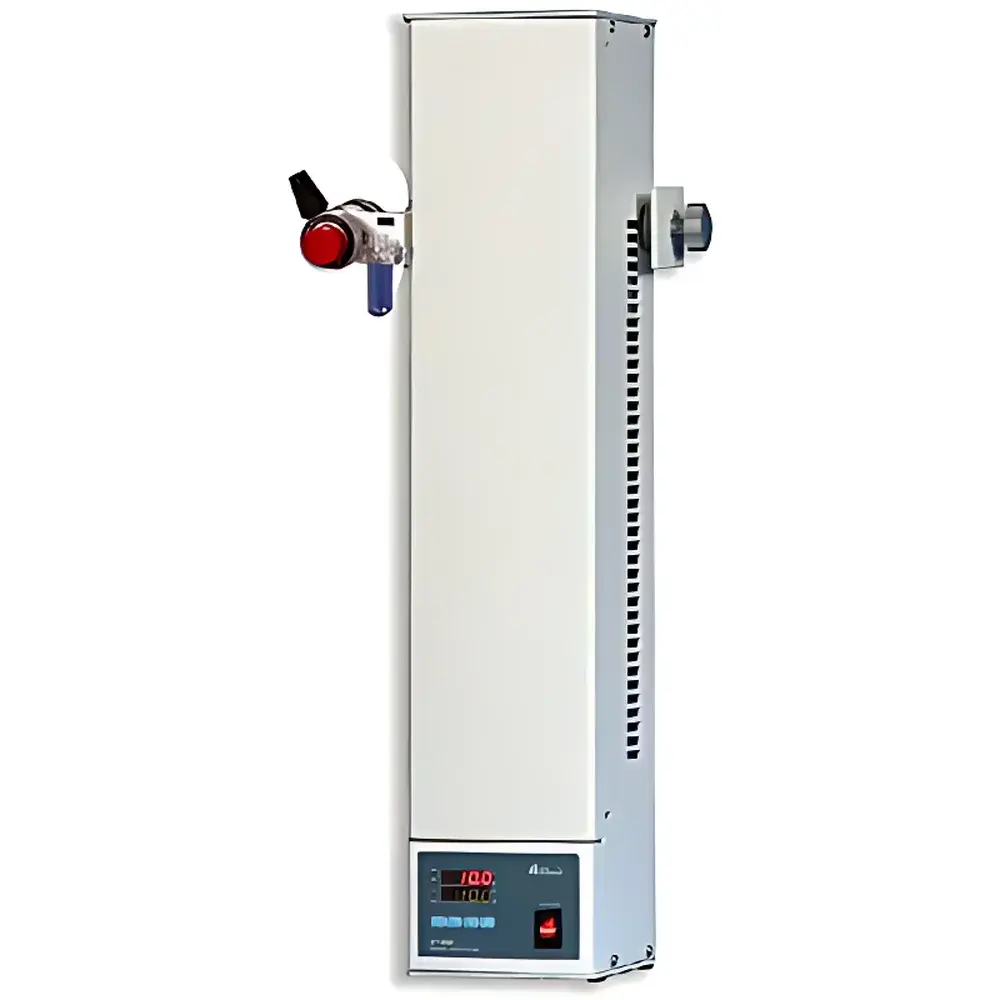
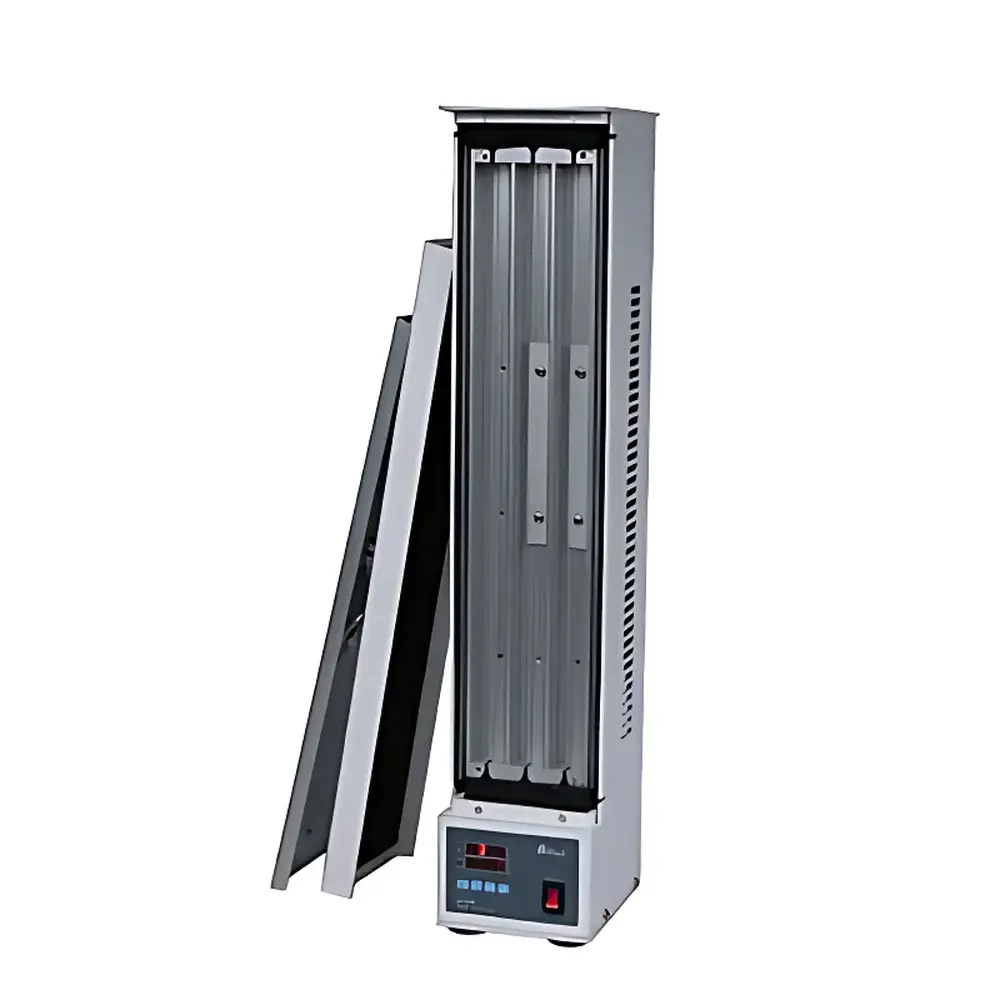
AT-950 Peltier-Based Refrigerated/Heated HPLC Column Oven by Autoscience
| Brand | Autoscience |
|---|---|
| Model | AT-950 |
| Temperature Range | 4–75 °C |
| Max. Cooling Capacity | 20 °C below ambient |
| Temperature Accuracy | ±0.5 °C |
| Temperature Stability (Precision) | ±0.1–±0.2 °C |
| Temp. Setpoint Resolution | 0.1 °C |
| Over-Temperature Protection | 80 °C |
| Display | Dual 4-digit LED (SV/PV) |
| Power Supply | 220 V±10%, 50 Hz (110 V±10%, 60 Hz optional) |
| External Dimensions (W×H×D) | 110×545×135 mm |
| Chamber Internal Dimensions (W×H×D) | 82×400×34 mm |
| Column Capacity | Three 4.6 mm ID × 300 mm columns |
| Cooling Technology | Thermoelectric (Peltier) module |
| Heating/Cooling Mode | Automatic bidirectional control |
| Drain Channel | Integrated condensate and leakage drainage |
| Accessories | Adjustable inlet-valve mounting bracket, spill tray, bottle clamps, aluminum thermal conduction blocks |
Overview
The AT-950 Peltier-Based Refrigerated/Heated HPLC Column Oven is an engineered thermal management solution designed for high-performance liquid chromatography (HPLC) and ultra-high-performance liquid chromatography (UHPLC) systems. Unlike conventional resistive-heating-only column ovens, the AT-950 integrates solid-state thermoelectric (Peltier) modules to deliver precise, bidirectional temperature control—enabling both active heating and active cooling across a wide operational range of 4 °C to 75 °C. This capability ensures consistent column temperature regardless of laboratory ambient fluctuations, directly improving retention time reproducibility, peak shape symmetry, and method robustness—particularly critical for gradient elution, low-temperature separations (e.g., chiral or thermolabile analytes), and regulatory-compliant workflows under ICH Q2(R2) and USP . The oven’s compact footprint and integrated mechanical design allow seamless integration with standard HPLC racks and autosamplers without requiring external chillers or auxiliary cooling infrastructure.
Key Features
- Intelligent dual-mode temperature regulation using adaptive AI-based auto-tuning (AT) algorithm for rapid stabilization and minimal overshoot
- Dual 4-digit LED display showing setpoint temperature (SV) and real-time chamber temperature (PV) simultaneously
- Thermoelectric (Peltier) heating/cooling architecture delivering ±0.1–±0.2 °C short-term stability and ±0.5 °C absolute accuracy over full range
- Active cooling capacity of up to 20 °C below ambient—verified per ASTM E2234-21 test protocol for thermal performance validation
- Integrated condensate drainage channel in chamber base to safely evacuate refrigeration-induced moisture or column leakage
- Aluminum thermal conduction blocks included as standard accessories to enhance axial heat transfer uniformity across column length
- Over-temperature safety cutoff at 80 °C with hardware-level fail-safe circuitry compliant with IEC 61010-1 Class II requirements
- Adjustable inlet-valve mounting bracket and spill containment tray supplied standard for GMP-aligned system configuration
Sample Compatibility & Compliance
The AT-950 accommodates up to three standard 4.6 mm ID × 300 mm analytical columns within its insulated chamber (82 mm W × 400 mm H × 34 mm D), supporting common stainless-steel, fused-silica, and polymer-coated column formats. Its thermally stable cavity minimizes radial and axial temperature gradients (<0.3 °C deviation across column length per ISO 17025:2017 clause 6.4.7), ensuring compliance with method validation requirements for pharmacopeial assays (USP , EP 2.2.46). The device meets electromagnetic compatibility (EMC) standards per CISPR 11 Group 1 Class B and carries CE marking for laboratory equipment. While not certified to FDA 21 CFR Part 11 out-of-the-box, its deterministic temperature logging interface supports integration with validated LIMS or CDS platforms that implement audit-trail and electronic-signature controls.
Software & Data Management
The AT-950 operates as a standalone analog-controlled instrument with no embedded firmware or network interface; temperature parameters are configured exclusively via front-panel keypad input. All operational states—including setpoint, PV reading, heating/cooling status, and fault indicators—are continuously visible on the dual LED display. For laboratories requiring traceable temperature records, the unit features a 0–5 V analog output (±1% FS linearity) compatible with external data loggers (e.g., Omega OM-DAQPRO-5300) or PLC-based SCADA systems. When deployed in GLP/GMP environments, users may document calibration history, preventive maintenance logs, and daily operational checks using paper-based or electronic forms aligned with Annex 11 principles.
Applications
- Stabilizing retention times in reversed-phase, HILIC, and ion-pair chromatography methods where ±0.5 °C drift causes >1.2% RSD in tR
- Enabling low-temperature separations of labile compounds (e.g., peptides, oligonucleotides, or oxidized lipids) without solvent freezing or viscosity-related backpressure spikes
- Supporting method transfer between labs with differing ambient conditions—critical for contract testing and multi-site clinical trial bioanalysis
- Maintaining column integrity during extended gradient runs (>60 min) by preventing thermal degradation of bonded phases
- Facilitating isocratic method development where precise thermal control improves selectivity (α) between structurally similar isomers
FAQ
Does the AT-950 support remote temperature programming via RS-232 or Ethernet?
No. The AT-950 is a manually operated, analog-controlled column oven without digital communication interfaces.
What is the maximum power consumption under full cooling load?
Rated input power is ≤200 W at 220 V/50 Hz; actual draw depends on ambient temperature and setpoint delta.
Can the chamber accommodate columns with guard cartridges or in-line filters?
Yes—the 34 mm depth allows standard 4.6 mm ID columns with integrated frits or 10–20 mm guard cartridges when oriented vertically.
Is NIST-traceable calibration documentation available?
Autoscience provides factory calibration certificates (per ISO/IEC 17025-accredited third-party lab) upon request; annual recalibration is recommended.
How does the Peltier system handle continuous operation at sub-ambient temperatures?
Continuous cooling at ≤15 °C is thermally sustainable provided ambient humidity remains <60% RH to prevent excessive condensation buildup.



