
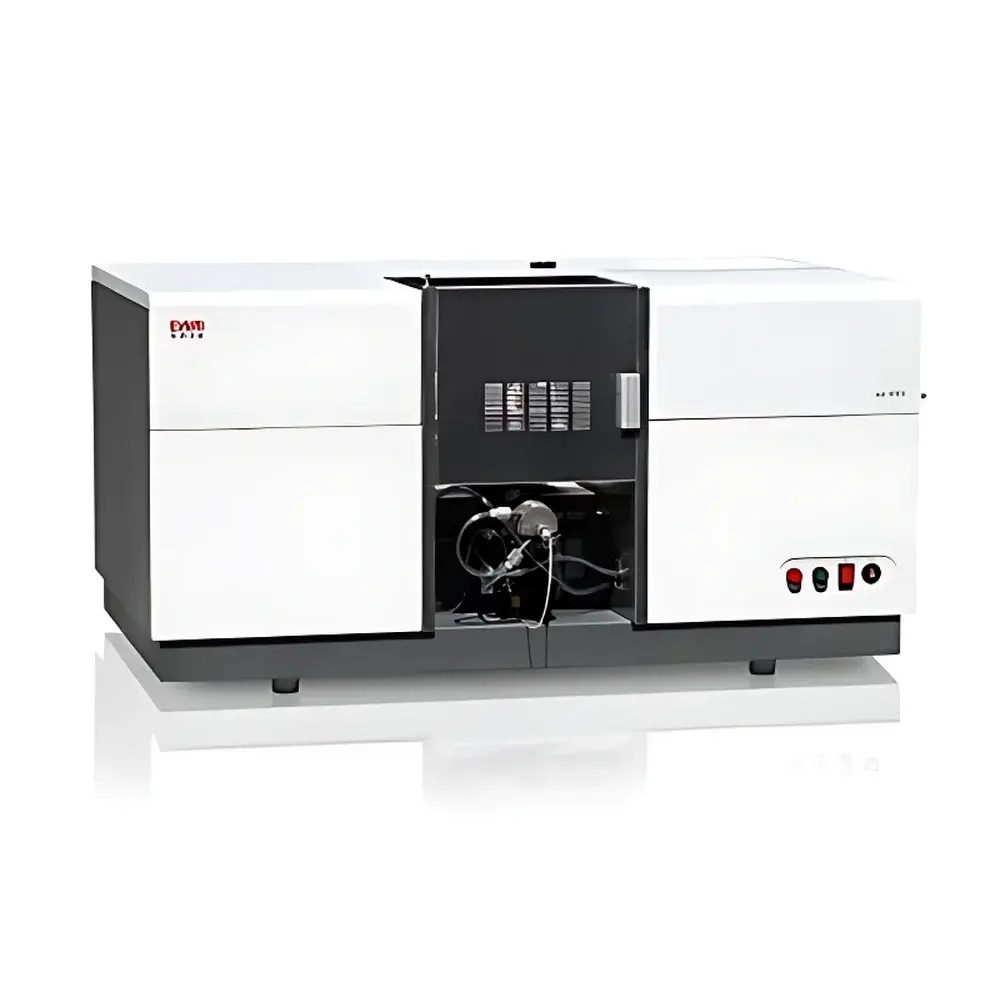
AA-7003 Atomic Absorption Spectrometer (Flame-GF AAS) by East & West Analytical Instruments
| Brand | East & West Analytical Instruments |
|---|---|
| Origin | Beijing, China |
| Manufacturer Type | Direct Manufacturer |
| Instrument Type | Flame and Graphite Furnace Atomic Absorption Spectrometer |
| Monochromator | Plane Grating (1800 lines/mm) |
| Detector | Photomultiplier Tube (PMT) |
| Background Correction | D₂ Lamp + Self-Reversal (SR) Method |
| Resolution | <0.2 nm (at 250 nm) |
| Sensitivity | 0.0044 Abs for 1 µg/mL Cu (i.e., ~5 ppm Cu solution yields ~1.0 Abs) |
| Precision (RSD) | ≤0.5% (n=10, typical for flame mode) |
| Detection Limit (Flame) | 0.002 µg/mL Cu |
| Detection Limit (Graphite Furnace) | 0.005 pg for Cd |
| Atomization Options | Integrated Flame & Graphite Furnace with <2 s Switching |
| Optional Accessories | HG-01 Ceramic Hydride Generator, GF Autosampler, N₂O/C₂H₂ High-Temperature System |
Overview
The AA-7003 Atomic Absorption Spectrometer is a dual-mode benchtop instrument engineered for high-precision elemental quantification in environmental, pharmaceutical, food safety, metallurgical, and geological laboratories. It operates on the fundamental principle of atomic absorption spectroscopy: ground-state free atoms in the gaseous phase absorb light at element-specific wavelengths emitted by hollow cathode lamps. The AA-7003 uniquely integrates flame atomization, graphite furnace atomization, dedicated graphite furnace power supply, optical path, and electronic detection subsystems within a single compact chassis—making it one of the most space-efficient AAS platforms globally. Its optomechanical design features a fully suspended optical system, decoupling critical components from mechanical vibration and ambient thermal drift to ensure long-term baseline stability and measurement reproducibility across extended analytical sessions.
Key Features
- Monolithic integrated architecture: Co-located flame atomizer, graphite furnace chamber, power electronics, monochromator, and PMT detector minimize optical path length and signal loss while enhancing alignment robustness.
- Ultra-stable titanium-based nebulization system: Aerospace-grade investment-cast CP-titanium雾化室 (atomization chamber) and burner head deliver exceptional resistance to acidic/oxidizing matrices, thermal shock resilience up to 2500 °C, and service life exceeding 5 years under routine QC operation.
- High-efficiency optical train: 1800-line/mm plane diffraction grating provides superior spectral energy throughput and resolution (<0.2 nm at 250 nm), enabling accurate peak isolation for overlapping absorption lines (e.g., Fe 248.3 nm / Cr 248.4 nm).
- Intelligent dual-background correction: Simultaneous D₂ lamp continuum and self-reversal (SR) methods operate across full UV–Vis range (190–900 nm); SR correction eliminates non-specific absorption without requiring separate lamp changes or manual recalibration.
- Automated operational sequence: Full computer control enables wavelength auto-positioning, slit width switching, lamp current/gain optimization, and six-lamp turret selection—all completed in ≤40 s per element. Flame-to-GF mode transition occurs in <2 s with zero mechanical realignment.
- Comprehensive safety architecture: Real-time monitoring of hollow cathode lamp current, fuel gas pressure (C₂H₂, N₂O), coolant flow, graphite furnace temperature ramp profile, and flame status triggers hardware-level interlocks compliant with IEC 61010-1.
Sample Compatibility & Compliance
The AA-7003 supports aqueous, diluted acid-digested, and organic-solvent-miscible samples (with appropriate matrix modifiers). Flame mode accommodates concentrations from 0.1 µg/mL to 100 mg/mL; graphite furnace extends linear dynamic range down to sub-pg absolute mass levels (e.g., 0.005 pg Cd). When configured with the optional HG-01 ceramic hydride generator, it meets EPA Method 200.9 and ISO 11969 requirements for As, Se, Sb, Bi, Te, Pb, Sn, and Hg speciation in drinking water and wastewater. All firmware and data handling modules comply with GLP/GMP documentation standards—including full audit trail logging, user access controls, and electronic signature support aligned with FDA 21 CFR Part 11 Annex 11 principles.
Software & Data Management
The proprietary AAWinPro v4.2 software suite provides complete instrument control, method development, calibration curve fitting (linear, quadratic, weighted least squares), QC charting (Levey-Jennings, Shewhart), and report generation in PDF/XLS formats. Raw spectral data are stored in vendor-neutral .csv and .jdx formats. Software supports ASTM E1901-compliant peak integration, background subtraction validation flags, and automatic outlier rejection per ICH Q2(R2) guidelines. Remote diagnostics and method synchronization across multi-instrument labs are enabled via secure HTTPS API endpoints.
Applications
- Environmental testing: Quantification of heavy metals (Pb, Cd, Cr, Ni, Zn) in soil extracts per ISO 11466 and EPA 7000B.
- Pharmaceutical QA/QC: Residual catalyst analysis (Pd, Pt, Rh) in APIs per USP /.
- Food & beverage: Na, K, Ca, Mg profiling in dairy products (AOAC 985.27); trace As/Hg in rice (GB 5009.11–2014 equivalent).
- Geochemical exploration: Multi-element analysis of rock digests using N₂O/C₂H₂ flame for refractory elements (V, Mo, Ti, Al).
- Clinical research: Serum Zn/Cu ratio determination and whole-blood Pb screening (CLIA-waived protocols).
FAQ
What atomization techniques does the AA-7003 support?
Flame atomization (air-acetylene or nitrous oxide-acetylene), electrothermal graphite furnace atomization, and hydride generation (via optional HG-01 module).
Is the instrument compliant with international regulatory standards?
Yes—software audit trails meet FDA 21 CFR Part 11; analytical performance aligns with ISO 7027, ASTM E1901, and EN 16170 for trace metal quantification.
Can the AA-7003 perform sequential multi-element analysis?
Yes—the six-lamp automated turret and synchronized wavelength/slit/lamp-current control enable unattended sequential determination of up to six elements per sample without manual intervention.
What maintenance intervals are recommended for the titanium burner system?
No scheduled replacement is required; cleaning with 10% HNO₃ every 200 analyses maintains optimal nebulization efficiency and combustion stability.
Does the system support external LIMS integration?
Yes—ASCII-based data export, ODBC connectivity, and RESTful API allow bidirectional communication with major LIMS platforms including LabWare, Thermo Fisher SampleManager, and STARLIMS.






