
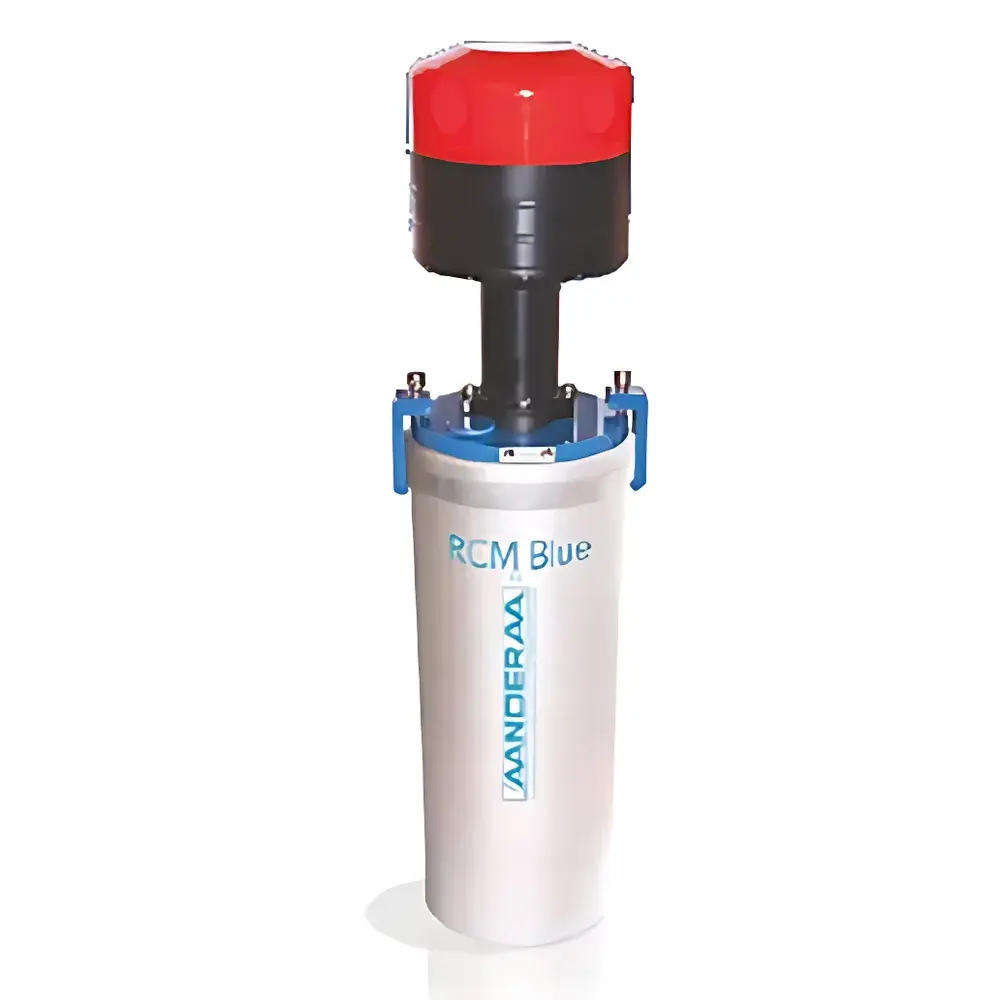
Aanderaa RCM Blue Doppler Current Meter
| Brand | Aanderaa |
|---|---|
| Origin | Norway |
| Manufacturer Type | Authorized Distributor |
| Region of Origin | Imported |
| Model | RCM Blue |
| Pricing | Available Upon Request |
Overview
The Aanderaa RCM Blue Doppler Current Meter is a self-contained, high-precision oceanographic instrument engineered for long-term, unattended measurement of current velocity, direction, and temperature in marine and freshwater environments. It operates on the principle of acoustic Doppler velocimetry (ADV) using backscatter signal analysis from suspended particles in the water column. Unlike conventional single-frequency Doppler systems, the RCM Blue integrates Aanderaa’s proprietary ZPulse multi-frequency pulse technology—where each transmitted acoustic pulse simultaneously encodes multiple discrete frequencies. This enables parallel spectral decomposition of the returned echo, allowing high-fidelity Doppler shift estimation with statistically improved precision per unit energy consumption. The sensor employs two orthogonal acoustic axes, each equipped with dual transducers operating in alternating transmit/receive mode. By enabling forward-looking pulse transmission (i.e., one transducer emits while its orthogonal counterpart receives), the system minimizes flow distortion caused by mooring-induced vortices and cable wake interference—a critical advantage in shallow-water or near-bottom deployments. Integrated solid-state 3-axis compass and tilt-compensated inclinometer ensure accurate horizontal vector derivation even under dynamic deployment conditions up to ±50° tilt.
Key Features
- ZPulse multi-frequency acoustic technology for enhanced statistical accuracy, reduced power demand, and accelerated sampling rates
- Self-contained operation with internal data storage and rechargeable 70 Ah lithium-thionyl chloride battery pack supporting up to 19 months of continuous logging at standard sampling intervals
- Bluetooth 4.2 wireless interface for remote configuration, real-time status monitoring, and post-deployment data download—eliminating the need to open the pressure housing between deployments
- Integrated high-stability thermistor for concurrent temperature measurement (±0.1 °C accuracy) synchronized with current vectors
- Automatic tilt compensation algorithm utilizing fused output from MEMS-based 3-axis accelerometer and solid-state fluxgate compass
- Dual-axis orthogonal beam geometry with selectable forward-scatter mode to suppress boundary-layer turbulence artifacts
- LED status indicators for operational mode, battery level, memory usage, and Bluetooth connectivity
- Corrosion-resistant titanium pressure housing rated to 600 m depth with IP68 ingress protection
Sample Compatibility & Compliance
The RCM Blue is validated for deployment across diverse aquatic media including coastal seawater, estuarine brackish zones, deep-ocean basins, and low-conductivity freshwater lakes and rivers. Its acoustic operating frequency (typically 600 kHz or 1 MHz depending on configuration) ensures optimal scattering response across typical natural particle size distributions (0.1–100 µm). The instrument conforms to IEC 60529 (IP68), ISO 9001:2015 manufacturing standards, and complies with EU RoHS Directive 2011/65/EU. Data integrity protocols align with GLP and GMP principles; timestamped binary data logs include embedded metadata (sensor ID, firmware version, calibration coefficients, tilt angles, magnetic deviation corrections) required for traceable scientific reporting. Optional NIST-traceable factory calibration certificates are available upon request.
Software & Data Management
Aanderaa Data Studio is a Windows-based desktop application designed exclusively for RCM Blue data handling. It supports drag-and-drop import of binary .BIN files, automatic time-series alignment, vector averaging (user-definable window lengths), tidal harmonic analysis, and automated removal of spurious outliers based on velocity magnitude thresholds and angular consistency checks. All processed datasets export natively to CSV and Excel-compatible XLSX formats, preserving full metadata headers. The software includes built-in support for USB Bluetooth adapters (CSR Harmony or Cambridge Silicon Radio chipsets) and provides real-time telemetry during Bluetooth-linked field configuration. Audit trails—including user login timestamps, parameter change logs, and export history—are retained in SQLite database format compliant with FDA 21 CFR Part 11 requirements when enabled via enterprise license.
Applications
- Long-term moored current profiling for coastal circulation modeling and sediment transport studies
- Real-time validation of numerical ocean models (e.g., ROMS, FVCOM) and satellite-derived surface current products
- Environmental impact assessments for offshore wind farm construction and dredging operations
- Hydrodynamic monitoring in aquaculture sites to assess feed dispersion and waste plume behavior
- Glacial lake outburst flood (GLOF) early warning systems requiring robust, low-maintenance instrumentation
- Climate research initiatives tracking interannual variability in western boundary currents (e.g., Gulf Stream, Kuroshio)
FAQ
What is the maximum operational depth rating for the RCM Blue?
The standard titanium-housed RCM Blue is rated to 600 meters water depth (mwd), with optional configurations available for 1000 mwd upon special order.
Does the RCM Blue require external power or can it operate autonomously?
It operates fully autonomously using its internal 70 Ah battery pack; no external power source or cabled connection is required for standard deployments.
How does ZPulse technology improve measurement accuracy compared to conventional single-frequency Doppler systems?
ZPulse achieves equivalent statistical precision with approximately half the number of acoustic pulses per ensemble, thereby reducing both power consumption and acoustic noise footprint while maintaining high temporal resolution.
Is tilt compensation applied in real time during data acquisition?
Yes—tilt and compass data are sampled synchronously with Doppler measurements and used in real-time to compute corrected horizontal velocity components before storage.
Can the RCM Blue be integrated into existing telemetry networks (e.g., Iridium, GSM)?
While the RCM Blue itself does not feature satellite or cellular modems, its Bluetooth interface allows seamless integration with third-party gateway buoys or shore stations equipped with compatible radio modules and middleware APIs.
Related Products







