
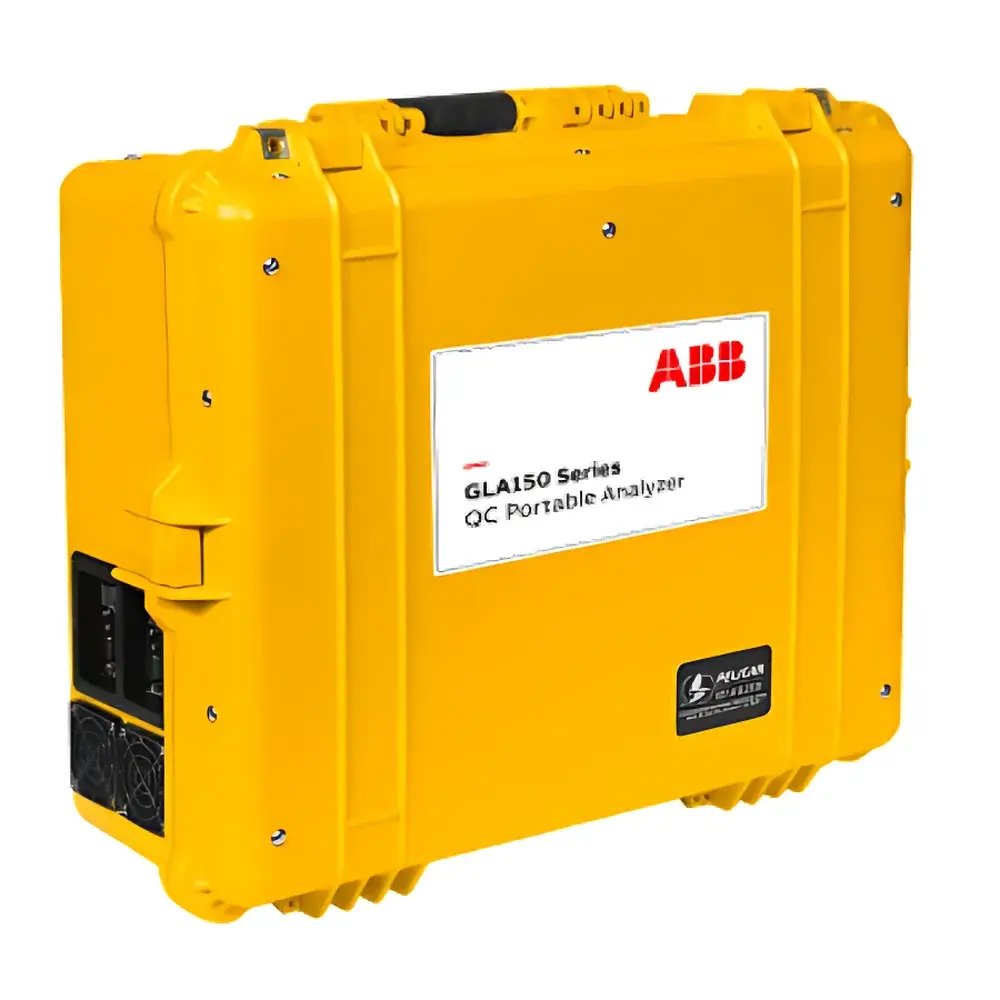
ABB GLA151-N2OCM Quantum Cascade Laser Portable Greenhouse Gas Analyzer
| Brand | ABB |
|---|---|
| Origin | Canada |
| Manufacturer Type | Authorized Distributor |
| Origin Category | Imported |
| Model | GLA151-N2OCM |
| Price | Upon Request |
| Measured Gases & Ranges | Simultaneous N₂O and CO detection |
| Detection Limits (1σ, 10 sec) | N₂O ≤ 0.2 ppb, CO ≤ 0.2 ppb, H₂O ≤ 40 ppm |
| Linear Range | N₂O up to 4 ppm, CO up to 4 ppm, H₂O up to 30,000 ppm |
| Operating Temperature | 5–45 °C |
| Relative Humidity | <99% RH (non-condensing) |
| Measurement Rate | 0.01–10 Hz (user-selectable) |
| Flow Response Time | <30 s (1/e), <10 s (1/e) with ACC-DP3H external diaphragm pump |
| Water Vapor Correction | Real-time spectroscopic correction for dilution and pressure broadening effects |
Overview
The ABB GLA151-N2OCM is a field-deployable, quantum cascade laser (QCL)-based trace gas analyzer engineered for simultaneous, high-precision measurement of nitrous oxide (N₂O) and carbon monoxide (CO) in ambient air and controlled emission environments. Leveraging ABB’s patented Off-Axis Integrated Cavity Output Spectroscopy (OA-ICOS) — the fourth-generation cavity-enhanced absorption technique — the instrument delivers exceptional sensitivity, stability, and spectral selectivity without reliance on fragile optical cavities or complex alignment procedures inherent in traditional cavity ring-down spectroscopy (CRDS) or direct absorption systems. Unlike conventional analyzers requiring physical sample drying or empirical water vapor corrections, the GLA151-N2OCM performs real-time, physics-based spectroscopic correction for H₂O-induced dilution and collisional line broadening across its full dynamic range. This enables direct reporting of dry-mole-fraction concentrations for both N₂O and CO — a critical requirement for atmospheric flux studies, eddy covariance networks, and regulatory-grade greenhouse gas inventories compliant with IPCC Tier 3 methodologies.
Key Features
- Simultaneous dual-species detection of N₂O and CO at sub-part-per-trillion sensitivity (≤0.2 ppb, 10-sec average)
- Integrated water vapor measurement (0–30,000 ppm) with first-principles correction for spectroscopic interferences
- User-selectable measurement rates from 0.01 Hz to 10 Hz, optimized for both slow-gradient ambient monitoring and rapid chamber-flux dynamics
- Negligible zero and span drift (<0.1 ppb/week typical), minimizing calibration frequency and eliminating dependency on costly reference gases
- Ruggedized portable chassis rated for continuous unattended operation in remote field conditions (5–45 °C, <99% RH non-condensing)
- Onboard embedded computer with multi-gigabyte storage capacity supporting >12 months of high-frequency data logging without external intervention
- Standard RS-232 digital interface and analog voltage outputs (0–5 V or 4–20 mA) for seamless integration into existing SCADA, CR1000, or Campbell Scientific data acquisition ecosystems
Sample Compatibility & Compliance
The GLA151-N2OCM is validated for direct analysis of untreated ambient air, soil flux chamber headspace, stack effluent (with appropriate particulate filtration), and urban background sampling lines. Its OA-ICOS architecture ensures immunity to optical contamination from aerosols and hydrocarbon vapors common in industrial or agricultural settings. The analyzer meets performance criteria referenced in ISO 14064-3 (GHG assertion standards), ASTM D6348 (gaseous emissions testing), and supports audit-ready data integrity under GLP and GMP frameworks. Full traceability is maintained via embedded time-stamped metadata, including internal temperature/pressure/humidity logs, laser current/voltage diagnostics, and cavity alignment status — all accessible via secure SSH or local USB export. Firmware complies with FDA 21 CFR Part 11 requirements for electronic records and signatures when configured with user-access controls and audit trail logging enabled.
Software & Data Management
Control, calibration, and real-time visualization are managed through ABB’s proprietary GLA Control Suite — a Windows-based application supporting remote configuration, spectral viewing, alarm thresholding, and automated baseline validation. All raw absorbance spectra and processed concentration time series are stored in HDF5 format, enabling reproducible reprocessing with updated line parameters (e.g., HITRAN 2020+). Export options include CSV, NetCDF, and XML for interoperability with Python (Pandas, Xarray), MATLAB, or R-based atmospheric modeling pipelines. Optional digital data logging modules (OPT-DATALOG) provide synchronized timestamping with GPS PPS signals and parallel ingestion of auxiliary sensor streams (e.g., anemometer, pyranometer, IRGA) via configurable RS-232 multiplexing. Multi-analyzer synchronization across distributed sites is supported using NTPv4 or PTP (IEEE 1588) network time protocols.
Applications
- Soil-atmosphere N₂O and CO flux quantification in agricultural and forested ecosystems using static/dynamic chambers or gradient methods
- Urban air quality monitoring networks targeting combustion-related CO and agricultural/industrial N₂O sources
- Verification of methane mitigation co-benefits (e.g., N₂O suppression during low-NOx combustion or nitrification inhibitors)
- Mobile platform deployment on research vessels, light aircraft, or UAV-mounted payloads for regional-scale plume mapping
- Calibration transfer and reference standard validation in metrology laboratories accredited to ISO/IEC 17025
- Long-term trend analysis in global atmospheric observatories (e.g., NOAA GML, ICOS, AGAGE)
FAQ
Does the GLA151-N2OCM require sample drying prior to analysis?
No. It employs real-time, spectroscopically derived water vapor correction algorithms that account for both dilution and pressure-broadening effects, eliminating the need for Nafion dryers or cryogenic traps.
Can the instrument operate autonomously for extended periods?
Yes. With its onboard Linux-based controller and internal SSD, it supports continuous logging for over one year at 1-Hz resolution without external power or data offload.
What calibration protocols are recommended for long-term field deployment?
ABB recommends quarterly span verification using certified NIST-traceable gas standards; zero checks may be performed using synthetic zero air or catalytic scrubbers. Drift compensation is automatically applied using built-in cavity-length stabilization and laser wavelength referencing.
Is the system compatible with multi-port inlet manifolds?
Yes. It integrates natively with ABB’s MIU-8 (8-channel) and MIU-16 (16-channel) multiplexed inlet units, enabling automated sequential sampling from multiple locations or treatment plots.
How is data security and regulatory compliance ensured?
Firmware supports role-based access control, encrypted data-at-rest (AES-256), immutable audit trails, and electronic signature workflows aligned with 21 CFR Part 11 Annex 11 and ISO 17025 documentation requirements.
Related Products







