
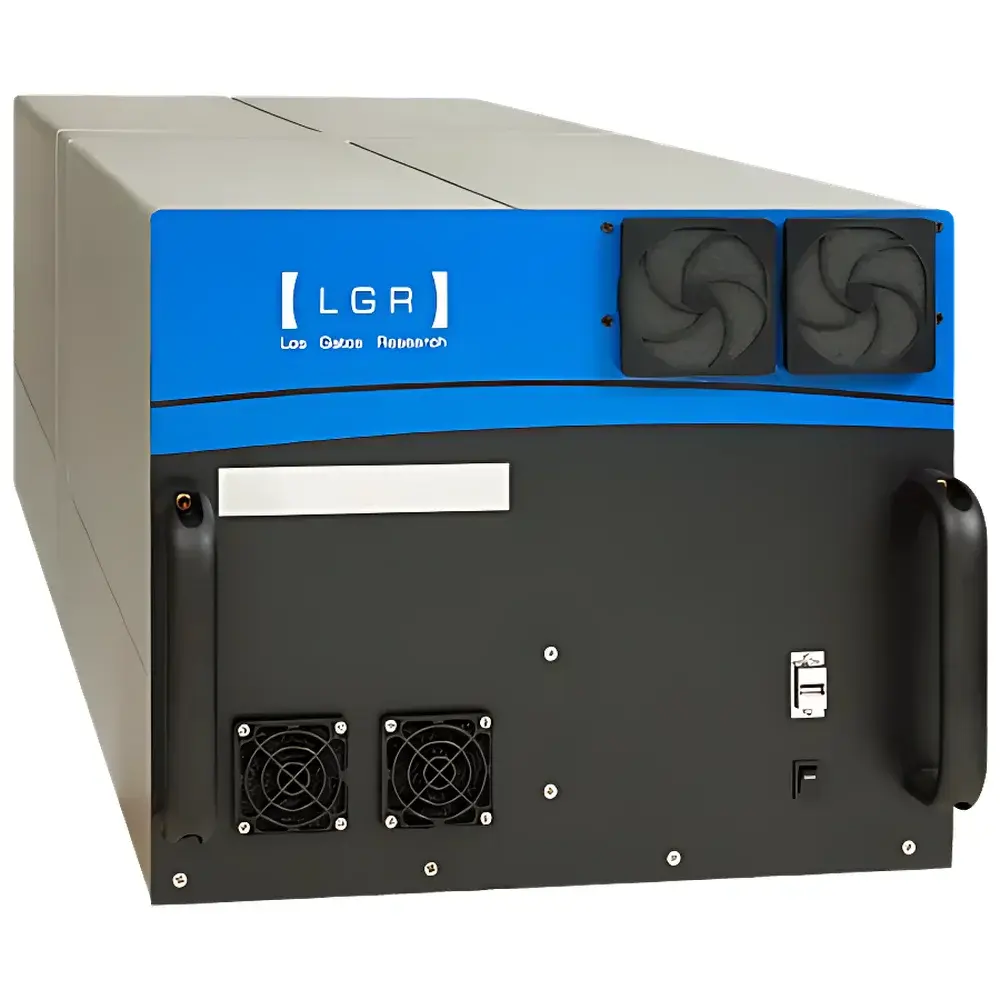
ABB GLA451-N2OI3 Enhanced-Performance Quantum Cascade Laser Isotope Ratio Analyzer for Nitrous Oxide
| Brand | ABB |
|---|---|
| Origin | Canada |
| Model | GLA451-N2OI3 |
| Measurement Targets | N₂O, δ¹⁵N, δ¹⁵Nα, δ¹⁵Nβ, δ¹⁸O, δ¹⁷O* |
| Detection Principle | Off-Axis Integrated Cavity Output Spectroscopy (OA-ICOS) with Quantum Cascade Laser |
| Dynamic Range | >20× ambient environmental concentration |
| Measurement Frequency | Up to 10 Hz (high-flow mode) |
| Sample Introduction | Automated gas sampler or manual injection |
| Internal Temperature Control | Yes |
| Data Storage | Onboard computer with long-term archival capability |
| Output Interfaces | Analog + RS232 digital |
| Software Included | Instrument control, real-time diagnostics, isotope ratio calculation and time-series analysis |
Overview
The ABB GLA451-N2OI3 is an enhanced-performance, benchtop quantum cascade laser (QCL)-based isotope ratio analyzer engineered for continuous, high-precision measurement of nitrous oxide (N₂O) mole fraction and its site-specific stable isotope ratios—δ¹⁵Nα, δ¹⁵Nβ, δ¹⁸O, and δ¹⁷O*—in ambient air, soil headspace, aqueous headspace, and laboratory gas standards. Unlike traditional isotope ratio mass spectrometry (IRMS), which requires cryogenic trapping, chemical conversion, and complex sample preparation, the GLA451-N2OI3 employs off-axis integrated cavity output spectroscopy (OA-ICOS), a highly selective, absorption-based optical technique leveraging tunable mid-infrared QCLs. This enables direct, calibration-free quantification of isotopologues without pre-concentration, water cooling, or vacuum systems. The instrument resolves structural isomers—¹⁴N¹⁵N¹⁶O (δ¹⁵Nα) and ¹⁵N¹⁴N¹⁶O (δ¹⁵Nβ)—by exploiting subtle spectral shifts in rovibrational transitions, providing unambiguous intramolecular nitrogen position information essential for distinguishing microbial nitrification from denitrification pathways.
Key Features
- Direct, real-time measurement of N₂O concentration and six isotopic parameters (δ¹⁵N, δ¹⁵Nα, δ¹⁵Nβ, δ¹⁸O, δ¹⁷O*, and ¹⁷O-excess) without offline enrichment or derivatization
- Enhanced-Performance (EP) OA-ICOS architecture with proprietary active thermal stabilization, minimizing thermal drift and ensuring long-term baseline stability (<0.05‰/24 h for δ¹⁵Nα)
- Two operational modes: standard sensitivity (1 Hz) and high-speed acquisition (up to 10 Hz under high-flow conditions), configurable via software
- Integrated onboard computer supporting autonomous operation for >30 days; data logged locally with timestamped metadata and checksum validation
- Robust interference rejection: validated against CO₂, CH₄, H₂O, and NOₓ at environmentally relevant mixing ratios (e.g., <500 ppm CO₂ causes <0.1‰ bias in δ¹⁸O)
- Wide dynamic range: linear response from 0.1 ppb to >2 ppm N₂O—enabling reliable analysis across ambient air (≈330 ppb), soil flux chambers (≈1–100 ppm), and industrial stack emissions
- Comprehensive real-time diagnostics: laser wavelength tracking, cavity alignment status, pressure/temperature sensor health, and absorption line-fit residuals
Sample Compatibility & Compliance
The GLA451-N2OI3 accepts gaseous samples via standardized 1/8″ Swagelok fittings and supports both automated multi-port gas sampling (e.g., ABB GSA-16) and manual syringe injection. It operates at ambient pressure (700–1050 hPa) and accommodates variable H₂O content (0–3% v/v) with built-in compensation algorithms—eliminating the need for external dryers or permeation dryers that may induce isotopic fractionation. The system meets ISO/IEC 17025 requirements for analytical competence when operated within defined uncertainty budgets. Its measurement traceability aligns with IUPAC Technical Report guidelines for atmospheric isotope reference materials (e.g., USGS32, USGS34, N2O-IAEA). For regulated environments, the firmware supports audit-trail logging compliant with FDA 21 CFR Part 11 (electronic records and signatures) and includes user-access level controls for method locking and data integrity verification.
Software & Data Management
ABB’s proprietary GLA Control Suite provides full instrument orchestration—including wavelength scanning, cavity resonance optimization, spectral fitting (Voigt profile deconvolution), and isotopic ratio computation using calibrated line intensity ratios. All raw interferograms and processed spectra are archived in HDF5 format with embedded metadata (pressure, temperature, flow rate, laser current, cavity length). Time-series outputs include ASCII-compatible CSV files with column headers conforming to the ICOS Carbon Portal naming convention (e.g., “n2o_ppb”, “delta15n_alpha_permil”). Remote access is enabled via Ethernet; TLS-secured API endpoints allow integration with LabVIEW, Python (via RESTful interface), or enterprise LIMS platforms. Data export supports GLP/GMP-compliant reporting templates with electronic signature fields and revision-controlled method versions.
Applications
- Soil biogeochemistry: Quantifying site-specific ¹⁵N distribution to differentiate bacterial vs. fungal denitrification, nitrifier denitrification, and hybrid N₂O formation pathways
- Wastewater treatment monitoring: Tracking δ¹⁵Nα/δ¹⁵Nβ signatures to identify dominant N-cycling microbes in activated sludge reactors and biofilters
- Atmospheric source apportionment: Constraining regional N₂O emission inventories using isotopic fingerprints from aircraft campaigns and tall-tower networks
- Groundwater nitrate溯源: Coupling N₂O isotopes with δ¹⁵N–δ¹⁸O of co-occurring NO₃⁻ to distinguish agricultural fertilizer, manure, and atmospheric deposition inputs
- Climate model validation: Providing observational constraints on N₂O production mechanisms in Earth system models (e.g., CESM, MPI-ESM)
- Method development labs: Serving as a reference-grade analyzer for validating new IRMS protocols and calibrating secondary standards
FAQ
Does the GLA451-N2OI3 require external calibration gases for routine operation?
No. The EP OA-ICOS architecture enables drift-corrected, self-referencing measurements using internal cavity-length and laser-wavelength standards. Primary calibration is performed during factory certification using NIST-traceable N₂O isotopic reference gases (USGS32, USGS34); field recalibration is optional and recommended annually.
Can the instrument distinguish between ¹⁵Nα and ¹⁵Nβ in a single spectral scan?
Yes. The QCL’s narrow linewidth (10⁴) resolve the 0.15 cm⁻¹ separation between the ν₁ fundamental bands of ¹⁴N¹⁵N¹⁶O and ¹⁵N¹⁴N¹⁶O, enabling simultaneous, independent quantification without chromatographic separation.
Is water vapor correction applied in real time?
Yes. H₂O cross-sensitivity is modeled using first-principles line broadening coefficients and corrected on-the-fly during spectral fitting. No external drying is required for samples with ≤3% H₂O.
What is the minimum detectable change in δ¹⁵Nα at 1 Hz integration time?
The 1σ precision is 0.12‰ for δ¹⁵Nα over 1 hour (1000 scans), based on repeated analysis of ambient air standards under controlled lab conditions.
How is data security managed during unattended operation?
All local storage uses encrypted SQLite databases with SHA-256 hashing of raw spectra; remote connections enforce TLS 1.2+ with certificate pinning; audit logs record every parameter change, user login, and file export event.





