
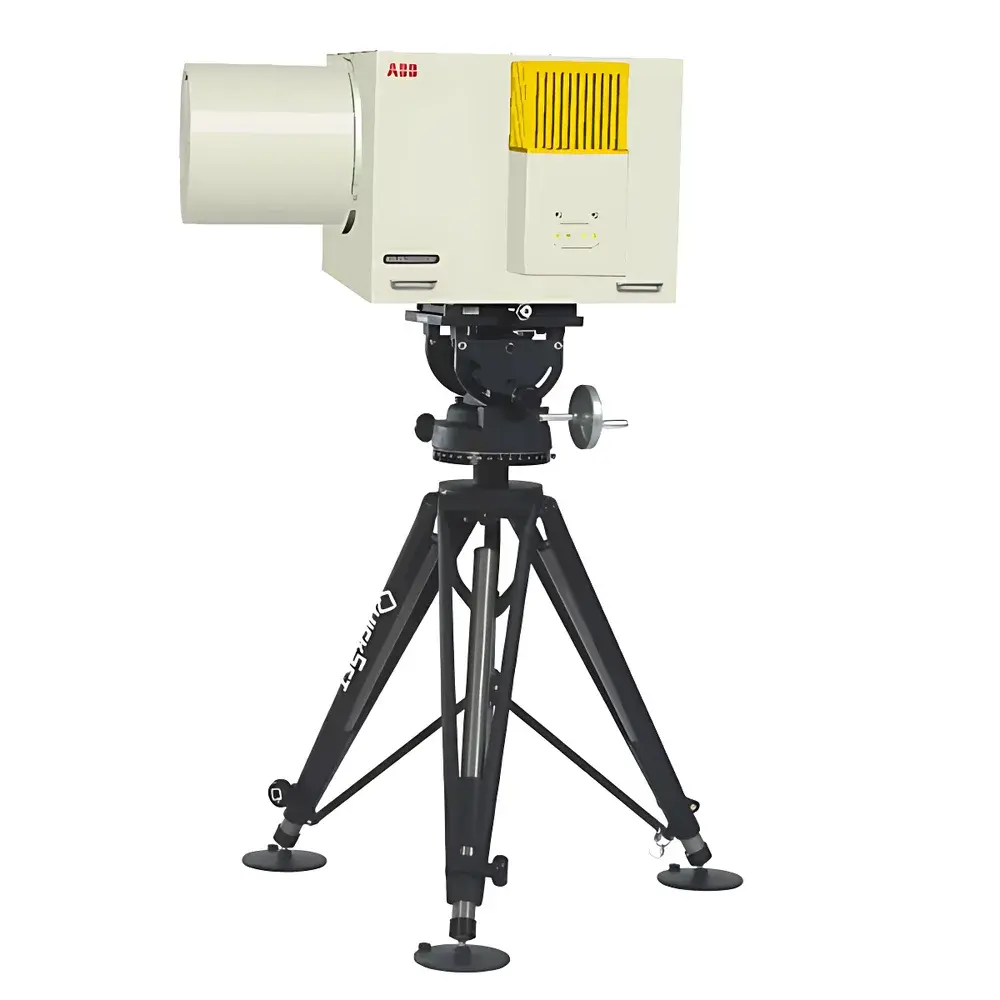
ABB MR-i Advanced FT-IR Hyperspectral Imaging Radiometer
| Brand | ABB |
|---|---|
| Origin | Canada |
| Manufacturer Type | Authorized Distributor |
| Origin Category | Imported |
| Model | MR-i |
| Price | USD 2,000,000 |
Overview
The ABB MR-i is a high-performance, commercial-grade Fourier Transform Infrared (FT-IR) hyperspectral imaging radiometer engineered for quantitative spectral radiance measurement across spatially resolved scenes. Unlike conventional point-scanning or filter-based systems, the MR-i employs a robust, un-damped, four-port Michelson interferometer architecture—derived from ABB’s proven Bomem MR-series radiometers—to deliver simultaneous, co-registered spectral and spatial data acquisition. Each pixel in the acquired image contains a full infrared spectrum (typically spanning 2–14 µm), enabling true three-dimensional datacubes (x, y, λ). This architecture supports both mid-wave infrared (MWIR: 3–5 µm) and long-wave infrared (LWIR: 8–12 µm) detection modalities, making it uniquely suited for applications requiring broad spectral coverage, high radiometric accuracy, and temporal synchronization of dual-band measurements.
Key Features
- Four-port interferometer design with zero-moving-part optical path stability, ensuring high spectral fidelity and long-term calibration retention.
- Dual-camera configuration capability: supports simultaneous MWIR/LWIR imaging or dual-MWIR/dual-LWIR setups for extended dynamic range and cross-band correlation analysis.
- Precise hardware-level synchronization between detectors (sub-millisecond timing alignment), eliminating frame-to-frame registration errors.
- Co-aligned optical axes across all detector modules, enabling pixel-perfect spatial registration without post-acquisition geometric correction.
- Modular detector interface accommodating standard MCT or InSb focal plane arrays with cryogenic or Stirling-cooled operation.
- Integrated blackbody calibration source with traceable NIST-traceable temperature control (±0.1 °C) for on-board radiometric calibration before and after acquisition sequences.
Sample Compatibility & Compliance
The MR-i operates as a non-contact, passive remote sensing instrument and requires no sample preparation. It is compatible with outdoor field deployments, laboratory-controlled environments, and airborne or ground-based mobile platforms (e.g., tripod-mounted, vehicle-integrated, or UAV-compatible configurations). The system complies with ISO/IEC 17025 requirements for radiometric calibration laboratories and supports audit-ready documentation per GLP and defense-sector quality standards (e.g., MIL-STD-810H for environmental ruggedness). Data acquisition protocols are configurable to align with ASTM E1933 (Standard Test Methods for Measuring and Compensating for Emissivity Using Infrared Imaging Systems) and ISO 18434-1 (Condition monitoring and diagnostics of machines — Thermography — Part 1: General procedures). Firmware and data handling routines support secure export formats compliant with ITAR-controlled data transmission frameworks where applicable.
Software & Data Management
The MR-i is operated via ABB’s proprietary SpectraSuite™ software suite, which provides real-time interferogram visualization, spectral calibration, radiometric correction, and datacube export in ENVI-compatible BIL/BIP formats. The software includes embedded atmospheric correction modules (e.g., MODTRAN-based line-by-line radiative transfer modeling) for quantitative retrieval of surface emissivity, gas concentration maps, and thermal contrast signatures. All processing workflows support metadata embedding (including GPS time stamps, platform attitude, ambient temperature, and humidity) and generate immutable audit logs meeting FDA 21 CFR Part 11 requirements for electronic records and signatures. Raw interferograms and calibrated radiance cubes are stored in HDF5 format with built-in checksum validation and optional AES-256 encryption for classified or export-controlled datasets.
Applications
- Military signature analysis: quantitative characterization of aircraft engine plumes, missile exhausts, and decoy flare spectral emissions for threat modeling and countermeasure development.
- Infrared camouflage evaluation: spectral emissivity mapping of multispectral concealment materials under varying background thermal conditions.
- Explosive event classification: discrimination of blast signatures (e.g., detonation vs. deflagration) using time-resolved hyperspectral radiance evolution in MWIR/LWIR bands.
- Atmospheric remote sensing: standoff detection and quantification of chemical vapor clouds (e.g., SF₆, NH₃, NO₂) via spectral absorption feature fitting and tomographic reconstruction.
- Meteorological turbulence profiling: high-temporal-resolution imaging of refractive index fluctuations in the boundary layer using differential radiance gradients.
- Industrial thermal process monitoring: spatially resolved emissivity-corrected temperature mapping of high-temperature manufacturing surfaces (e.g., turbine blade coatings, glass annealing furnaces).
FAQ
What spectral resolution can the MR-i achieve?
Spectral resolution is configurable via mirror scan velocity and aperture settings; typical operational resolution ranges from 0.25 cm⁻¹ to 4 cm⁻¹ (unapodized), with full-width-at-half-maximum (FWHM) performance verified against NIST SRM 2036 reference sources.
Is the MR-i suitable for airborne deployment?
Yes—the instrument meets MIL-STD-810H shock/vibration specifications and features an integrated inertial measurement unit (IMU) option for motion compensation during flight operations.
Does the system support real-time processing?
Raw interferogram streaming is supported at up to 60 Hz (full frame); radiance cube generation and basic spectral unmixing are available in near-real-time (<500 ms latency) using onboard GPU-accelerated firmware.
How is radiometric calibration maintained over time?
Calibration is performed using dual internal blackbodies (high- and low-temperature references) before each acquisition sequence, with drift correction algorithms referencing stable cavity resonance frequencies within the interferometer.
Can third-party algorithms be integrated into the data processing pipeline?
Yes—SpectraSuite™ exposes a documented C/C++ API and Python bindings (via PyMRi) for custom algorithm injection, including machine learning inference engines trained on domain-specific spectral libraries.



