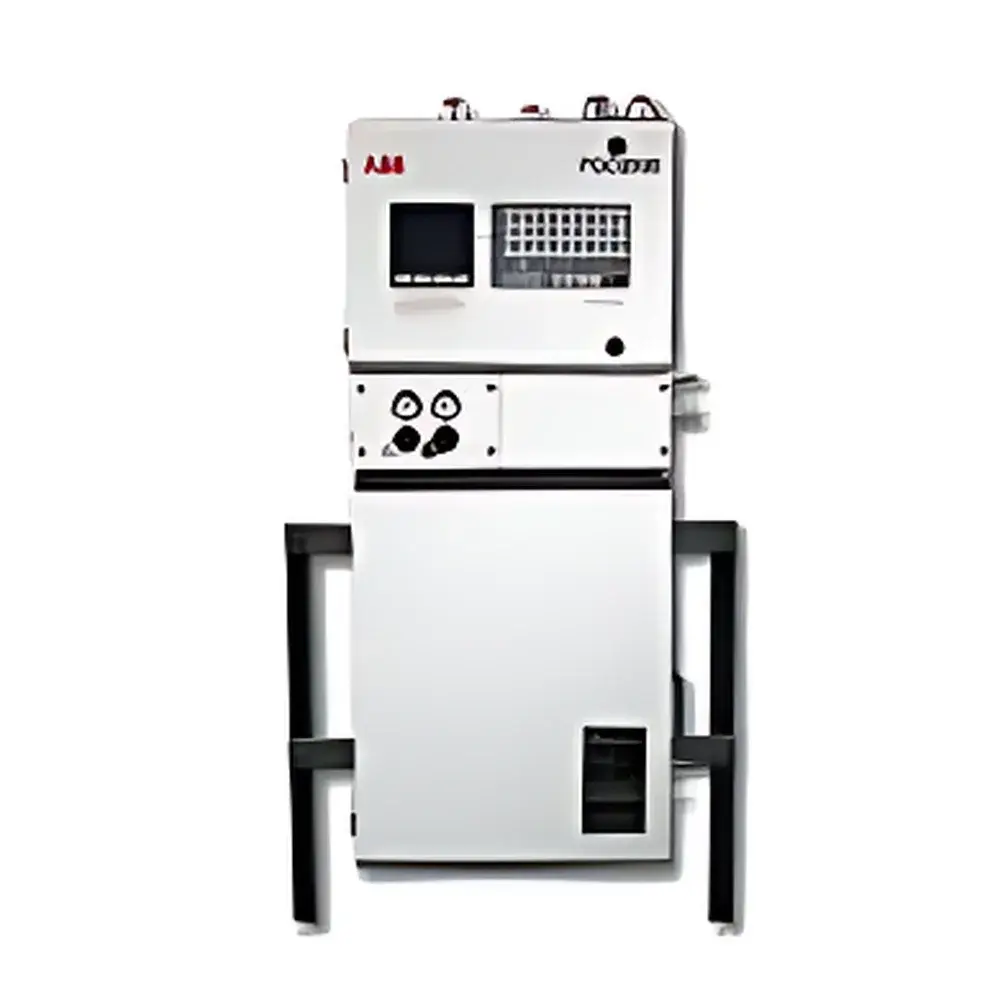
ABB PGC2000 Series E2 Process Gas Chromatograph
| Origin | USA |
|---|---|
| Manufacturer Type | Authorized Distributor |
| Origin Category | Imported |
| Model | PGC2000 Series |
| Pricing | Upon Request |
Overview
The ABB PGC2000 Series E2 is a second-generation industrial process gas chromatograph engineered for continuous, unattended operation in demanding hydrocarbon processing environments. As the evolutionary successor to the Vista 2000 platform, the PGC2000 E2 implements gas chromatographic separation based on differential partitioning of volatile analytes between a mobile phase (carrier gas) and stationary phase (capillary or packed column), followed by selective detection. Its architecture supports real-time compositional analysis of refinery streams, petrochemical feedstocks, natural gas, syngas, and specialty gases — delivering quantitative data critical for process optimization, product specification compliance, and safety monitoring. With roots tracing to ABB’s 1957 introduction of the world’s first online process GC, the PGC2000 E2 embodies over six decades of application-specific engineering refinement, particularly for high-reliability hydrocarbon analysis across HPI (Hydrocarbon Processing Industry) and LNG facilities.
Key Features
- Industrial-grade embedded controller with real-time OS, enabling deterministic response times and robust system recovery under continuous 24/7 operation
- Five independently controlled temperature zones with digital temperature control (DTC), supporting complex programmed temperature ramping and isothermal stability ±0.1°C
- Five-zone electronic pressure control (EPC) with sub-psi resolution, ensuring reproducible carrier gas flow and retention time stability across ambient fluctuations
- Modular valve architecture including M2CP sliding plate valves (for low-maintenance CP applications), Model 791 micro-liquid sampling valves (rated to 435 PSI / 200°C), and Valco DV-22 diaphragm valves (optimized for rapid column switching)
- Multi-detector compatibility: FID (ppb-level HC detection), TCD (universal detection, %-level quantification), FPD (sulfur-selective, 200× sensitivity boost with sulfur add-on module), DBDID (ppb-level halocarbons, NH₃, H₂S, PH₃ in ultra-high-purity gases), and PID (tunable 9.5–11.8 eV UV lamps for NOₓ, olefins, BTX, and heteroatom compounds)
- Helium- or argon-based DBDID plasma ionization source with thermoelectrically cooled PMT and barrier discharge electrode stack for enhanced signal-to-noise ratio
- Integrated air-bath oven with PFA-lined pneumatic tubing, optimized internal layout for tool-free valve access, and metal-surface passivation for extended column life
Sample Compatibility & Compliance
The PGC2000 E2 accommodates gaseous and liquid-phase samples via dedicated sampling interfaces — including pressurized liquid injection (up to 435 PSI), vapor-phase sampling (up to 300 PSI), and heated transfer lines (to 200°C). It complies with CSA C22.2 No. 142, UL 61010-1, ATEX Directive 2014/34/EU (Zone 1/21, II 2G Ex d IIB+H₂ T4 Gb), IECEx certification (Ex db IIB+H₂ T4 Gb), and EMC Directive 2014/30/EU. The standard configuration meets Division 2 (Class I, Div 2, Groups B, C, D) requirements per NEC 500; optional purge interlock modules enable Division 1 certification. All hardware and firmware support audit trails, electronic signatures, and configurable user roles aligned with FDA 21 CFR Part 11 and GLP/GMP documentation requirements.
Software & Data Management
The instrument runs on VistaBASIC — a real-time, interpreted scripting environment enabling full customization of analysis logic, sample sequencing, derived parameter calculation (e.g., heating value/BTU), and cross-analyzer data exchange via VistaNET 2.0. Local operation uses a 50-key tactile keypad and graphical LCD with multilingual menu navigation and context-sensitive help. Chromatograms are stored locally (≥1 hour raw data buffer) and remotely via VistaNET 2.0 OPC server integration. Statistical Quality Control (SQC) monitors peak area, baseline noise, detector status, and calibration drift against user-defined control limits. Data export supports CSV, XML, and Modbus TCP protocols. Firmware updates and method deployment occur over secure Ethernet or RS-232, with version-controlled configuration archives and rollback capability.
Applications
The PGC2000 E2 serves as a foundational analytical node in closed-loop process control systems across multiple domains: continuous distillation cut-point monitoring (PGC2002 E2); naphthene/paraffin/aromatic (PNA) and paraffin/isoparaffin/naphthene/aromatic (PINA) assays (PGC2003/2004 E2); sulfur-in-fuel quantification (PGC2007 E2); light olefin (ethylene, propylene) purity verification (PGC2008 E2); and rapid thermal-programmed analysis of trace impurities in ethylene oxide, ammonia, and semiconductor-grade gases (PGC2005/2009 E2). Its modular design enables concurrent dual-detector configurations (e.g., FID + TCD or FPD + DBDID) for orthogonal detection strategies required in custody transfer, environmental emissions reporting (EPA Method 18, ISO 6416), and catalyst performance evaluation.
FAQ
What distinguishes the PGC2000 E2 from legacy Vista 2000 platforms?
The E2 generation introduces five-zone EPC/DTC, VistaNET 2.0-native Ethernet communication, redundant Ethernet controller option, expanded VistaBASIC I/O addressing, and next-generation detectors (DBDID, enhanced FPD) — all within the same footprint and service interface.
Can the PGC2000 E2 operate in hazardous areas without external purging?
Yes — standard models are certified for Class I, Div 2 environments. For Class I, Div 1 installation, optional positive-pressure purge interlock modules are available.
Is regulatory-compliant data handling supported out-of-the-box?
Yes — audit trail logging, electronic signature capture, role-based access control, and 21 CFR Part 11–compliant configuration management are embedded in the VistaBASIC runtime and VistaNET 2.0 server suite.
How does ABB ensure long-term application reliability beyond hardware design?
Through factory-certified application engineering services, including method development, column selection, valve sequencing logic validation, and 20-year field-proven maintenance protocols — backed by ABB’s global Tier 3 technical support infrastructure.
What level of remote diagnostics and predictive maintenance is available?
Comprehensive self-diagnostics report sensor health, detector gain stability, column bleed trends, and EPC actuator wear. Integrated SNMP traps and VistaNET 2.0 alarms feed into enterprise CMMS platforms for proactive service scheduling.