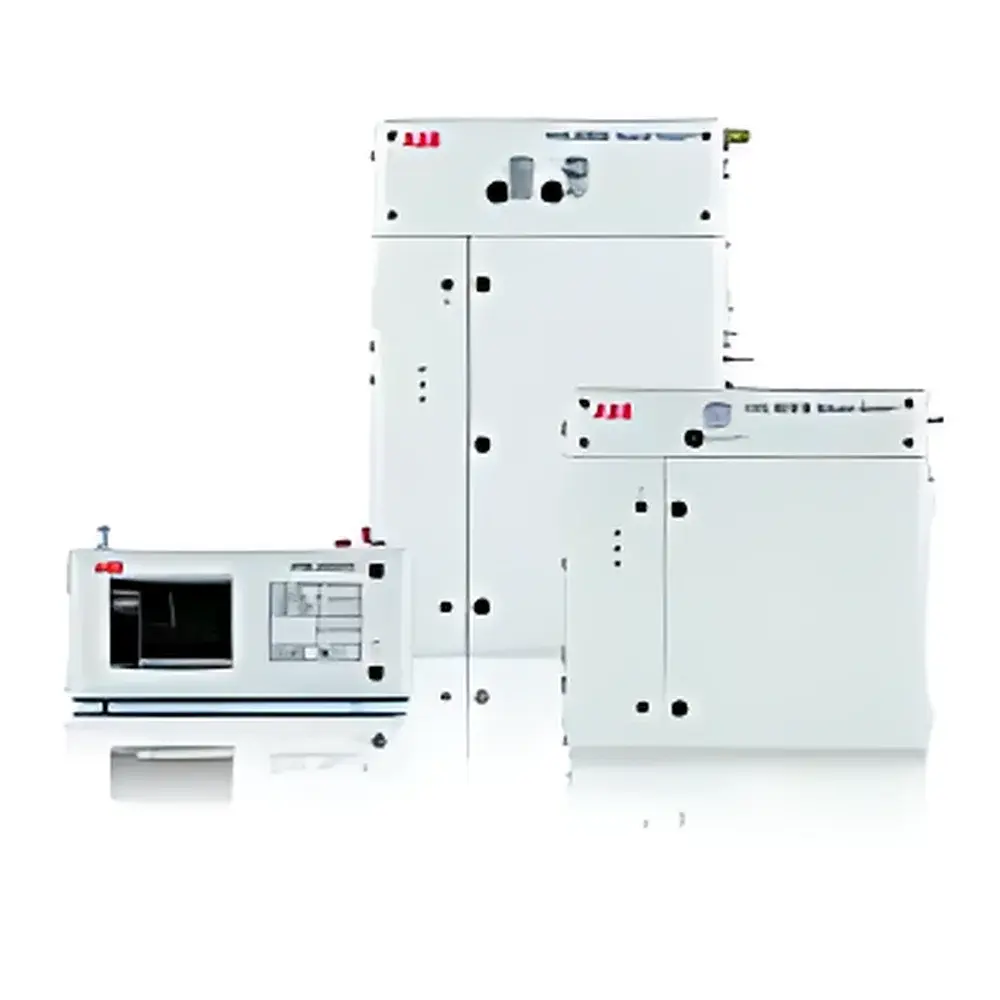
ABB PGC5000 Series Online Gas Chromatograph
| Brand | ABB |
|---|---|
| Origin | USA |
| Model | PGC5000 |
| Detection Principles | Gas Chromatography with Thermal Conductivity (TCD), Flame Ionization (FID), and Flame Photometric (FPD) Detection |
| Column Oven Configurations | Dual Intelligent Isothermal Zones (PGC5000B & PGC5000C) |
| Interface | 10.4″ SVGA Touchscreen HMI, Redundant Ethernet, USB, MODBUS RTU/TCP, Analog/Digital I/O |
| Compliance | Designed for SIL2-capable system integration per IEC 61511, compatible with FDA 21 CFR Part 11 audit trail requirements via optional software configuration |
Overview
The ABB PGC5000 Series Online Gas Chromatograph is an industrial-grade, continuous-duty analytical instrument engineered for real-time compositional analysis of process gas streams in demanding production environments. Based on proven gas chromatographic separation principles—where sample components are partitioned between a mobile gas phase (carrier gas) and a stationary phase coated inside fused-silica capillary or packed columns—the PGC5000 delivers high-resolution, repeatable quantification of hydrocarbons, permanent gases, sulfur compounds, and light organics. Its architecture reflects over five decades of ABB’s domain expertise in process analytics, emphasizing robustness, operational simplicity, and deterministic response under fluctuating plant conditions. Unlike laboratory GC systems, the PGC5000 is purpose-built for unattended, 24/7 operation in hazardous area enclosures (Class I Div 1/Zone 1), with integrated thermal management, pressure-regulated carrier gas delivery, and auto-calibration routines validated per ASTM D1945 and ISO 6974-2.
Key Features
- Distributed intelligent control architecture: Separates core functions across dedicated modules—main controller (PGC5000A), column oven(s) (PGC5000B or PGC5000C), and detector assemblies—to minimize single-point failure risk and simplify maintenance.
- 10.4″ SVGA touchscreen HMI with dual-language (English/Chinese) interface: Supports intuitive tab-based navigation, drag-and-drop method editing, and context-sensitive help—reducing operator training time and minimizing configuration errors.
- Redundant Ethernet ports and native MODBUS TCP/RTU support: Enables seamless integration into DCS, SIS, and MES platforms without protocol gateways; supports OPC UA via optional firmware upgrade.
- Two column oven variants: PGC5000B (compact, single-detector optimized) and PGC5000C (28% larger volume, multi-stream multiplexing capable) both feature precision ±0.1°C isothermal control, rapid thermal stabilization (<15 min from ambient to setpoint), and independent zone programming.
- Modular detector compatibility: Field-replaceable sTCD (standard TCD), mTCD (micro-TCD), FID (flame ionization), and FPD (flame photometric) detectors—each with factory-calibrated linear dynamic range and certified detection limits per ISO 10156.
Sample Compatibility & Compliance
The PGC5000 accommodates sample matrices including refinery off-gases, syngas, natural gas, biogas, ethylene cracker streams, and flare gas—within pressure ranges of 0.1–1.0 MPa (gauge) and moisture content up to 100 ppmv (with optional Nafion dryer integration). All wetted materials comply with NACE MR0175/ISO 15156 for sour service applications. The system meets electromagnetic compatibility requirements per EN 61326-1 and carries CE marking for industrial use. When configured with secure user authentication, electronic signatures, and time-stamped audit logs, it satisfies data integrity expectations under FDA 21 CFR Part 11 and EU Annex 11 for regulated manufacturing. Optional SIL2 certification documentation is available for safety-critical loop integration per IEC 61511.
Software & Data Management
The embedded PGC5000 Control Software (v4.x) provides full method lifecycle management—including sequence definition, retention time locking, peak integration rules, and calibration curve generation using internal standard or external standard protocols. Raw chromatograms and processed results are stored locally on industrial-grade SSD with configurable retention policies (default: 90 days). Data export supports CSV, XML, and OPC UA PubSub formats. Remote diagnostics and firmware updates are performed securely via HTTPS with TLS 1.2 encryption. Audit trails record all user actions—including method edits, calibration events, and alarm acknowledgments—with immutable timestamps traceable to NIST-traceable time sources.
Applications
- Petrochemical refining: Real-time monitoring of C1–C5 hydrocarbons in FCCU, hydrotreater, and alkylation unit streams.
- Natural gas custody transfer: Accurate BTU calculation per AGA Report No. 8 using compositional analysis of methane through pentanes and inert gases.
- Chemical synthesis: In-line verification of reaction completion in ammonia, methanol, and vinyl chloride processes.
- Environmental compliance: Continuous measurement of SO₂, H₂S, and total reduced sulfur (TRS) species in flare and vent stacks per EPA Method 15/16.
- Hydrogen purity assurance: Quantification of CO, CO₂, CH₄, and O₂ impurities down to sub-ppm levels in PEM electrolyzer feed gas.
FAQ
What carrier gases are supported?
Helium, hydrogen, and nitrogen are qualified per ABB Application Note AN-PGC5000-GAS-01; hydrogen requires additional leak detection and ventilation interlocks per NFPA 55.
Can the PGC5000 operate in explosion-hazardous areas?
Yes—when installed in ABB-certified X-Frame or Zone 1-rated cabinets with appropriate purge or intrinsic safety barriers (e.g., Pepperl+Fuchs KFD2-UT2-EX1).
Is remote access to chromatograms possible?
Yes—via secure web browser interface or OPC UA client; raw .CDF files conform to ASTM E1947-17 format for third-party spectral reprocessing.
How often does calibration require verification?
Initial calibration validation is recommended after installation; subsequent checks follow site-specific QA/QC procedures—typically every 7–30 days depending on matrix stability and regulatory scope (e.g., USP for pharmaceutical utilities).
Does the system support predictive maintenance alerts?
Yes—embedded health monitoring tracks column backpressure trends, detector baseline drift, and oven temperature deviation; alerts integrate with CMMS via Modbus or SNMP traps.