
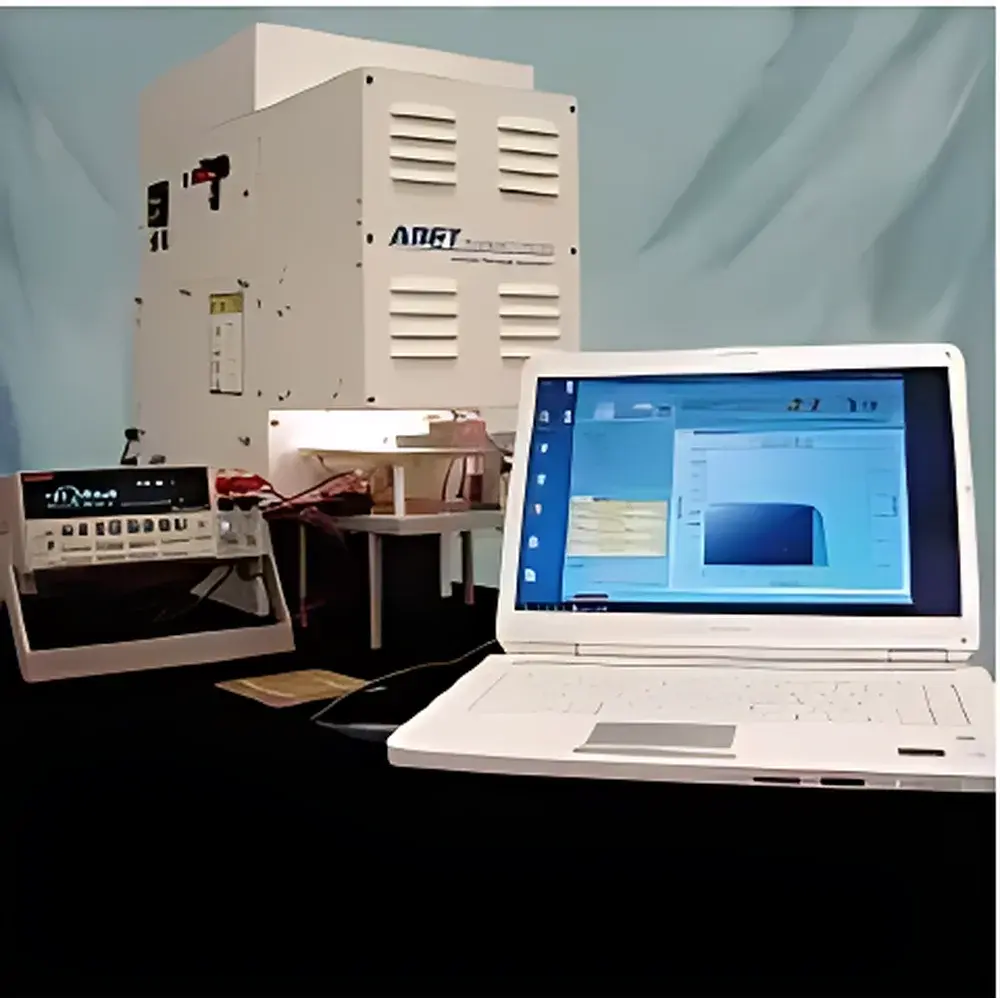
ABET SUN2000 Class A Solar Simulator
| Brand | ABET Technologies |
|---|---|
| Origin | USA |
| Light Source | Xenon Arc Lamp (Ozone-Free) |
| Illumination Mode | External Illumination |
| Output Area | 35 mm Ø (standard), configurable up to 8" × 8" |
| Spectral Match | ASTM E927-19 Class A, IEC 60904-9 Ed. 3 (2020) Class A, JIS C 8912 Class A |
| Spatial Uniformity | ≤2% (with diffuser), Class B per ASTM/IEC/JIS |
| Temporal Stability (short-term) | ≤0.5% over 10 s |
| Temporal Stability (long-term) | ≤2% over 8 h |
| Working Distance | 50–200 mm (adjustable) |
| Beam Direction | Horizontal (optional 90° turning mirror) |
| Lamp Power | 150 W |
| Lamp Lifetime | 1500 hours |
| Cooling | HEPA-filtered forced-air system |
| Control Interface | Integrated photofeedback loop, digital shutter with timer, electronic lamp power regulation |
| Input Power | 110/240 VAC, 50/60 Hz, ≤10 A |
Overview
The ABET SUN2000 Class A Solar Simulator is a precision-engineered optical instrument designed for reliable, repeatable, and standards-compliant solar irradiance simulation in photovoltaic (PV) research, materials testing, and optoelectronic characterization laboratories. Based on stabilized, ozone-free xenon arc lamp technology, the SUN2000 generates a broadband spectrum closely matching the Air Mass 1.5 Global (AM1.5G) reference spectrum (defined in ASTM E927-19, IEC 60904-9 Ed. 3:2020, and JIS C 8912). Its core optical architecture employs collimated beam delivery with integrated photofeedback control, enabling real-time irradiance stabilization independent of lamp aging or thermal drift. Unlike broadband LED-based simulators, the xenon source delivers continuous spectral coverage from 280 nm to 1100 nm—critical for accurate quantum efficiency (QE) mapping, spectral response validation, and degradation studies of multi-junction cells and perovskite absorbers. The system is engineered for integration into controlled-environment test benches and is routinely deployed in university labs, NREL-accredited PV testing facilities, and ISO/IEC 17025-certified calibration laboratories.
Key Features
- Ozone-free 150 W xenon short-arc lamp with ≥1500-hour rated lifetime and integrated lamp-hour counter
- Class A spectral match per ASTM E927-19, IEC 60904-9:2020, and JIS C 8912—verified via calibrated spectroradiometer traceable to NIST standards
- Spatial uniformity ≤2% across 35 mm Ø output field (with optional diffuser); meets Class B requirements without diffuser
- Short-term temporal stability ≤0.5% (10 s interval) and long-term stability ≤2% (8 h continuous operation), validated under GLP-aligned monitoring protocols
- Adjustable working distance (50–200 mm) with mechanical repeatability ±0.1 mm; horizontal beam orientation with optional 90° kinematic turning mirror for vertical sample mounting
- Integrated photofeedback loop continuously monitors irradiance at the sample plane and dynamically adjusts lamp power to maintain setpoint accuracy
- HEPA-filtered forced-air cooling system ensures stable thermal management and prevents dust contamination of optical surfaces
- Digital electronic shutter with programmable timing (1 ms–999 s resolution) and TTL trigger compatibility for synchronized IV measurements
Sample Compatibility & Compliance
The SUN2000 supports sample formats ranging from 10 mm × 10 mm mini-cells to standard 156 mm × 156 mm silicon wafers (with appropriate collimation optics and extended working distance configurations). Its compact footprint and modular design allow seamless integration with environmental chambers, probe stations, and vacuum gloveboxes. All optical components—including fused silica lenses, cold mirrors, and quartz diffusers—are selected for high UV transmission and minimal spectral distortion. The system complies with safety requirements per IEC 61000-6-3 (EMC emissions) and IEC 60598-1 (luminaire safety), and its electrical architecture conforms to UL 61010-1 and CE marking directives. Documentation includes full traceable calibration certificates, spectral match reports, uniformity maps, and stability logs—essential for FDA 21 CFR Part 11–compliant data integrity frameworks and ISO/IEC 17025 audit readiness.
Software & Data Management
While the SUN2000 operates as a standalone optical source, it is fully compatible with ABET’s ReRa Tracer IV measurement platform and third-party DAQ systems (e.g., Keysight B2900 series, Keithley 2450/2460). The integrated digital shutter and photofeedback interface support SCPI command sets over USB or RS-232, enabling automated irradiance ramping, timed exposure sequences, and closed-loop feedback synchronization. All operational parameters—including lamp voltage/current, shutter state, photodiode signal, and ambient temperature—are logged at user-defined intervals (100 ms–10 s) and exported in CSV or HDF5 format. Audit trails are retained for ≥12 months, supporting GLP/GMP documentation requirements. Firmware updates are delivered via secure HTTPS download with SHA-256 signature verification.
Applications
- Photovoltaic device characterization: J-V curve acquisition under standardized AM1.5G illumination for efficiency reporting (IEC 61215, IEC 61646)
- Quantum efficiency and external quantum efficiency (EQE) mapping of single-junction and tandem solar cells
- Light-induced degradation (LID) and UV-induced degradation (UVID) studies requiring spectrally accurate, stable irradiance
- Calibration of reference cells and pyranometers against primary standards
- Photochemical reaction kinetics studies in photocatalysis and solar fuel research
- Accelerated aging tests of encapsulants, anti-reflective coatings, and polymer substrates per ASTM D7869
- Educational laboratory use for semiconductor physics, renewable energy, and optical engineering curricula
FAQ
What standards does the SUN2000 meet for spectral match and uniformity?
It achieves Class A spectral match per ASTM E927-19, IEC 60904-9:2020, and JIS C 8912. Spatial uniformity is ≤2% across the 35 mm Ø field when used with the standard diffuser—meeting Class B per all three standards without diffuser.
Can the SUN2000 be integrated with an existing IV measurement system?
Yes. It provides TTL-compatible shutter triggering, analog photofeedback output (0–10 V), and SCPI-over-USB/RS-232 control for full automation with commercial source meters and custom LabVIEW/Python DAQ environments.
Is the xenon lamp truly ozone-free, and how is this verified?
Yes. The lamp envelope uses synthetic fused silica doped to suppress <200 nm emission, eliminating ozone generation. Each lamp batch undergoes spectral verification using a NIST-traceable UV-VIS spectroradiometer prior to shipment.
What maintenance is required to sustain Class A performance over time?
Annual recalibration of spectral match and uniformity is recommended. Lamp replacement every ~1500 hours, periodic HEPA filter replacement (every 6 months under continuous use), and quarterly optical surface inspection with methanol/isopropanol cleaning constitute the preventive maintenance schedule.
Does ABET provide traceable calibration documentation?
Yes. Every unit ships with a Certificate of Conformance, spectral match report (measured with Ocean Insight QE Pro), spatial uniformity map (acquired via calibrated CCD radiometer), and stability log—all traceable to NIST standards and compliant with ISO/IEC 17025 documentation requirements.





