
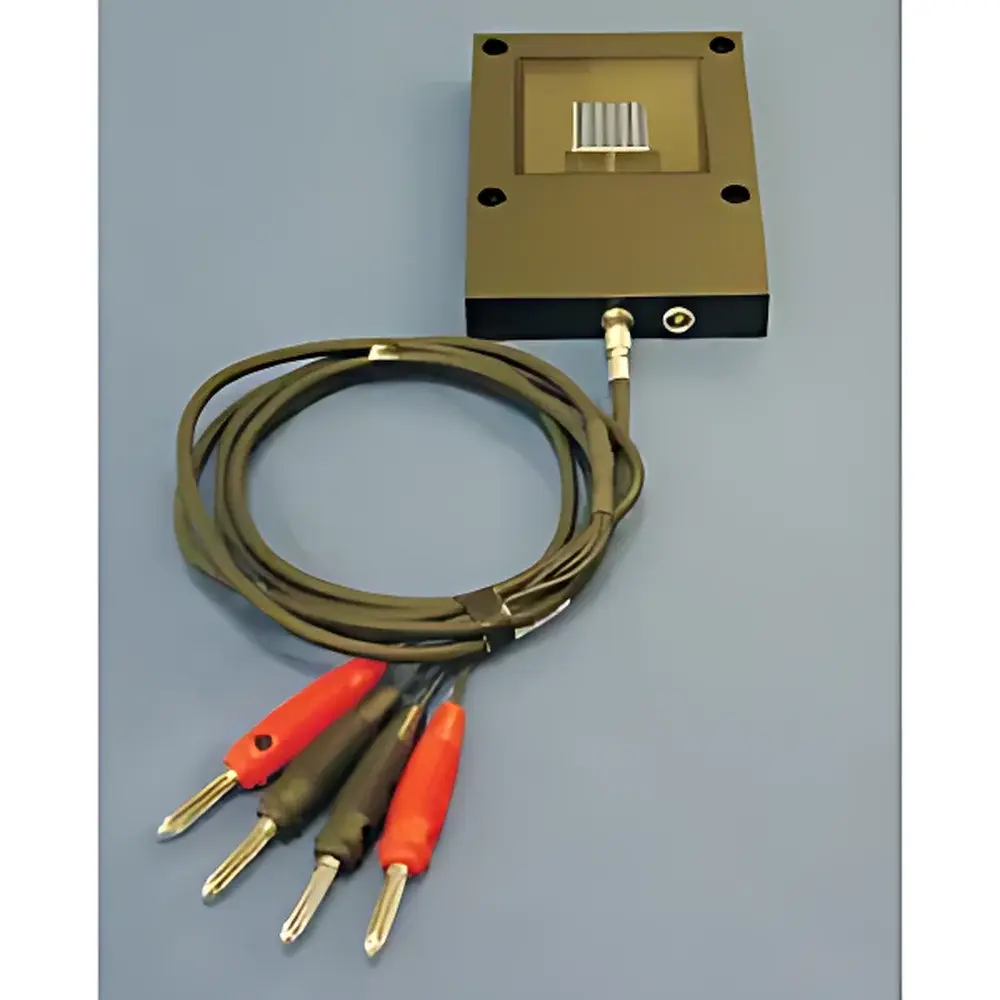
ABET Technologies QE/IPCE Measurement System
| Brand | ABET Technologies |
|---|---|
| Origin | USA |
| Manufacturer Type | Authorized Distributor |
| Origin Category | Imported |
| Model | QE Measurement Systems |
| Pricing | Available Upon Request |
| Light Source | LED-based monochromatic source (DC to high-frequency modulation, no mechanical chopper required) |
| Focal Length | 250 mm |
| Monochromator Drive | Direct-drive grating mechanism |
| Spectral Range | 300–1800 nm |
| Output Coupling | Fiber-coupled, uniform beam profile |
| Detection | Dual-channel lock-in amplifier |
| Device Compatibility | Single-junction and multi-junction photovoltaic devices |
| Measurable Parameters | External Quantum Efficiency (EQE), Incident Photon-to-Current Efficiency (IPCE), Internal Quantum Efficiency (IQE) |
| Bias Voltage Range | ±10 V |
| Current Measurement Range | Up to 100 mA (I–V characterization) |
| Auxiliary Light Source | Optional broadband (white) or custom spectral source |
| Control & Processing | Integrated Windows OS with embedded DSP-based lock-in amplifier |
| Software | Photor™ — full-featured quantum efficiency analysis suite |
Overview
The ABET Technologies QE/IPCE Measurement System is a fully integrated, laboratory-grade quantum efficiency characterization platform engineered for precision photovoltaic (PV) device evaluation. It operates on the principle of monochromatic photocurrent spectroscopy, where incident photon flux at discrete wavelengths is precisely quantified and correlated with the resulting electrical response under controlled bias conditions. Unlike conventional systems relying on rotating filter wheels or mechanical choppers—sources of timing jitter and intensity instability—this system employs a solid-state LED-driven monochromator with direct-drive grating mechanics, enabling stable, continuous, and rapidly tunable spectral output from 300 nm to 1800 nm. The architecture supports both external (EQE/IPCE) and internal (IQE) quantum efficiency determination through synchronized optical excitation, electrical biasing, and high-sensitivity current detection. Designed for research labs, PV R&D centers, and NREL-accredited testing facilities, it meets the physical and metrological requirements for traceable, repeatable quantum efficiency mapping in accordance with ASTM E1021, IEC 60904-8, and ISO 17025-compliant calibration practices.
Key Features
- LED-based monochromatic light source eliminating mechanical choppers—ensures temporal stability, reduced maintenance, and improved signal-to-noise ratio
- 250 mm focal length Czerny–Turner monochromator with direct-drive grating for high wavelength accuracy (±0.2 nm) and repeatability (<0.05 nm RMS)
- Fiber-coupled optical output delivering spatially uniform illumination across sample areas up to 2 cm²
- Dual-channel digital lock-in amplifier with 120 dB dynamic range and sub-microamp sensitivity (down to 100 fA resolution)
- Integrated ±10 V programmable DC bias supply with fast settling time (<10 µs), supporting dark-current subtraction and junction characterization
- Simultaneous I–V sweep capability up to 100 mA with 16-bit current/voltage digitization and auto-ranging
- Optional variable auxiliary light source (broadband white or user-defined spectrum) for Voc-dependent EQE measurements and spectral mismatch correction
- Photor™ software suite featuring automated wavelength scanning, spectral responsivity normalization, IQE deconvolution (with reflectance/transmittance input), and batch processing workflows
Sample Compatibility & Compliance
The system accommodates standard photovoltaic test structures including silicon heterojunction (SHJ), perovskite single-junction and tandem cells, organic PV (OPV), CIGS, GaAs, and emerging low-bandgap absorbers. Sample holders support standard 1 cm² test cells and customizable fixtures for encapsulated modules or mini-modules (up to 5 cm × 5 cm). All optical and electrical calibrations are traceable to NIST-certified reference detectors (e.g., Hamamatsu S1337 series) and calibrated radiometers. The system complies with GLP and GMP documentation standards, supporting audit-ready data logs with timestamped metadata, operator ID, environmental conditions (optional sensor integration), and full instrument configuration snapshots. Data export formats include CSV, HDF5, and XML for compatibility with PV performance modeling tools such as PC1D and SCAPS.
Software & Data Management
Photor™ is a native Windows application built on a modular C++/Qt framework with real-time DSP acceleration. It provides full control over monochromator positioning, LED driver modulation frequency (1 Hz–50 kHz), lock-in time constants (10 µs–30 s), and bias sequencing. Raw data streams—including photocurrent, reference photodiode signal, bias voltage, and auxiliary light status—are logged synchronously at user-defined sampling rates. The software implements automatic dark-current compensation, spectral irradiance correction using NIST-traceable responsivity curves, and IQE calculation via user-supplied reflectance (R) and transmittance (T) spectra. Audit trails meet FDA 21 CFR Part 11 requirements, including electronic signatures, role-based access control, and immutable raw-data archiving. Export modules support direct integration with MATLAB, Python (via PyPhotor API), and LIMS platforms.
Applications
- Quantitative EQE/IPCE mapping of lab-scale solar cells for bandgap validation and recombination loss analysis
- IQE derivation to isolate bulk vs. interface recombination mechanisms in multijunction devices
- Spectral mismatch factor (MMF) determination for PV calibration laboratories seeking ISO/IEC 17025 accreditation
- Stability assessment under prolonged monochromatic stress (wavelength-resolved degradation kinetics)
- Optical modeling validation using measured quantum efficiency spectra as boundary conditions
- Process development feedback for deposition, etching, and passivation steps in thin-film and wafer-based PV manufacturing
FAQ
What spectral range does the system cover, and how is calibration maintained?
The system covers 300–1800 nm using interchangeable LEDs and optimized diffraction gratings. Wavelength calibration is performed using mercury-argon emission lines; irradiance calibration uses NIST-traceable photodiodes with annual recalibration recommended.
Can the system measure tandem or multi-junction solar cells?
Yes—the dual-channel lock-in architecture enables simultaneous front- and rear-junction current extraction when combined with selective biasing and wavelength-specific illumination protocols.
Is Photor™ compatible with third-party data analysis environments?
Yes—Photor™ supports programmatic access via COM interface and exports structured HDF5 files with embedded metadata, enabling seamless ingestion into Python, MATLAB, or custom ML pipelines.
Does the system support automated temperature control integration?
While not included by default, the system features analog/digital I/O ports for synchronization with external environmental chambers or Peltier stages (e.g., Linkam LTS420) via TTL triggers and analog voltage feedback.
How is measurement uncertainty quantified in reported EQE values?
Photor™ calculates expanded uncertainty (k = 2) per GUM guidelines, incorporating contributions from spectral irradiance (±1.8%), current measurement (±0.35% of reading), positional repeatability (±0.1 nm), and reference detector drift (±0.2% annually).



