
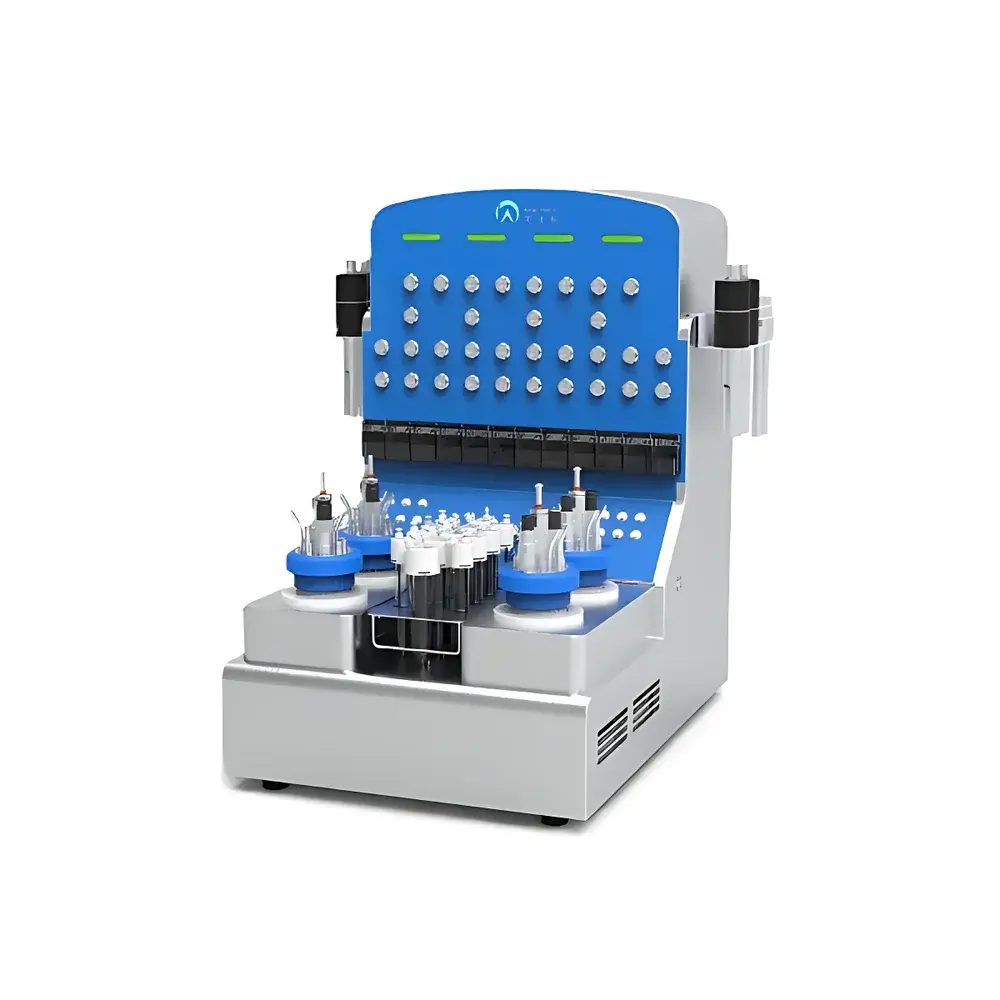
AbioBundle Multimini Parallel Bioreactor System
| Brand | Applitech |
|---|---|
| Origin | Guangdong, China |
| Manufacturer Type | Original Equipment Manufacturer (OEM) |
| Country of Origin | China |
| Model | AbioBundle Multimini |
| Pricing | Available Upon Request |
Overview
The AbioBundle Multimini Parallel Bioreactor System is an engineered platform for high-throughput, small-scale bioprocess development. Designed around Couette-type stirred-tank geometry with borosilicate glass vessels, it implements precise, independent control of critical bioreactor parameters—including temperature, pH, dissolved oxygen (DO), agitation speed, and feeding—across up to four parallel 50–500 mL working-volume vessels. Its core architecture integrates embedded real-time control with industrial-grade computing (IPC), enabling deterministic response times and synchronization accuracy essential for comparative process studies. Unlike conventional water-jacketed systems, the Multimini employs solid-state Peltier elements for bidirectional temperature regulation (cooling/heating), eliminating dependency on external chilled water circuits and mitigating risks associated with condensation, microbial ingress, or coolant leakage. This dry thermal management system supports operation within ±0.1 °C setpoint stability under dynamic load conditions, meeting requirements for reproducible mammalian cell culture and microbial fermentation.
Key Features
- Four independently controllable glass bioreactors (50–500 mL working volume), each equipped with magnetic drive stirrer, gas sparging manifold, and integrated temperature/pH/DO sensor ports.
- Peltier-based thermal regulation with no external cooling water—reducing lab infrastructure burden and enhancing biosafety compliance.
- Modular peristaltic pump module: up to three variable-speed pumps per vessel, each with dedicated Prime/Empty function for rapid tubing priming, sterile line purging, or feed interruption.
- Quick-swap feed interface supporting both single-use centrifuge tubes (e.g., 15/50 mL conical) and pre-sterilized disposable bottles—enabling rapid media or additive switching without system revalidation.
- Compact footprint: total system area < 0.5 m² for full quad configuration; optimized for benchtop deployment in GLP-compliant R&D labs and cleanroom-adjacent environments.
- Native support for intelligent ISFET-based pH electrodes and optical DO sensors; compatible with external mass flow controllers (MFCs), precision balances (RS-232/USB), and third-party peristaltic pumps via analog/digital I/O.
Sample Compatibility & Compliance
The Multimini accommodates suspension-adapted mammalian cells (CHO, HEK293, iPSCs), microbial strains (E. coli, P. pastoris, S. cerevisiae), filamentous fungi, insect cells (Sf9, High Five), and plant cell aggregates. All wetted materials comply with USP Class VI and ISO 10993-5 standards; glass vessels are ASTM E438 Type I, Class A. The system supports execution of protocols aligned with ICH Q5D (cell substrate characterization), USP (ancillary materials), and FDA 21 CFR Part 11 when deployed with audit-trail-enabled software configurations. Full traceability of parameter logs, user actions, and alarm events is maintained through timestamped binary data files compliant with ASME BPE-2023 metadata conventions.
Software & Data Management
Control and monitoring are delivered via Applitech’s Aiopt™ Process Control Suite—a deterministic real-time application built on a Linux RT kernel. The suite provides dual-mode interaction: local touchscreen interface (optional external display via HDMI) and browser-based WebUI (HTTPS/TLS 1.2 encrypted) accessible from any networked workstation. All control loops utilize model-predictive adaptive algorithms tuned for low-inertia bioreactor dynamics, delivering < 2% overshoot during step changes in agitation or gas blending. Raw sensor data (10 Hz sampling), calculated derived variables (e.g., OUR, CER, qP), and event logs are stored in HDF5 format with embedded metadata (vessel ID, operator, protocol version, calibration timestamps). Export options include CSV, MATLAB .mat, and ISA-88-compliant XML for integration into LIMS or MES platforms.
Applications
- Cell line screening and clone selection under controlled microenvironmental gradients (pH, DO, feed rate).
- Media optimization studies using Design of Experiments (DoE) across ≥4 parallel conditions per run.
- Toxicity assessment of novel transfection reagents, viral vectors, or metabolic intermediates in adherent and suspension cultures.
- Process characterization for monoclonal antibody production, recombinant protein expression, and viral vector manufacturing (AAV, lentivirus).
- Development of perfusion and fed-batch strategies for high-density CHO cultures (>20 × 10⁶ cells/mL) and anaerobic Clostridia fermentations.
- Scale-down model validation for clinical-stage bioprocesses prior to transfer to 50–200 L pilot reactors.
FAQ
What is the minimum working volume per vessel?
The system supports a minimum working volume of 50 mL per glass vessel—currently the smallest commercially available stirred-tank parallel bioreactor platform certified for mammalian cell culture.
Can the Multimini be integrated into existing automation frameworks?
Yes. It exposes Modbus TCP and OPC UA interfaces for seamless integration with SCADA, DeltaV, or custom Python-based orchestration scripts.
Is validation documentation provided for GMP use?
Applitech supplies IQ/OQ protocols, traceable calibration certificates (NIST-traceable sensors), and risk assessments (FMEA) upon request—aligned with Annex 15 and ASTM E2500 guidelines.
How is sterility maintained during multi-day runs?
All fluid paths use single-use, gamma-irradiated tubing sets; vessel lids incorporate septum-access ports with HEPA-filtered venting; and the entire system operates under positive-pressure nitrogen blanket capability (optional add-on).
Does the system support real-time metabolic flux analysis?
When paired with inline NIR probes or off-gas analyzers (via analog input expansion), the Aiopt™ software calculates real-time respiratory quotients (RQ) and specific uptake/production rates using stoichiometric balancing algorithms.



