
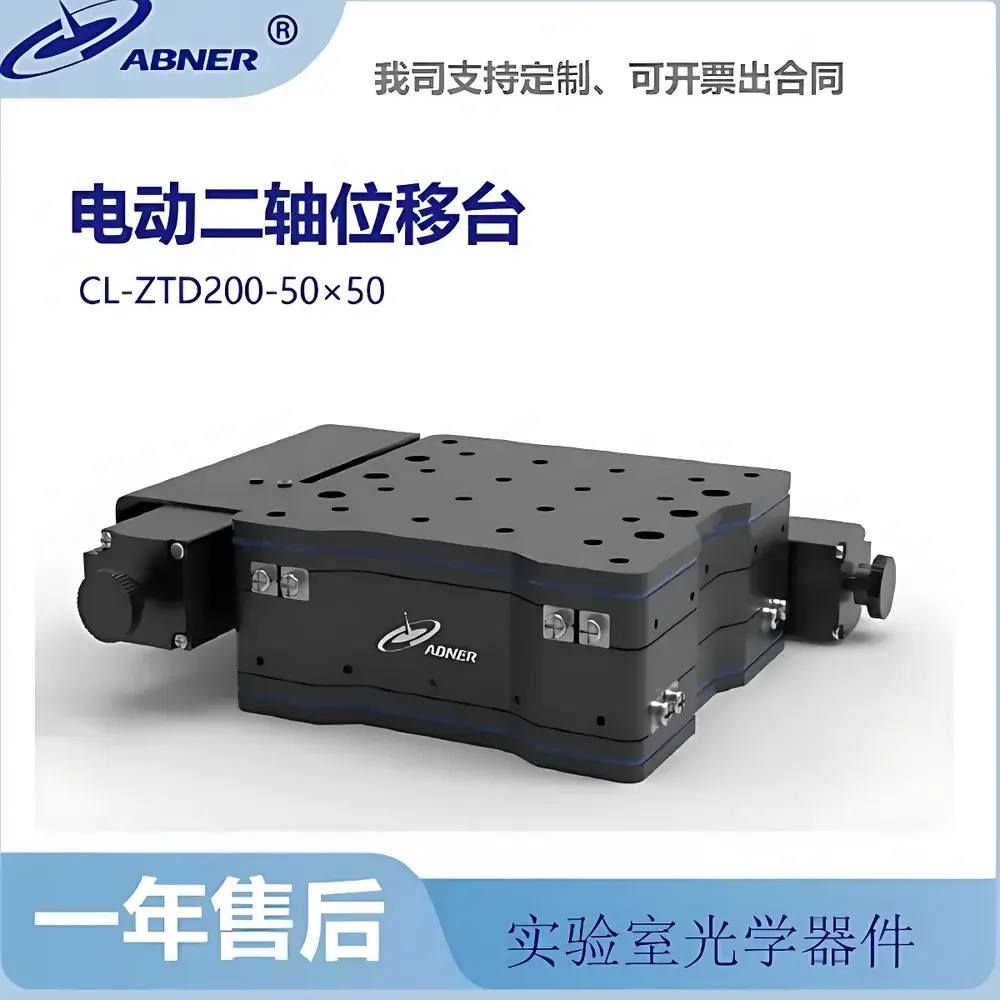
Abner CL-ZTD200-50×50 Dual-Axis Motorized XY Translation Stage
| Brand | Abner |
|---|---|
| Origin | Jiangsu, China |
| Model | CL-ZTD200-50×50 |
| Travel Range (X/Y) | 50 mm × 50 mm |
| Platform Dimensions | 155 mm × 155 mm |
| Construction | Anodized Aluminum Alloy |
| Drive Mechanism | Precision Ball Screw with Crossed-Roller Bearings or Linear Rails |
| Motor Type | Stepper or Servo Motor (Configurable) |
| Positioning Accuracy | ≤ ±1.5 µm (typical, dependent on feedback option) |
| Repeatability | ≤ ±0.5 µm |
| Load Capacity | ≤ 5 kg (horizontal, static) |
| Control Interfaces | USB, RS-232, RS-485, CAN |
| Software Compatibility | LabVIEW, Python, C++, MATLAB |
| Compliance | CE-marked per EU Machinery Directive 2006/42/EC and EMC Directive 2014/30/EU |
| Customization Options | Extended travel, integrated encoder feedback, vacuum-compatible variants, OEM mounting configurations |
Overview
The Abner CL-ZTD200-50×50 is a high-stiffness, dual-axis motorized XY translation stage engineered for precision positioning in optical alignment, laser beam steering, micro-sample scanning, and automated metrology applications. Based on the Couette-type mechanical architecture common to high-fidelity translation stages, it employs orthogonal linear motion axes driven by preloaded ball screws and guided by crossed-roller bearings — a configuration that minimizes pitch/yaw error and ensures sub-micron repeatability under controlled loading conditions. The monolithic aluminum alloy base and top plate are CNC-machined and hard-anodized (Type III), delivering thermal stability (coefficient of linear expansion: ~23.1 µm/m·°C), corrosion resistance, and structural rigidity essential for vibration-sensitive optical benches and cleanroom-integrated systems. With a nominal travel range of 50 mm per axis and a 155 mm × 155 mm mounting surface featuring a standardized M4/M6 threaded hole pattern (ISO 2768-mK tolerance), the stage supports rapid integration into multi-component optomechanical assemblies including interferometers, confocal microscopes, and wafer-level test fixtures.
Key Features
- High-rigidity monolithic aluminum construction with hard-anodized surface finish (6061-T6 base material, Ra ≤ 0.8 µm)
- Dual independent axes with precision-ground ball screws (lead accuracy: ±12 µm/300 mm) and preload-adjustable crossed-roller bearing guides
- Configurable drive options: 1.8° two-phase stepper motors (standard) or 2500-line incremental encoder-equipped servo motors (optional)
- Position resolution down to 0.1 µm (with 1000-line encoder + 4× quadrature interpolation) and open-loop step resolution of 0.5 µm (1/10 microstepping)
- Integrated limit switches and home sensors (optical or Hall-effect) for deterministic homing and over-travel protection
- Modular control interface architecture supporting USB 2.0 (CDC class), RS-232 (TTL/RS232 level selectable), RS-485 (multi-drop capability), and CAN 2.0B bus
Sample Compatibility & Compliance
The CL-ZTD200-50×50 is designed for use with standard optical components (e.g., mirrors, lenses, fiber couplers, photodetectors) and semiconductor-grade samples up to 5 kg in mass. Its flatness tolerance (≤ 5 µm over full travel) and parallelism deviation (≤ 3 arcsec) meet ISO 10360-2 requirements for coordinate measuring machine (CMM) auxiliary stages. The unit complies with CE marking directives for machinery safety (2006/42/EC), electromagnetic compatibility (2014/30/EU), and RoHS 2011/65/EU restrictions on hazardous substances. While not certified to ISO 14644-1 Class 5, its sealed bearing housings and non-outgassing anodized surface permit operation in ISO Class 7 cleanrooms. Vacuum-compatible versions (10⁻⁶ mbar) are available with stainless-steel hardware and dry-lubricated guides upon request.
Software & Data Management
Abner provides a cross-platform SDK (Windows/Linux/macOS) with native drivers for LabVIEW (2015+), Python (3.7+, via PySerial or CANopen libraries), C/C++ (DLL/SO), and MATLAB (Instrument Control Toolbox). All communication protocols implement ASCII command sets compliant with SCPI-like syntax (e.g., “MOV X 25.345” or “POS? Y”) and support asynchronous status reporting. For regulated environments, optional firmware upgrades enable audit-trail logging (timestamped position commands, error codes, and system events) aligned with FDA 21 CFR Part 11 electronic record requirements when deployed with validated host software. Data export supports CSV, HDF5, and TDMS formats for traceability in GLP/GMP workflows.
Applications
- Active alignment of single-mode fiber arrays in photonic packaging lines
- Automated focus scanning in laser-induced breakdown spectroscopy (LIBS) sample chambers
- Multi-point calibration of CCD/CMOS sensor response uniformity
- MEMS device characterization requiring synchronized XY motion and electrical stimulus
- Integration into custom-built atomic force microscope (AFM) scanner frames as coarse approach stage
- Robotic optical path switching in reconfigurable free-space quantum optics experiments
FAQ
What is the maximum recommended payload for horizontal operation?
The stage is rated for ≤5 kg static load under horizontal orientation; dynamic load capacity reduces to 3 kg at acceleration >0.2 g.
Can this stage be used in vacuum environments?
Standard units are air-rated only; vacuum-compatible variants (10⁻⁶ mbar) require optional stainless-steel fasteners, ceramic-coated screws, and fluoropolymer-lubricated guides.
Is encoder feedback included by default?
No — incremental encoders are optional add-ons; the base model operates in open-loop stepper mode with stall detection via current monitoring.
Does Abner provide OEM mechanical drawings and API documentation?
Yes — STEP/IGES models and full protocol specifications (including error code definitions and timing diagrams) are provided under NDA upon quotation acceptance.
How is thermal drift compensated during extended scans?
While no active temperature compensation is built-in, the stage’s low thermal expansion coefficient and symmetrical thermal mass distribution limit positional drift to <0.8 µm/°C across the full travel range.




