
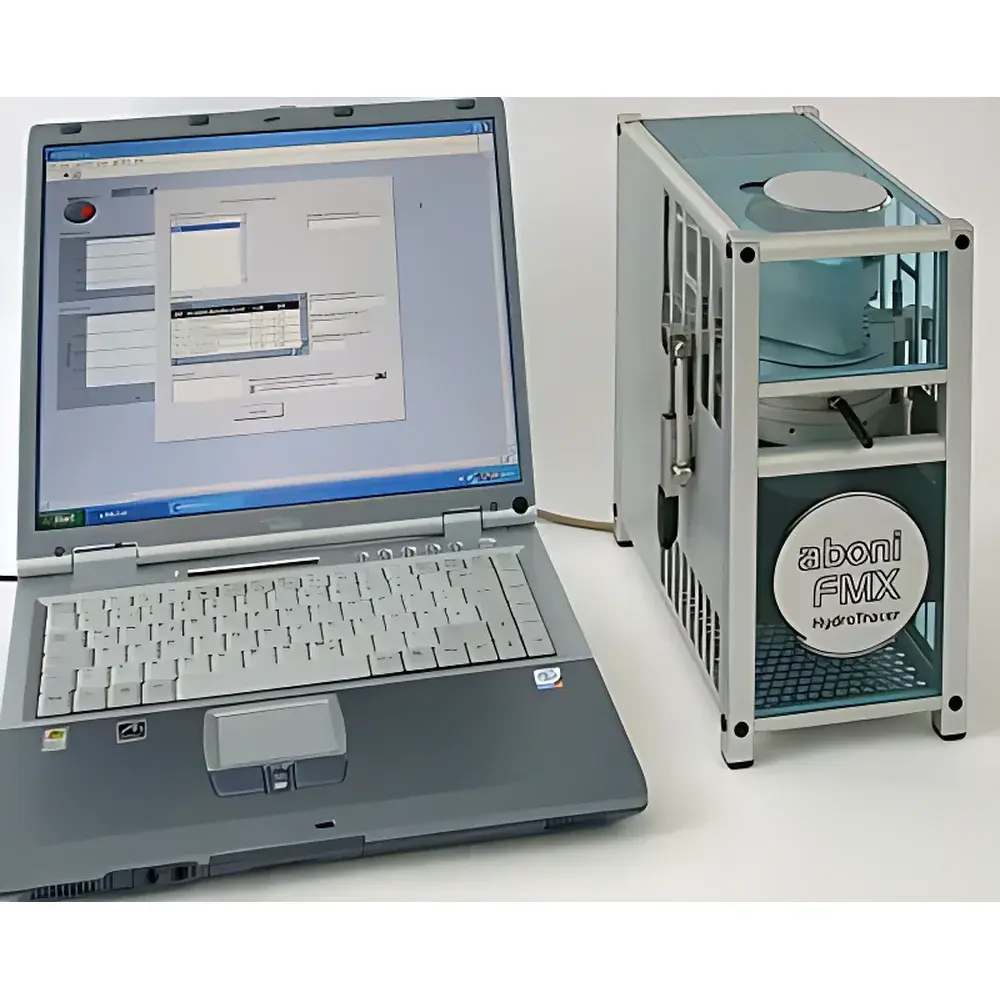
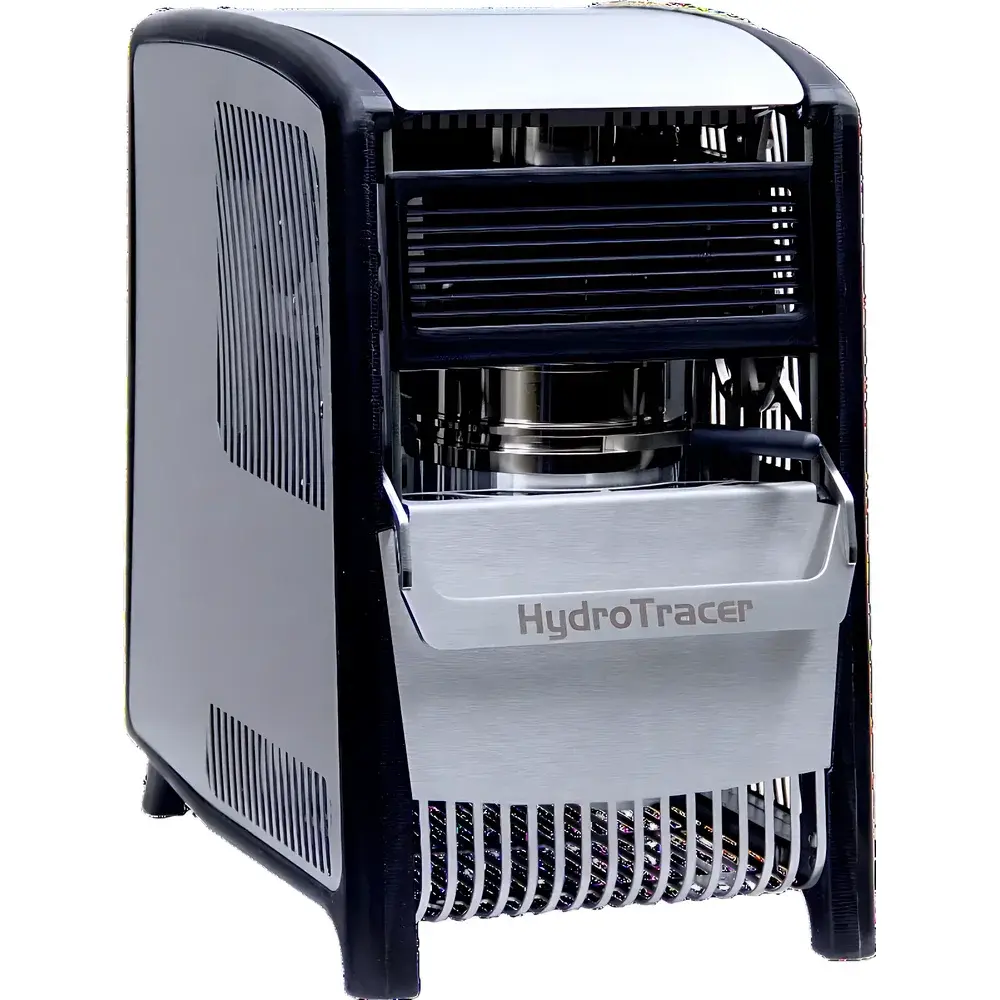
Aboni FMX HydroTracer Coulometric Karl Fischer Moisture Analyzer
| Brand | Aboni |
|---|---|
| Origin | Germany |
| Instrument Type | Coulometric Karl Fischer Moisture Analyzer |
| Sample Form | Solids, Powders, Films |
| Measuring Principle | Hydride-Generation Gas Evolution (CaH₂ Reaction) |
| Absolute Range | 0.2–30 mg H₂O |
| Relative Range | 0.0005–5 % w/w |
| Reproducibility | ±0.1 mg H₂O (at 1 mg), ±0.3 mg H₂O (at 20 mg) |
| Sample Weight | 0.01–50 g (up to 100 g, density-dependent) |
| Sample Volume | ~50 cm³ |
| Test Temperature | 50–210 °C (1 °C increments) |
| Ambient Air Monitoring | Temp (0.1 °C), RH (0.1 %), Pressure (1 mbar) |
| Reagent | Calcium Hydride (CaH₂) powder (~0.1 g/test) |
| Power Supply | 100/115/230 VAC |
| Dimensions | 285 × 170 × 250 mm (H×W×D) |
| Weight | 4.6 kg |
| Interface | Bidirectional RS-232 |
| PC Requirements | Windows® 98/ME/2000/NT/XP with RS-232 or USB (via adapter) |
| Compliance | ISO 15512 |
Overview
The Aboni FMX HydroTracer is a precision coulometric moisture analyzer engineered for the quantitative determination of trace water content in solid, powdered, and thin-film materials—where conventional volumetric Karl Fischer titration or thermogravimetric analysis (TGA) face limitations in accuracy, reagent safety, or sample compatibility. Unlike classical electrochemical KF methods, the FMX HydroTracer employs a stoichiometric hydride-generation principle: upon controlled thermal decomposition in an inert atmosphere, water reacts quantitatively with calcium hydride (CaH₂) to produce hydrogen gas (2H₂O + CaH₂ → Ca(OH)₂ + 2H₂). The evolved hydrogen is measured via calibrated thermal conductivity detection, with signal amplitude directly proportional to absolute water mass. This gas-evolution approach eliminates interference from solvents, acids, aldehydes, or other redox-active species that compromise standard KF titrations—making it especially suitable for pharmaceutical excipients, polymer films, metal powders, and battery-grade cathode materials. Its design adheres strictly to ISO 15512 (“Plastics — Determination of water content — Hydride generation method”), ensuring metrological traceability and regulatory acceptability in GMP-compliant environments.
Key Features
- True coulometric hydride-generation architecture with CaH₂ reagent—no iodine, no methanol, no pyridine; inherently safer and lower-cost per test.
- Wide dynamic range: absolute quantification from 0.2 mg to 30 mg H₂O, corresponding to relative moisture levels from 0.0005 % to 5 % w/w—ideal for low-moisture polymers and high-purity ceramics.
- Programmable heating profile: precise temperature ramping from 50 °C to 210 °C in 1 °C increments, enabling selective water release from bound or crystalline hydrates without thermal degradation.
- Integrated ambient condition monitoring: simultaneous real-time acquisition of chamber temperature (±0.1 °C), relative humidity (±0.1 % RH), and barometric pressure (±1 mbar)—critical for environmental correction and method validation.
- Compact, field-deployable form factor (4.6 kg, 285 × 170 × 250 mm) with robust mechanical housing—validated for use in QC labs, production floors, and mobile analytical units.
- Bidirectional RS-232 interface ensures deterministic command-response communication with host PCs, supporting automated sequence execution and audit-ready data logging.
Sample Compatibility & Compliance
The FMX HydroTracer is validated for non-volatile, thermally stable solids—including hygroscopic powders (e.g., silica gel, lithium cobalt oxide), pressed pellets (e.g., pharmaceutical tablets), laminated films (e.g., PVDC-coated packaging), and granular catalysts. It excludes samples containing reactive hydride-forming elements (e.g., Al, Mg) or volatile organics that decompose below 50 °C. All measurement protocols conform to ISO 15512, and system performance verification includes repeatability assessment per ISO 5725-2 (trueness and precision). When operated under documented SOPs with calibrated CaH₂ lots and certified reference standards (e.g., NIST SRM 2890), the instrument supports GLP and GMP data integrity requirements—including full traceability of ambient parameters, thermal profiles, and raw H₂ response curves.
Software & Data Management
Data acquisition and reporting are managed via dedicated Windows®-based software compatible with legacy and modern OS versions (Windows 98 through XP, via RS-232 or USB-RS232 adapter). The software records absolute water mass (x.xx mg), relative moisture (% w/w and ppm), test temperature profile, and ambient metadata in timestamped CSV files. Each dataset includes embedded instrument ID, operator login (optional), and reagent batch traceability. Audit trails capture all parameter modifications, calibration events, and manual overrides—enabling compliance with FDA 21 CFR Part 11 when deployed with appropriate electronic signature controls and networked backup. Raw thermal conductivity signals are preserved for retrospective reprocessing, and export modules support LIMS integration via delimited text or ODBC.
Applications
- Pharmaceuticals: Quantifying residual moisture in lyophilized APIs and excipients where KF reagent incompatibility or solvent interference occurs.
- Electronics: Verifying moisture content in solder pastes, dielectric films, and Li-ion battery cathode powders—critical for preventing HF generation during cell formation.
- Packaging: Validating water barrier performance of multilayer polymer films used in food and medical device packaging.
- Advanced Materials: Characterizing hydration states in MOFs, zeolites, and cementitious binders for construction R&D.
- Quality Control: Routine release testing of desiccants, molecular sieves, and ceramic green bodies prior to sintering.
FAQ
How does the FMX HydroTracer differ fundamentally from classical Karl Fischer titration?
It replaces electrochemical iodine generation with stoichiometric CaH₂–H₂O reaction and H₂ gas quantification—eliminating reagent toxicity, solvent handling, and endpoint drift issues inherent to KF methods.
Is calibration required before each analysis?
No routine recalibration is needed; system linearity is verified using certified water standards (e.g., 1.00 mg H₂O ampoules) at start-of-shift or after reagent change—per ISO 15512 Annex B.
Can the instrument measure samples with >5 % moisture content?
Not directly—the upper limit is 5 % w/w; higher levels require sample dilution or pre-drying to fall within the validated range.
What maintenance is required for long-term reliability?
Annual verification of thermal sensor accuracy, GC detector baseline stability, and CaH₂ reagent purity; no consumable electrodes or titrant pumps to replace.
Does the system support 21 CFR Part 11 compliance out-of-the-box?
The hardware and firmware meet technical prerequisites; full Part 11 compliance requires site-specific implementation of electronic signatures, audit trail review procedures, and access controls per organizational SOPs.
Related Products





