
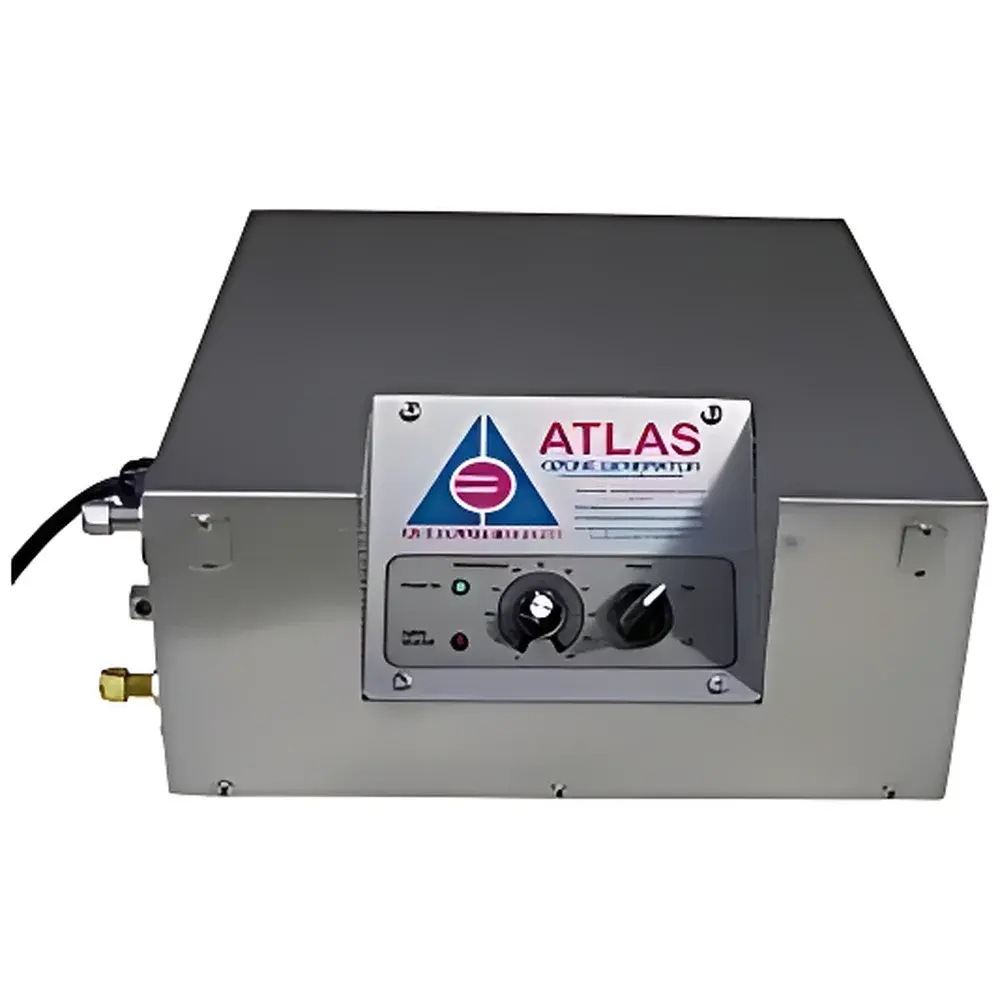
Absolute Ozone Atlas80 Ozone Generator
| Brand | Absolute Ozone |
|---|---|
| Origin | Canada |
| Model | Atlas80 |
| Ozone Output | 80 g/h (4.5 ppd) |
| Max Ozone Output | 95 g/h (5 ppd) |
| Ozone Concentration | 5–12% w/w |
| Operating Pressure | 25 psig (adjustable 20–100 psig) |
| Gas Flow Rate | 0.1–20 SLPM |
| Input Power | 120 V ~ ±10%, 50/60 Hz, 9.0 A (single-phase) or 220 V ~ ±10%, 50/60 Hz, 7.0 A (single-phase) |
| Max Power Consumption | 650 W |
| Inlet/Outlet Fitting | 0.25-inch stainless steel compression fittings |
| Construction Materials | Brushed stainless steel and aluminum housing |
Overview
The Absolute Ozone Atlas80 Ozone Generator is a compact, laboratory-grade corona discharge ozone generator engineered for stable, continuous ozone production from medical- or industrial-grade oxygen feed gas. Designed and manufactured in Canada, the Atlas80 employs high-efficiency dielectric barrier discharge (DBD) technology within a thermally managed reactor core to convert molecular oxygen (O₂) into ozone (O₃) with precise concentration control and minimal nitrogen oxide byproduct formation. Its fixed-frequency, air-cooled architecture delivers nominal output of 80 g/h at 5–12% w/w ozone concentration—ideal for controlled oxidation studies, aqueous disinfection validation, catalytic reaction screening, and low-flow gas-phase sterilization protocols in research and quality assurance laboratories. Unlike UV-based or electrolytic systems, the Atlas80 offers superior scalability, long-term stability under constant load, and compatibility with regulated oxygen supply infrastructure compliant with ISO 8573-1 Class 2 purity standards.
Key Features
- Corona discharge ozone generation using high-dielectric-strength ceramic/metal DBD cells optimized for O₂-to-O₃ conversion efficiency
- Adjustable operating pressure range (20–100 psig) enables precise tuning of ozone mass transfer kinetics for liquid or gas-phase applications
- Robust mechanical construction: brushed stainless steel and aluminum enclosure rated for continuous operation; all wetted parts fabricated from 304 stainless steel, PTFE-lined tubing, and brass components
- Factory leak-tested to 150 psig per ASME B31.3 process piping guidelines, ensuring integrity under elevated backpressure conditions
- Low-power consumption design (≤650 W) with dual-voltage input capability (120 V or 220 V, single-phase), supporting global laboratory power infrastructures
- Modular front-panel interface with status LEDs and analog output for integration into PLC-controlled environmental chambers or pilot-scale reactors
Sample Compatibility & Compliance
The Atlas80 is intended for use exclusively with oxygen feed gas meeting USP or ISO 8573-1:2010 Class 2 specifications (hydrocarbon content ≤0.1 mg/m³, moisture ≤−40 °C dew point, particulate ≤0.1 µm). It is not compatible with ambient air or compressed air without prior purification. The unit operates safely in ventilated indoor environments across ambient temperatures of 5–35 °C and relative humidity ≤80% non-condensing. While not certified to UL 61010-1 or IEC 61000-6-3 as a standalone appliance, its electrical design conforms to CSA C22.2 No. 61010-1 requirements for laboratory equipment. All materials contacting ozone are selected per ASTM D1494 (ozone resistance of elastomers) and NIST IR 6937 guidelines for ozone system component compatibility.
Software & Data Management
The Atlas80 operates as a stand-alone analog-controlled generator with no embedded firmware or digital interface. It provides a 0–10 VDC analog output proportional to ozone output rate (calibrated at factory), enabling direct integration with third-party data acquisition systems (e.g., LabVIEW, MATLAB, or Siemens S7 PLCs) for time-synchronized logging of ozone delivery against process variables such as flow rate, pressure, or temperature. For GxP-regulated environments, users may configure external audit trails via SCADA platforms compliant with FDA 21 CFR Part 11 requirements—including electronic signatures, user access controls, and immutable event logs—when paired with validated I/O modules and timestamped acquisition hardware.
Applications
- Validation of ozone-based water treatment kinetics in benchtop bioreactors and membrane fouling studies
- Controlled oxidation of organic probe compounds (e.g., phenol, oxalic acid) for reaction mechanism elucidation
- Surface decontamination efficacy testing on medical device substrates under ISO 14937 and EN 14885 frameworks
- Accelerated aging of polymer films and elastomeric seals exposed to ozone-rich atmospheres (ASTM D1149, D1171)
- Calibration and challenge testing of ozone monitors (e.g., UV photometers, electrochemical sensors) per EPA Method O3-1
- Gas-phase sterilization process development for pharmaceutical isolators and aseptic filling lines
FAQ
Can the Atlas80 operate using compressed air instead of oxygen?
No. The Atlas80 requires oxygen feed gas with ≥90% purity. Air-fed operation produces significant NOₓ contaminants and reduces ozone yield by >70% due to nitrogen quenching effects.
Is routine maintenance required beyond filter replacement?
Yes. Quarterly inspection of the oxygen inlet filter (included) and annual verification of DBD cell surface integrity are recommended. No consumable electrodes or replaceable dielectrics are required within the first 10,000 operational hours.
Does the unit include ozone destruct capability?
No. An external catalytic ozone destruct unit (e.g., heated MnO₂ bed or thermal decomposer) must be installed downstream when exhausting ozone to ambient lab air per OSHA PEL (0.1 ppm TWA) and ACGIH TLV (0.05 ppm STEL) limits.
What is the expected service life of the DBD reactor under continuous operation?
Based on accelerated lifetime testing at 80 g/h output and 25 psig, mean time between failures (MTBF) exceeds 18,000 hours with proper cooling and feed gas conditioning.
Is calibration documentation provided with shipment?
Yes. Each unit ships with a NIST-traceable factory calibration certificate covering ozone output rate (g/h), concentration (% w/w), and pressure response across the full operating range.
Related Products



