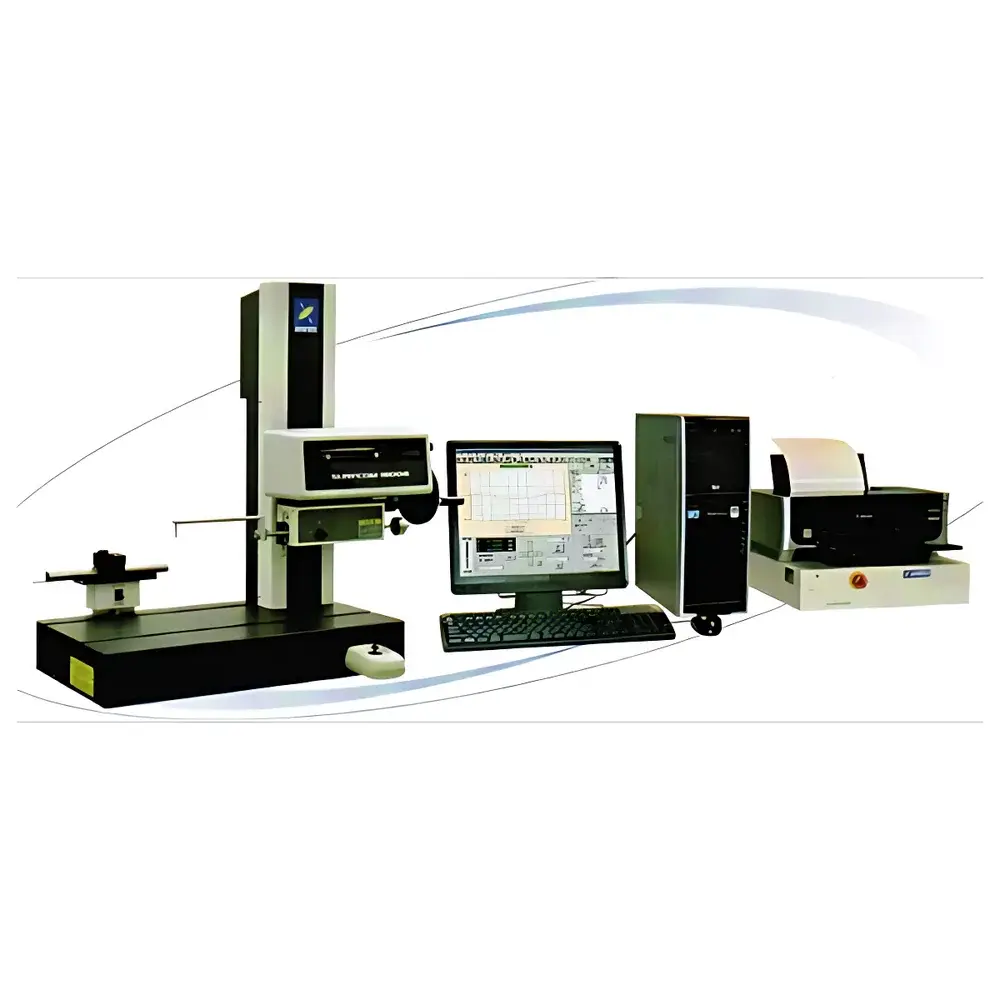
Accretech SURFCOM 1800G Integrated Profilometer & Surface Roughness Tester
| Brand | Accretech (Tokyo Seimitsu) |
|---|---|
| Origin | Japan |
| Model | SURFCOM 1800G |
| Z-Axis Range | 50 mm |
| X-Axis Range | 100 mm (200 mm optional) |
| Z-Axis Indication Accuracy | ±0.25% FS (±4 µm within 5 mm) |
| Z-Axis Resolution | 0.1 µm (±2.5 mm), 0.4 µm (10 mm), 1 µm (±25 mm) |
| X-Axis Indication Accuracy | ±(1 + 2L/100) µm (L in mm) |
| X-Axis Straightness | (0.05 + 1.5L/1000) mm |
| Measurement Principle | Contact stylus profilometry with Moiré fringe interferometric X-axis positioning and differential voltage displacement sensing on Z-axis |
| Stylus Force | 0.75 mN (standard), ≤30 mN (max) |
| Stylus Tip Radius | 2 µm or 25 µm (interchangeable) |
| Stylus Material | Diamond or superhard alloy |
| Traverse Speeds | 0.03–6 mm/s (8-step programmable) |
| Vertical Column Speed | 3 mm/s |
| Filter Types | 2RC standard, 2RC phase-corrected, Gaussian |
| Cutoff Wavelengths | 0.025–25 mm (7 standard values) |
| Standards Compliance | JIS B 0601:2001/1994/1982, ISO 4287, ISO 13565, DIN 4768, ASME B46.1, CNOMO |
| Roughness Parameters | Ra, Rq, Rv, Rp, Rc, Rz, Rmax, Rt, Rz(JIS), R3z, Sm, S, RDa, RDq, Rla, Rlq, Til, TA, lr, Pc, Rmr, tp2, Rmr2, Rdc, AVH, Hmax, Hmin, AREA, NCRX, R, Rx, AR, NR, CPM, SR, SAR |
| Profile Evaluation | Straightness, flatness, roundness, curvature, slope, angle, radius, distance, coordinate difference, polar coordinate difference, symmetry (point-point, point-circle, line-line, circle-circle, etc.), envelope wave profile, motif analysis (roughness & waviness), load curve, power spectral density (PSD), amplitude distribution |
| Software Functions | Auto-condition setup (patented AI function), CNC measurement sequence recording & playback, automatic feature recognition & dimensioning, shape synthesis, tilt compensation (linear, R-surface, front/rear/both-end, spline), macro programming, peak/valley search, workpiece trajectory mapping, design vs. actual comparison, mirror inversion |
Overview
The Accretech SURFCOM 1800G is a high-precision, dual-mode contact profilometer engineered for simultaneous surface roughness evaluation and geometric contour measurement in metrology laboratories, precision manufacturing QA/QC environments, and R&D facilities. It operates on the principle of mechanical stylus tracing—where a diamond or superhard alloy tip traverses the specimen surface while high-resolution displacement transducers capture vertical (Z-axis) deviations with sub-micron fidelity. The X-axis employs Moiré fringe interferometric encoding for traceable, linear position feedback, ensuring metrological integrity across the full 100 mm (or 200 mm optional) traverse range. Unlike optical profilers, the SURFCOM 1800G delivers direct physical contact-based quantification compliant with international standards including ISO 4287, JIS B 0601, ASME B46.1, and DIN 4768—making it suitable for audit-ready documentation under GLP and GMP frameworks where tactile repeatability and calibration traceability are mandatory.
Key Features
- Single-touch interface enabling seamless switching between roughness and contour measurement modes without hardware reconfiguration
- Patented AI-assisted auto-conditioning: system autonomously selects optimal stylus force, cutoff wavelength, sampling interval, and filter type based on initial surface scan data
- CNC measurement sequence recording and playback: captures complete motion logic—including column lift/drop, X/Z positioning, speed ramping, and analysis triggers—for fully repeatable automated inspection routines
- Automatic geometric feature recognition: identifies lines, circles, arcs, ellipses, intersections, and symmetry elements directly from raw profile data; overlays ANSI/Y14.5-compliant dimension lines and GD&T annotations on graphical output
- Shape synthesis capability: mathematically reconstructs true surface geometry by compensating for stylus tip angle-induced projection errors—eliminating analytical truncation at steep slopes or sharp edges
- Multi-tier tilt compensation: supports linear, R-surface, front-half, rear-half, dual-end, and spline-based leveling algorithms to isolate form error from waviness and roughness components
- Dual-resolution Z-axis sensing: 0.1 µm resolution over ±2.5 mm range for fine texture analysis; scalable to 1 µm over ±25 mm for large-form profiling
Sample Compatibility & Compliance
The SURFCOM 1800G accommodates rigid metallic, ceramic, and polymer specimens up to 150 kg mass and 1850 × 800 × 750 mm footprint. Its interchangeable stylus system supports 2 µm and 25 µm tip radii, enabling high-fidelity measurement of fine-ground surfaces (e.g., bearing races, optical molds) as well as coarse-machined features (e.g., turbine blades, hydraulic manifolds). All measurement algorithms adhere strictly to JIS B 0601:2001 definitions for parameter calculation, ensuring interoperability with upstream CAD models and downstream statistical process control (SPC) platforms. The instrument’s firmware and software architecture support 21 CFR Part 11-compliant electronic signatures, audit trails, and user-access-level controls—meeting FDA-regulated validation requirements for medical device and pharmaceutical component inspection.
Software & Data Management
The bundled SURFPAK software provides a unified environment for acquisition, visualization, evaluation, and reporting. Raw profile traces are stored in vendor-neutral ASCII formats compatible with MATLAB, Python (NumPy/Pandas), and third-party metrology suites. Analysis modules include motif-based segmentation (ISO 13565), power spectral density (PSD) generation per ISO 13565-2, load curve derivation, and amplitude distribution histograms. All computational steps—including filter application, mean line extraction, and parameter derivation—are logged with timestamps, operator ID, and instrument configuration metadata. Reports export to PDF with embedded calibration certificates, uncertainty budgets (per ISO/IEC 17025), and comparative overlays against nominal CAD geometry. Macro scripting enables batch processing of multi-feature parts, while the “design vs. actual” comparator highlights deviations exceeding user-defined tolerance bands in color-coded deviation maps.
Applications
This system serves critical roles in aerospace (blade root profile verification, seal land roughness), automotive (cylinder bore cross-hatch analysis, gear flank topography), medical device manufacturing (implant surface texture certification per ISO 10993-16), and precision optics (mirror substrate figure error separation). It is routinely deployed for validating grinding, EDM, laser ablation, and additive manufacturing post-processing outcomes—particularly where functional performance correlates strongly with multiscale topography (e.g., lubrication retention, fatigue initiation resistance, biointegration efficacy). In academic research, its shape synthesis and motif analysis tools support tribology, contact mechanics, and surface engineering investigations requiring quantitative linkage between microstructure and macroscopic behavior.
FAQ
What standards does the SURFCOM 1800G comply with for roughness measurement?
It conforms to JIS B 0601:2001, ISO 4287, ISO 13565-1/2/3, DIN 4768, ASME B46.1, and CNOMO—ensuring global interchangeability of reported parameters.
Can the system perform automated GD&T evaluation on complex profiles?
Yes—its AI-driven feature recognition identifies datum features, toleranced elements, and geometric relationships; outputs include position, concentricity, parallelism, and profile of a surface per ASME Y14.5.
Is the software validated for regulated industries?
SURFPAK supports 21 CFR Part 11 compliance via role-based access control, electronic signatures, and immutable audit logs—validated per IQ/OQ protocols upon installation.
How is traceability maintained across measurement campaigns?
Each dataset includes embedded calibration certificate references, environmental sensor readings (temperature/humidity), and full chain-of-custody metadata—exportable as XML for LIMS integration.
What stylus options are available for high-aspect-ratio features?
Standard 2 µm and 25 µm diamond tips are supplied; custom cantilevered or extended-shank styli can be integrated for deep grooves or recessed geometries.