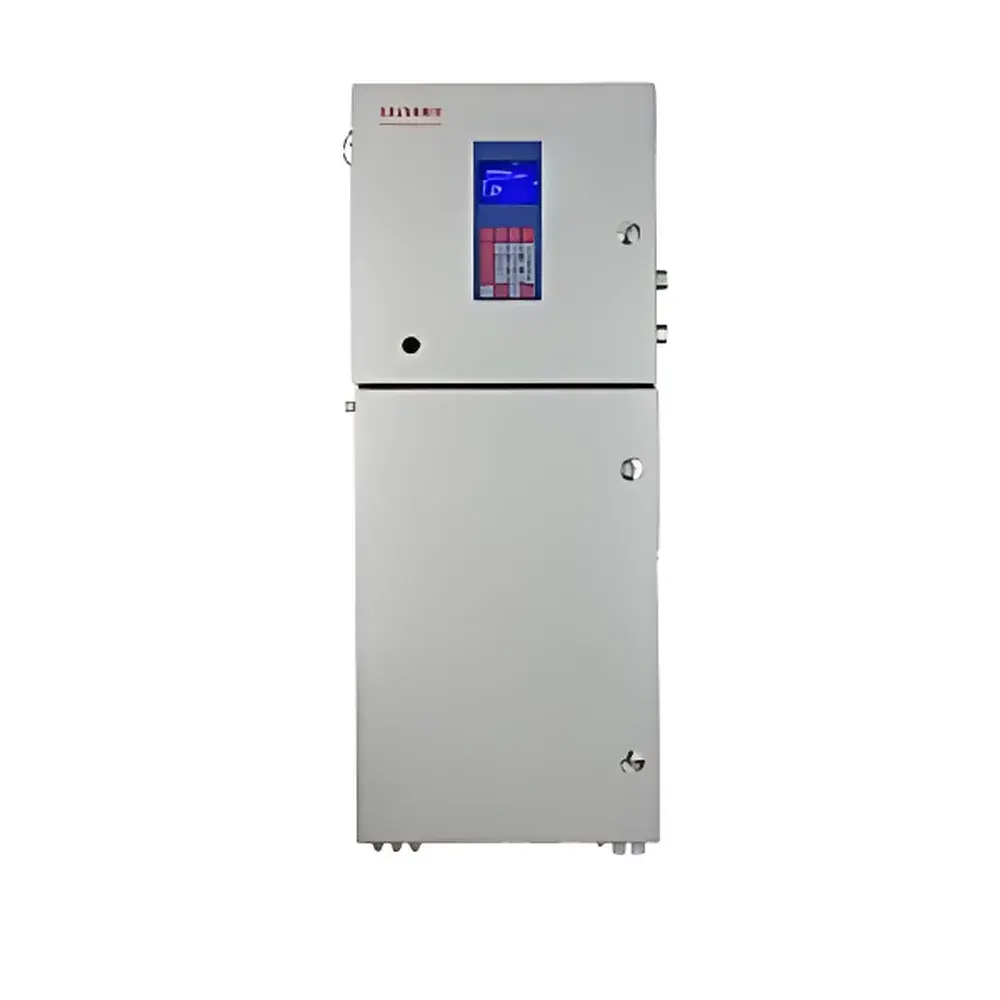
AccuSeris Sentinel Online Calcium & Magnesium Ion Analyzer
| Origin | USA |
|---|---|
| Manufacturer Type | Authorized Distributor |
| Origin Category | Imported |
| Model | AccuSeris (Sentinel) |
| Pricing | Upon Request |
Overview
The AccuSeris Sentinel Online Calcium & Magnesium Ion Analyzer is a fully automated, process-integrated titrimetric analyzer engineered for continuous, real-time quantification of total hardness—expressed as combined Ca²⁺ and Mg²⁺ concentrations—in saline aqueous streams. It employs standardized complexometric titration per ASTM D1126 and ISO 6059, using ethylenediaminetetraacetic acid (EDTA) as the chelating titrant and Eriochrome Black T (EBT) as the metallochromic indicator. Detection is achieved via a single-beam, dual-wavelength reflective fiber-optic photometer that monitors absorbance shifts at 575 nm (complex formation) and 700 nm (baseline correction), enabling robust endpoint discrimination in turbid or high-salinity matrices. Designed for unattended operation in demanding industrial environments—including desalination pre-treatment, power plant cooling water circuits, pharmaceutical water systems, and municipal wastewater reuse—the instrument delivers trace-level resolution (down to 100 ppb) with field-proven stability across variable temperature (5–70 °C), pressure (0–3.5 bar), and suspended solids load (<2% w/w, ≤1.27 mm particle size).
Key Features
- Fully programmable titration methodology supporting single- and double-endpoint modes with three endpoint detection algorithms: fixed threshold, first-derivative peak, and correlation-based inflection point analysis.
- Patented volumetric sampling system with 1/4″ OD sample tubing and integrated coiled flow path ensures representative sub-5 mL to 30 mL aliquots—even from high-turbidity or particulate-laden brines.
- Dual-sensor reaction cell accommodates simultaneous or sequential colorimetric and potentiometric detection; magnetic stirring guarantees homogeneous reagent-sample mixing.
- High-precision, maintenance-free piston pump for reagent delivery and peristaltic pumps for standards/cleaning solutions ensure long-term volumetric accuracy and low carryover.
- Eight programmable relay outputs (expandable to 16 via optional I/O module) support integration with PLCs, SCADA systems, and safety interlocks for automated process control.
- Three-tier password protection (operator, technician, administrator) enforces role-based access control aligned with GLP/GMP operational protocols.
- Auto-diagnostic routines include self-calibrating endpoint learning, flow rate verification, reagent level monitoring, and hardware fault logging with timestamped event history.
Sample Compatibility & Compliance
The AccuSeris Sentinel is validated for direct analysis of raw and filtered seawater, brackish intake, reverse osmosis permeate, boiler feedwater, and tertiary-treated effluent. It complies with key regulatory and industry frameworks including EPA Method 130.1 (hardness), ASTM D511 (calcium), ASTM D512 (chloride interference mitigation), and ISO 7888 (electrical conductivity correlation). Its design meets NEMA 4X enclosure rating for indoor/outdoor panel mounting and supports 21 CFR Part 11-compliant data integrity when paired with validated LIMS or SCADA platforms. All wetted materials—including PFA, PVDF, and sapphire optical windows—are certified for USP Class VI biocompatibility and NSF/ANSI 61 potable water contact.
Software & Data Management
The embedded firmware provides full method scripting capability via intuitive menu navigation—no external PC required for routine operation. Up to 10 independent analytical methods can be stored onboard, each defining unique reagent sequences, dilution factors, calibration curve types (linear, quadratic, multi-point), and cleaning cycles. Analytical results—including raw absorbance values, derivative traces, endpoint timestamps, and QC flags—are stored in non-volatile memory (retention >5 years without power) with automatic overwrite protection. Data export is supported via two isolated RS-232 ports (printer + host) and optional RS-485 Modbus RTU. The 4–20 mA analog output is fully scalable and assignable to any measured parameter (e.g., Ca²⁺ mg/L, Mg²⁺ mg/L, or total hardness as CaCO₃). Audit trails record all user actions, calibration events, and configuration changes with operator ID and timestamp.
Applications
- Real-time monitoring of scaling potential in seawater reverse osmosis (SWRO) pretreatment to optimize antiscalant dosing.
- Continuous hardness verification in pharmaceutical purified water (PW) and water-for-injection (WFI) distribution loops per USP .
- Automated quality control of ion exchange regeneration efficiency in nuclear power plant condensate polishing systems.
- Regulatory compliance reporting for EPA NPDES discharge permits requiring monthly hardness averages.
- Process optimization in food & beverage softening units where Ca²⁺/Mg²⁺ imbalance affects enzyme activity or membrane fouling rates.
- Research-grade kinetic studies of chelation reactions under controlled flow and temperature conditions.
FAQ
What detection principle does the AccuSeris Sentinel use for Ca²⁺/Mg²⁺ quantification?
It applies standardized EDTA complexometric titration with Eriochrome Black T indicator, coupled with dual-wavelength reflectance photometry for precise endpoint determination.
Can the instrument handle samples with high suspended solids?
Yes—it accepts up to 2% w/w suspended solids with particles ≤1.27 mm, enabled by its large-bore (1/4″) sample line and self-cleaning flow path design.
Is remote configuration and diagnostics supported?
Yes—via RS-232 or optional RS-485, allowing full command-line control, firmware updates, and diagnostic log retrieval from centralized control rooms.
How often does calibration need to be performed?
Calibration frequency is fully programmable—from daily to weekly—and may be triggered manually, on a time schedule, or following defined drift thresholds.
Does the system meet FDA 21 CFR Part 11 requirements?
When deployed with validated third-party data acquisition software and electronic signature workflows, the instrument’s audit trail, user authentication, and data immutability features support Part 11 compliance.
Related Products