
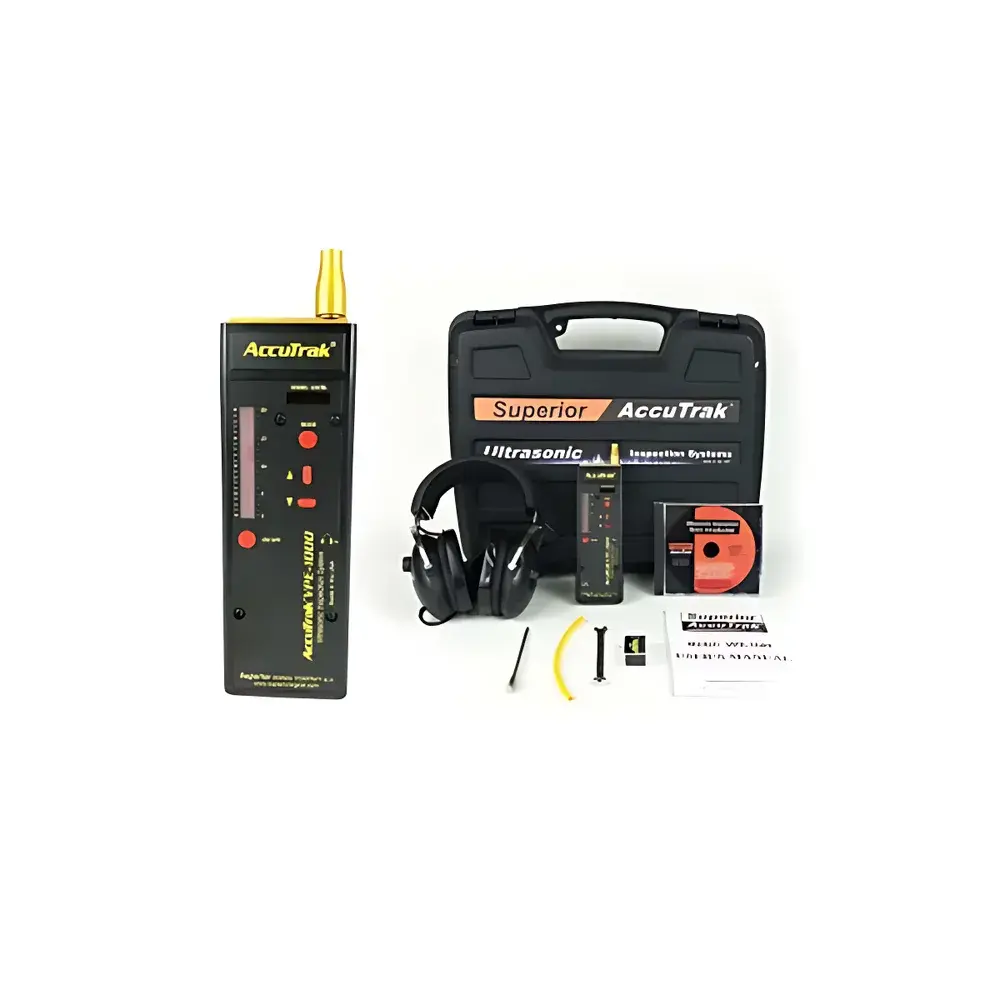
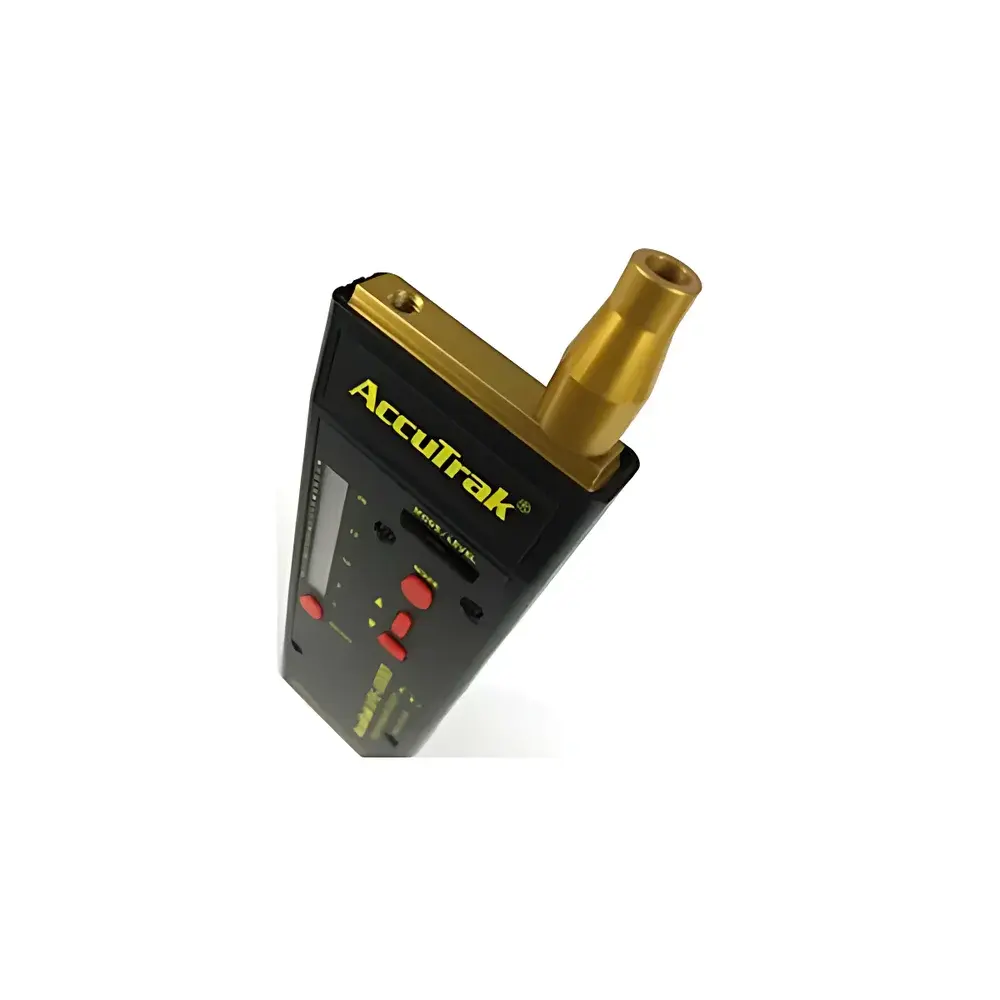
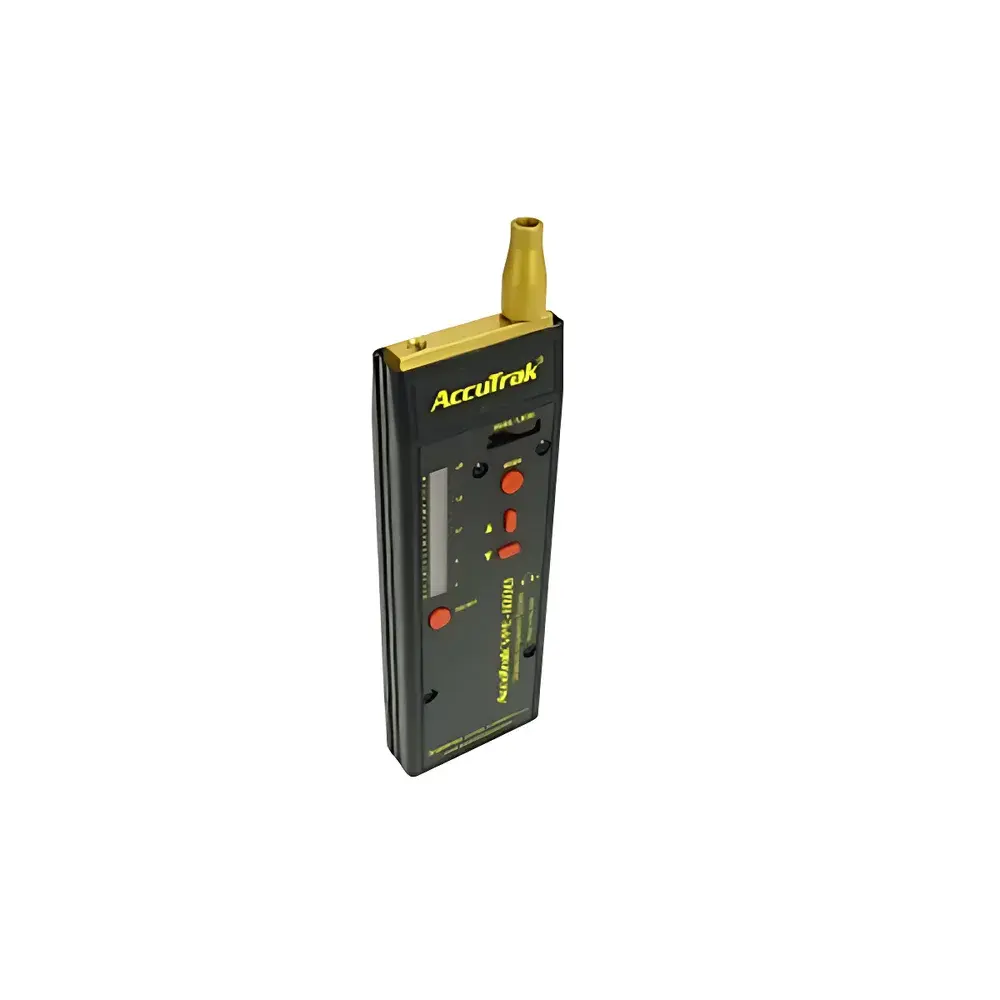
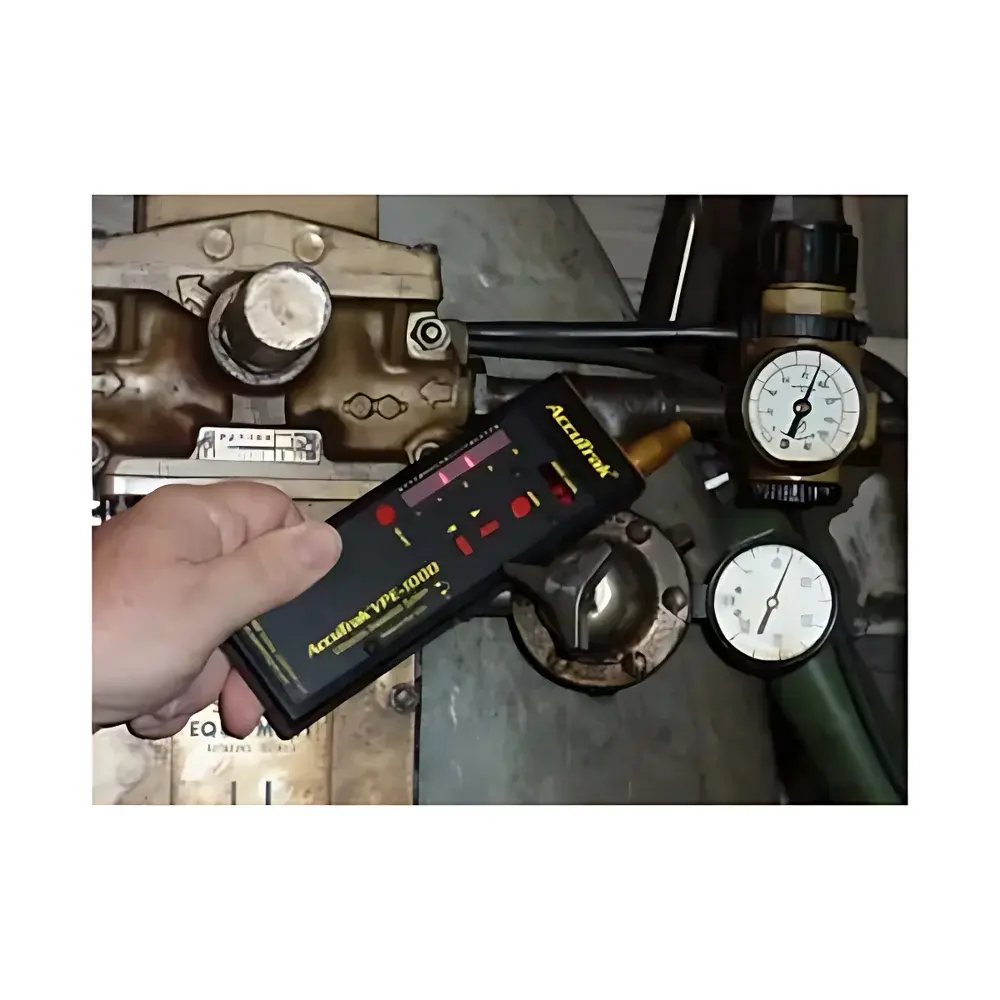
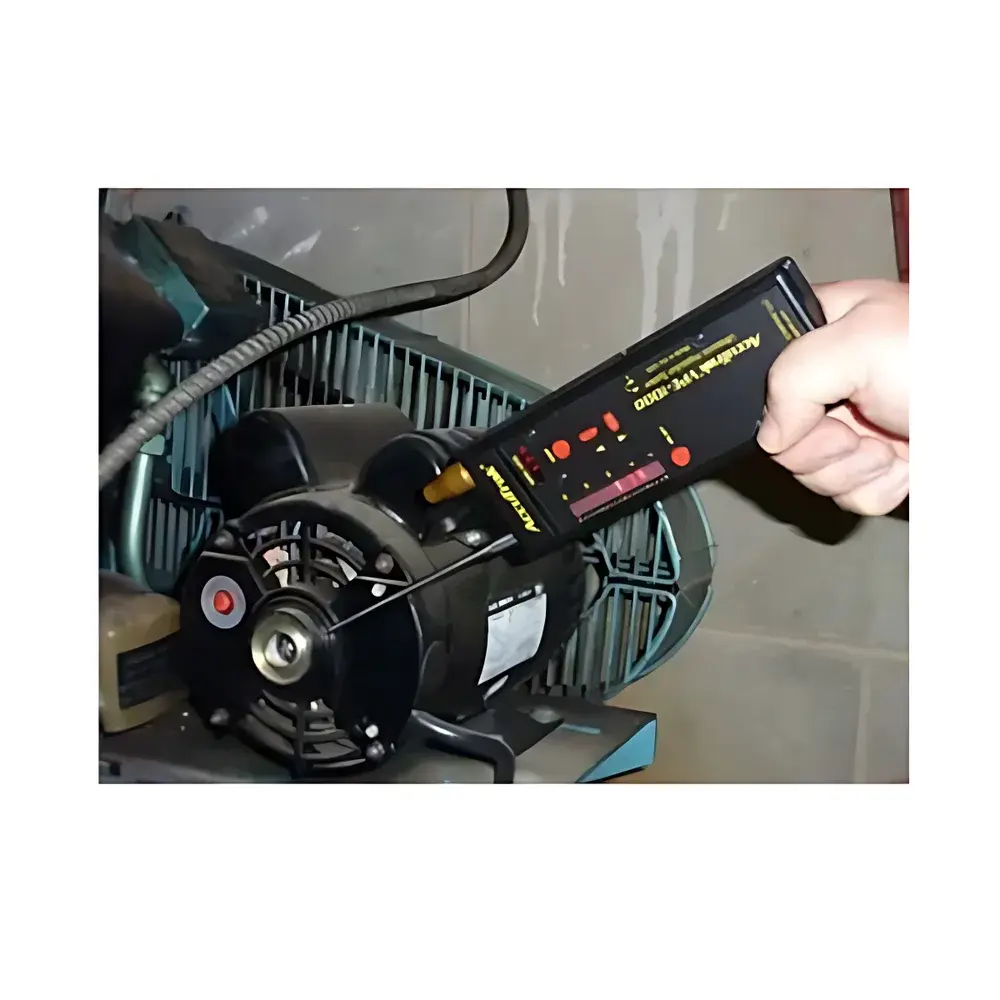
AccuTrak VPE-1000 Digital Ultrasonic Leak Detector
| Brand | AccuTrak (USA) |
|---|---|
| Origin | USA |
| Model | VPE-1000 |
| Weight | 233 g |
| Dimensions | 17.97 cm × 6.1 cm × 2.22 cm |
| Operating Frequency Range (Airborne) | 34–42 kHz |
| Contact Probe Frequency Range | 16–24 kHz |
| Sensitivity | −80 dB/V/µbar |
| Heterodyne Conversion | Digital |
| Audio Output Bandwidth | 0–4 kHz |
| Display | 20-segment bar graph + alphanumeric LCD with peak-hold |
| Sensitivity Control | 256-step digital |
| Volume Control | 256-step digital |
Overview
The AccuTrak VPE-1000 Digital Ultrasonic Leak Detector is an industrial-grade, handheld diagnostic instrument engineered for non-invasive detection of high-frequency acoustic emissions associated with pressurized gas leaks, mechanical friction, electrical arcing, and valve degradation. It operates on the principle of heterodyne frequency conversion: airborne or structure-borne ultrasonic energy (typically 20–100 kHz) generated by turbulent flow, partial discharge, or surface wear is captured by dual-mode transducers, down-converted in real time via a digitally stabilized oscillator, and rendered as audible sound (0–4 kHz) through stereo headphones or internal speaker output. Unlike analog predecessors, the VPE-1000 employs a microprocessor-controlled signal path with 256-step digital gain and volume resolution—ensuring repeatable amplitude response, minimal thermal drift, and immunity to analog noise coupling. Its −80 dB/V/µbar sensitivity enables detection of sub-millimeter air leaks at pressures as low as 1 psi, while its compact aluminum-and-ABS chassis (MIL-A-8625 Type III, Class 2 anodized finish) ensures durability in plant-floor environments without compromising ergonomics.
Key Features
- Dual independent sensor architecture: Air-coupled ultrasonic microphone (34–42 kHz) and contact probe (16–24 kHz), each with dedicated digital gain calibration and frequency-selective filtering
- True digital heterodyne conversion with crystal-stabilized oscillator—eliminates tuning drift and enables consistent inter-unit reproducibility
- Alphanumeric LCD display with 20-element dynamic bar graph and real-time peak-hold function for quantitative amplitude comparison across measurement points
- 256-step digital sensitivity control allows precise attenuation of background broadband noise while preserving leak signature fidelity
- Simultaneous audio zoom and visual feedback: Adjustable 0–4 kHz output bandwidth supports spectral discrimination between leak hiss, bearing rumble, and corona crackle
- Lightweight (233 g) ergonomic design with integrated battery compartment (AA cells), gold-anodized aluminum housing, and IP54-rated ingress protection for dust/moisture resistance
Sample Compatibility & Compliance
The VPE-1000 is compatible with all pressurized gas systems—including compressed air, nitrogen, CO₂, SF₆, refrigerants (R-134a, R-410A), steam, and vacuum lines—without requiring system shutdown or tracer gases. It detects leaks as small as 0.001 standard cubic centimeters per second (sccs) under typical industrial conditions. For regulatory alignment, the instrument supports documentation workflows compliant with ISO 55001 (Asset Management), ISO 17025 (Testing Laboratory Competence), and OSHA 1910.169 (Compressed Gas Safety). While not FDA 21 CFR Part 11-certified as a standalone device, its analog audio output and peak-hold display enable integration into validated maintenance record systems when paired with timestamped external logging hardware. All firmware and calibration routines adhere to NIST-traceable reference standards for ultrasonic pressure sensitivity.
Software & Data Management
The VPE-1000 operates as a fully self-contained hardware platform with no embedded operating system or cloud connectivity. All signal processing—including heterodyne mixing, digital filtering, RMS amplitude calculation, and peak-hold latching—is performed in real time by onboard ASICs. Data export is achieved via analog audio output (3.5 mm stereo jack) for connection to oscilloscopes, spectrum analyzers (e.g., Keysight FieldFox), or PC-based acoustic analysis software (e.g., SpectraPLUS, Audacity with ultrasonic preamp). The alphanumeric display logs maximum amplitude values (in arbitrary units) for up to 99 sequential test points, supporting manual entry into CMMS platforms such as IBM Maximo or SAP PM. Firmware updates are not field-upgradable; calibration verification is performed annually using NIST-traceable pistonphone sources per ASTM E1002.
Applications
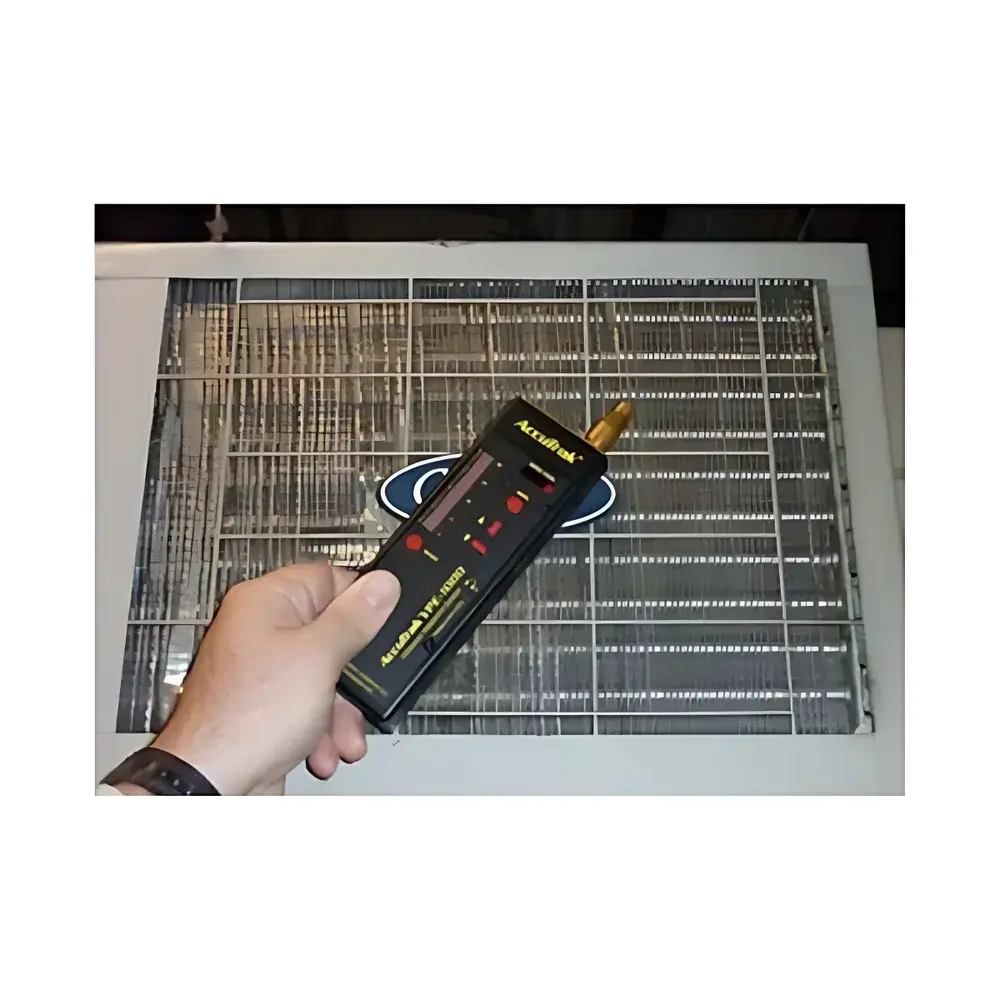
- Leak Detection: Quantitative localization of leaks in compressed air networks, HVAC refrigerant circuits, vacuum chambers, and pneumatic control systems
- Steam System Diagnostics: Rapid identification of failed steam traps (open vs. blocked), leaking isolation valves, and insulation breaches via ultrasonic intensity mapping
- Mechanical Condition Monitoring: Early-stage bearing fault detection (cage wear, spalling, lubrication starvation) and belt/pulley misalignment assessment
- Electrical Asset Inspection: Corona discharge and arcing detection in medium-voltage switchgear, bus ducts, and transformer bushings—prior to thermal runaway events
- Valve Integrity Testing: In-service evaluation of seat leakage in gate, globe, ball, and check valves without disassembly or process interruption
- Thermal Expansion Valve (TXV) Verification: Functional validation of refrigerant metering devices in chiller plants and cold storage facilities
FAQ
Does the VPE-1000 require periodic factory recalibration?
Yes. AccuTrak recommends annual calibration against a NIST-traceable 40 kHz pistonphone source per ASTM E1002. Field verification using known leak standards is advised before critical inspections.
Can the VPE-1000 detect helium or hydrogen leaks specifically?
It detects ultrasonic emission from turbulent flow—not gas chemistry—so it identifies leaks of any compressible fluid, including He and H₂, provided sufficient pressure differential and flow rate generate >34 kHz energy.
Is the contact probe interchangeable with third-party waveguides?
The threaded M6 × 0.75 interface is proprietary; only AccuTrak-certified contact probes and waveguides maintain specified frequency response and sensitivity calibration.
What battery life can be expected during continuous operation?
With alkaline AA cells, typical runtime is 50 hours at mid-range sensitivity; lithium AA batteries extend this to ≈75 hours with improved low-temperature performance.
How does the VPE-1000 differentiate between leak noise and mechanical vibration?
By combining directional sensing (air probe nulling), frequency band selection (narrowband filtering around 38 kHz), and amplitude decay profiling—true leaks exhibit sharp, localized intensity gradients unlike broad-spectrum vibration signatures.







