
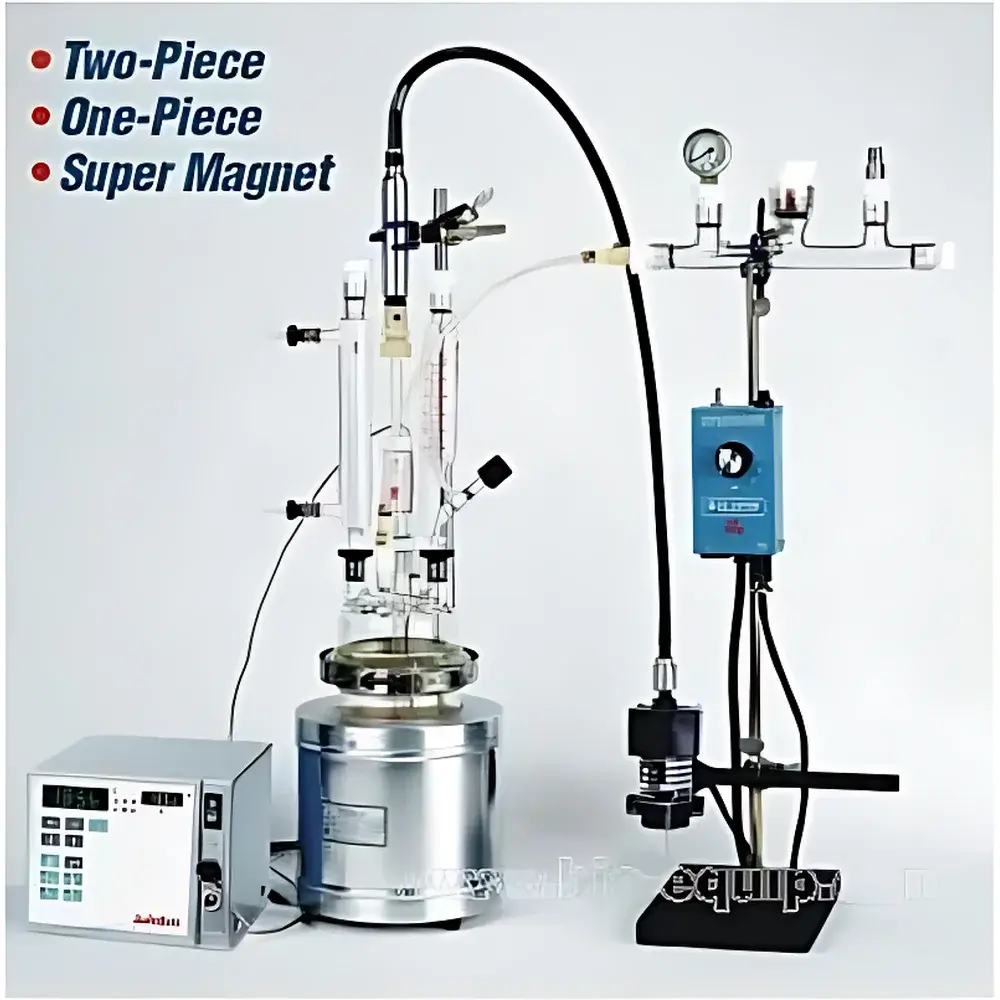
ACE GLASS Pressure Reactor Series
| Brand | ACE GLASS |
|---|---|
| Origin | USA |
| Model | Two-Piece & One-Piece Pressure Reactors |
| Volumes | 500 mL, 1 L, 2 L, 3 L, 5 L |
| Max Operating Pressure | 45 psig @ 100 °C (One-Piece) |
| Vacuum Capability | ≤ −0.9 bar (≈ 300 mbar abs) |
| Construction | Borosilicate glass (3.3) vessel with PTFE-sealed stainless steel head assembly |
| Heating Options | Electric heating mantle (for jacketless) or Huber Unistat/Tango circulators (for jacketed) |
| Stirring | Mechanical overhead stirring (three configurations available) |
| Compliance | Designed for ASTM E2515, ISO 17025-compliant lab environments |
Overview
The ACE GLASS Pressure Reactor Series is a modular, high-integrity laboratory-scale reaction system engineered for controlled chemical synthesis under elevated pressure and inert or vacuum conditions. Built upon decades of expertise in borosilicate glass fabrication and precision sealing technology, these reactors operate on the principle of sealed-vessel batch processing—enabling reproducible kinetic studies, catalytic hydrogenation, photochemical transformations, and air-sensitive organometallic reactions. Unlike metal-bodied alternatives, the all-glass wetted path (Type I, Class A borosilicate 3.3) ensures exceptional chemical resistance, optical clarity for real-time visual monitoring, and minimal leachable ion contribution—critical for pharmaceutical intermediate synthesis and catalyst screening where trace metal contamination must be avoided. The system supports both static and dynamic pressure regimes, with two distinct mechanical architectures: the Two-Piece design facilitates rapid vessel access and cleaning via separable body and head assembly, while the One-Piece configuration maximizes structural integrity and pressure containment through monolithic construction with centrally located 25 mm port and auxiliary 10–15 mm accessory ports.
Key Features
- Chemically inert fluid path: All surfaces contacting reactants consist exclusively of borosilicate glass 3.3 and virgin PTFE—no silicone grease required for vacuum-tight seals, eliminating potential contamination sources and enabling solvent-free cleaning validation.
- Dual-pressure architecture: Two-Piece reactors rated to 36 psig at 100 °C; One-Piece variants certified to 45 psig at 100 °C—validated per ASME B31.3 process piping guidelines for laboratory use.
- Modular temperature control integration: Compatible with Huber Unistat (jacketless operation) or Tango series (jacketed vessels), supporting precise thermal ramping from −80 °C to +200 °C with ±0.1 °C stability over extended durations.
- Three-tier stirring options: Standard magnetic coupling drive (up to 1000 rpm), high-torque overhead motorized stirrer (0–500 rpm, adjustable torque limit), and gas dispersion impeller configuration for heterogeneous catalysis applications.
- Full-system configurability: Includes quick-release clamps, bottom discharge valve (optional), reflux condenser, pressure-equalizing dropping funnel, vacuum inlet/outlet ports, and customizable accessory flanges (e.g., quartz UV windows, thermocouple wells, gas spargers).
Sample Compatibility & Compliance
These reactors accommodate a broad spectrum of sample types—including pyrophoric reagents, anhydrous solvents, corrosive halogenated compounds, and oxygen-sensitive organolithium species—without degradation of wetted materials. Glass/PTFE compatibility has been verified against USP , ISO 8536-1, and ASTM D1250 chemical resistance standards. The system meets requirements for Good Laboratory Practice (GLP) and current Good Manufacturing Practice (cGMP) environments when integrated with validated temperature logging (e.g., Huber’s TruControl software with 21 CFR Part 11-compliant electronic signatures and audit trail). Pressure relief mechanisms conform to ANSI Z21.20 safety protocols, and vacuum-rated components are tested to ISO 2859-1 sampling plans for leak integrity.
Software & Data Management
While the base reactor hardware operates without embedded electronics, full digital integration is achieved via third-party instrumentation platforms. When paired with Huber temperature controllers, users gain access to TruControl software featuring real-time PID parameter tuning, multi-channel data logging (temperature, pressure, stir speed), automated ramp-hold sequences, and exportable CSV/Excel reports. All recorded parameters support ALCOA+ principles (Attributable, Legible, Contemporaneous, Original, Accurate, Complete, Consistent, Enduring, Available) for regulatory submissions. Optional pressure transducers (e.g., Keller PA-23Y) interface directly with LabVIEW or MATLAB for closed-loop pressure regulation and kinetic modeling.
Applications
- Catalytic hydrogenation under controlled H₂ partial pressures (0.5–3 bar)
- Photochemical cyclization using UV-transparent glass vessels with external lamp coupling
- High-vacuum distillations and solvent removal (≤300 mbar abs)
- Grignard and lithium–halogen exchange reactions under strict inert atmosphere
- Accelerated aging studies for polymerization kinetics (e.g., epoxy curing under elevated T/P)
- Electrochemical synthesis with integrated reference electrode ports
FAQ
What is the maximum allowable working temperature for the glass vessel?
Borosilicate 3.3 glass maintains structural integrity up to 200 °C continuously; short-term excursions to 250 °C are permissible with derated pressure limits.
Can the reactor be used for exothermic reactions requiring active cooling?
Yes—jacketed configurations support circulation of coolant (e.g., ethanol/water mixtures) via Huber Tango units capable of −80 °C to +200 °C operation.
Is validation documentation available for GMP-regulated labs?
Factory calibration certificates, material traceability reports (MTRs), and pressure test records (hydrostatic + pneumatic) are supplied with each system; IQ/OQ protocol templates are provided upon request.
How is vacuum integrity verified during installation?
Each reactor undergoes helium leak testing per ASTM E499 prior to shipment; final system verification can be performed using a calibrated Pirani gauge and hold-time test per ISO 20487.
Are custom port configurations supported?
Yes—ACE GLASS offers bespoke flange layouts, quartz viewport integration, and electrical feedthroughs for in-situ sensors (pH, conductivity, FTIR probes) under NDA.
Related Products



