
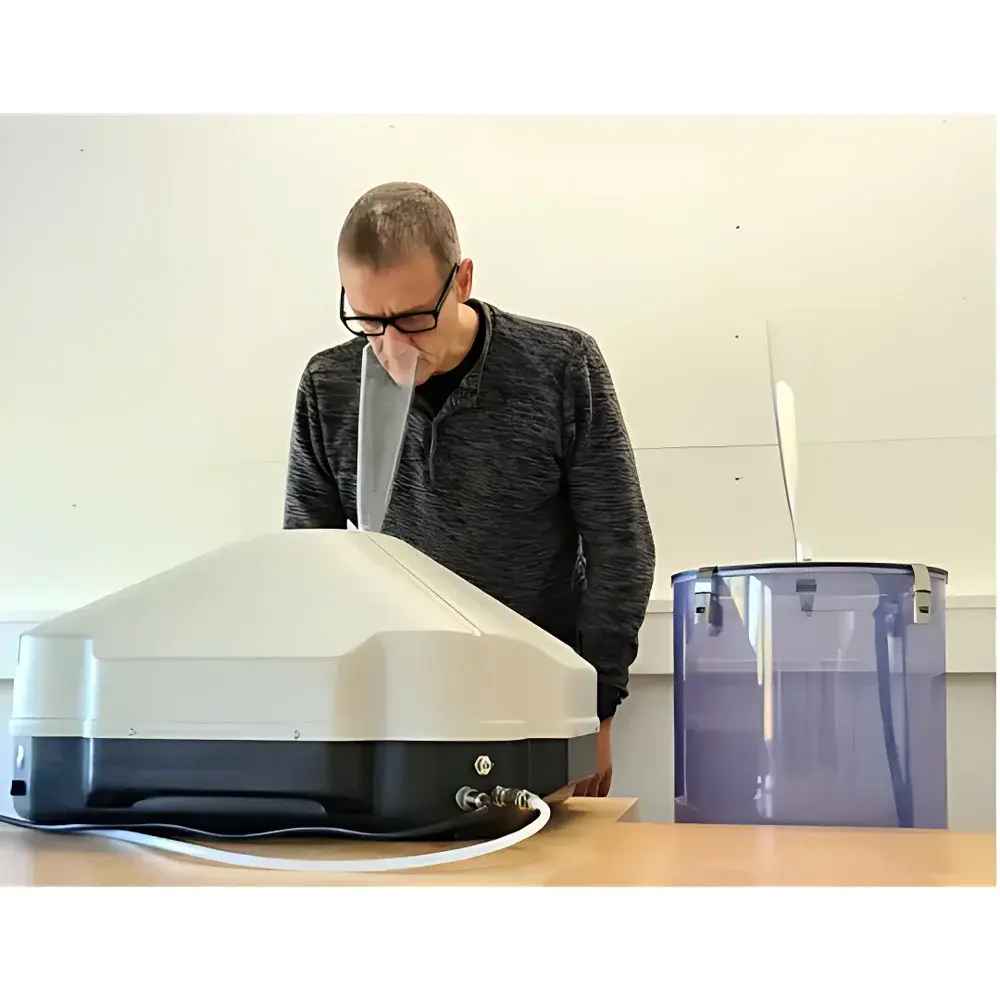
Acetone Scaling Instrument by Olfasense
| Brand | Olfasense |
|---|---|
| Origin | Germany |
| Model | Acetone Scaler (AS) |
| Configuration | 16-step calibrated acetone vapor concentration series (Pl scale 0–15) |
| Flow Control | Precision mass flow controllers |
| Intended Use | Olfactory training and threshold assessment for human panelists |
| Regulatory Context | Designed in alignment with EN 13725:2022 and ISO 8586:2014 for sensory panel training and odor intensity scaling |
Overview
The Acetone Scaling Instrument (AS) by Olfasense is a purpose-built olfactometric device engineered for standardized, repeatable presentation of acetone vapor at 16 discrete, gravimetrically verified concentration levels—corresponding to the Pl (Perception level) scale from 0 to 15. Unlike generic gas dilution systems, the AS integrates certified mass flow controllers, temperature-stabilized vaporization chambers, and inert stainless-steel delivery pathways to ensure metrological traceability of each presented concentration. It operates on the principle of dynamic olfactometry: precise binary dilution of saturated acetone vapor with odor-free, particle-filtered synthetic air, enabling controlled exposure durations and inter-stimulus intervals compliant with EN 13725:2022 Annex C for panelist training. The instrument does not measure physical concentration directly; rather, it delivers perceptually anchored reference stimuli to calibrate human olfactory response across trained assessors—forming the foundational tool for establishing intra- and inter-laboratory consistency in odor intensity scaling.
Key Features
- 16-step Pl-scale acetone vapor series (Pl 0 to Pl 15), each step independently validated via gravimetric calibration against NIST-traceable standards
- Dual-stage mass flow control: primary vapor generation at constant temperature (±0.2 °C), secondary dilution with zero-air (≤1 ppb VOC background, ISO 8573-1 Class 1)
- Automated stimulus timing: programmable exposure duration (0.5–5 s), inter-stimulus interval (30–120 s), and randomized sequence delivery to minimize adaptation bias
- Integrated humidity and temperature monitoring (±0.3 °C, ±2 % RH) with real-time logging for environmental correlation in sensory records
- Modular design compliant with ISO/IEC 17025 laboratory infrastructure requirements: CE-marked, RoHS-compliant, and compatible with GLP audit documentation workflows
Sample Compatibility & Compliance
The AS is exclusively configured for acetone (CAS No. 67-64-1) as the reference odorant. Its vapor generation system is chemically inert and unsuitable for aldehydes, sulfur compounds, or high-boiling-point organics. All concentration steps are validated under controlled ambient conditions (20–23 °C, 40–60 % RH) per EN 13725:2022 Clause 7.3. The instrument supports compliance with ISO 8586:2014 for sensory panel selection and training, and its output data structure aligns with FDA 21 CFR Part 11 requirements when paired with Olfasense’s certified LIMS-integrated software (optional). Calibration certificates include uncertainty budgets calculated per GUM (JCGM 100:2008) and are issued annually by DAkkS-accredited laboratories.
Software & Data Management
The AS interfaces via USB or Ethernet with Olfasense OlfactoSoft v5.2—a validated application supporting dual-mode operation: guided training mode (with automated Pl-level progression and pass/fail logic per ISO 8586) and research mode (free-response logging with timestamped stimulus metadata). All session data—including panelist ID, response latency, confidence scoring, and environmental parameters—are stored in encrypted SQLite databases with immutable audit trails. Export formats include CSV (for statistical analysis in R or Python) and PDF reports compliant with GLP Annex 11 requirements. Electronic signatures, role-based access control, and 21 CFR Part 11-compliant electronic records are enabled upon configuration with enterprise license.
Applications
- Olfactory threshold determination and longitudinal tracking of panelist sensitivity during qualification and requalification cycles
- Calibration of perception-based odor intensity scales (e.g., Pl scale, n-butanol equivalents) in accredited odor testing laboratories
- Method validation studies for dynamic olfactometry according to EN 13725:2022 Annex D
- Research into odor adaptation kinetics, cross-adaptation effects, and cognitive load during sequential stimulus presentation
- Training modules for regulatory inspectors conducting odor impact assessments under EU Directive 2010/75/EU (IED)
FAQ
Is the Acetone Scaler suitable for use with odorants other than acetone?
No. The AS is a single-odorant system calibrated exclusively for acetone vapor. Substitution with other compounds would invalidate traceability, compromise flow dynamics, and void calibration certification.
Does the instrument include built-in odorant saturation monitoring?
Yes. Integrated temperature-controlled saturator vessels maintain acetone at defined saturation vapor pressure (SVP), with real-time SVP calculation based on Antoine equation parameters per NIST Chemistry WebBook.
Can stimulus delivery be synchronized with external physiological recording equipment?
Yes. TTL trigger outputs (5 V, opto-isolated) are provided for synchronization with EEG, EDA, or eye-tracking systems, with sub-millisecond jitter specification.
What maintenance intervals are recommended for long-term metrological stability?
Quarterly verification of mass flow controllers using calibrated reference flows, annual full recalibration including saturator validation and leak testing per ISO 16000-28, and biannual replacement of PTFE vapor lines.
Is remote operation supported for multi-site panel training programs?
Yes. With OlfactoSoft Enterprise Edition, centralized administration enables geographically distributed sessions with synchronized stimulus delivery, centralized data aggregation, and cross-lab performance benchmarking.






